
 Portugues
Chase
Saved games stay in this browser only.
About the game
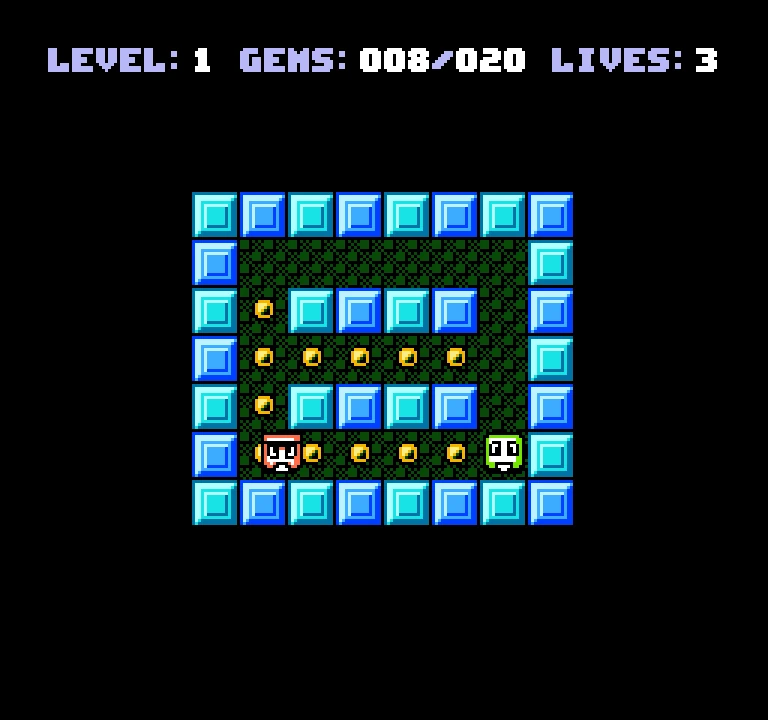
Chase is a small arcade game in the tradition of the maze chasers of the early home computers. Each level is a walled board scattered with gems. You steer a green face around the corridors, and the level ends when the last gem is gone. The catch is that you are not alone: colour-coded hunters patrol the same corridors, and a touch costs you a life.
The hunters are not clever, but they are not stupid either. Along a corridor they simply keep going, but at a junction each one picks a direction and often leans toward where you are standing. That makes the early levels forgiving and the later ones a matter of planning a route that gets you to the far gems without being cut off. Level one has twenty gems and a single hunter; the fifth level has close to a hundred gems and three hunters.
Shiru, a developer of NES homebrew, made Chase in 2012 as the example game for an article about programming NES games in C. It is short and plain on purpose, and it is a nice small game to pick up for a few minutes.
Playing it here
Chase is a homebrew game made for the NES: a new game by an independent developer, not a commercial release. It runs here in jsnes, an NES emulator written in JavaScript. Click Play and press Enter on the title screen. The screen shows the level, how many gems you have collected out of the total and how many lives you have left. You start with four lives in total, and the counter shows the spares.
Enter pauses and resumes the game. F2 saves the current state in this browser and F4 loads it.
Controls
| Key | NES button | Action |
|---|---|---|
| Arrow keys | Control Pad | move through the maze |
| Enter | Start | start, pause and resume |
| F2 / F4 | — | save / load the state |
A few things worth knowing
Keep moving. Standing still gives the hunters time to close in. Pick a route and commit to it.
Use the walls. The central blocks of each board form loops. Running around a loop is the classic way to keep a hunter behind you while you collect gems.
Mind the junctions. A hunter only changes direction at a junction, and it tends to turn toward you there. Passing a junction well ahead of one is safer than cutting across right in front of it.
Later levels add faster hunters. Each kind of hunter has its own speed, and the ones that join on levels two to five are a little quicker than the first.
FAQ
How many levels are there? Five. After the last one a "well done" screen appears.
What happens when I lose all my lives? The game shows a game over screen and goes back to the title screen, where Enter starts a new game from level one.
Is there a two player mode? No. Chase is a single player game.
Credits and licence
Chase is by Shiru, who made the game, the graphics and the music. The code header says: "Feel free to do anything you want with this code, consider it Public Domain". The game uses Shiru's neslib and FamiTone2 libraries, both released into the public domain by the author, and the cc65 runtime library under the zlib licence. The game's own title screen reads "PD 2012 SHIRU", marking the whole game, graphics and music included, as public domain, and the readme says: "This is an example game that is developed for my article Programming NES games in C". The complete text of the headers and the readme is in the licence file.