
 Portugues
Cirkoban
Saved games stay in this browser only.
About the game
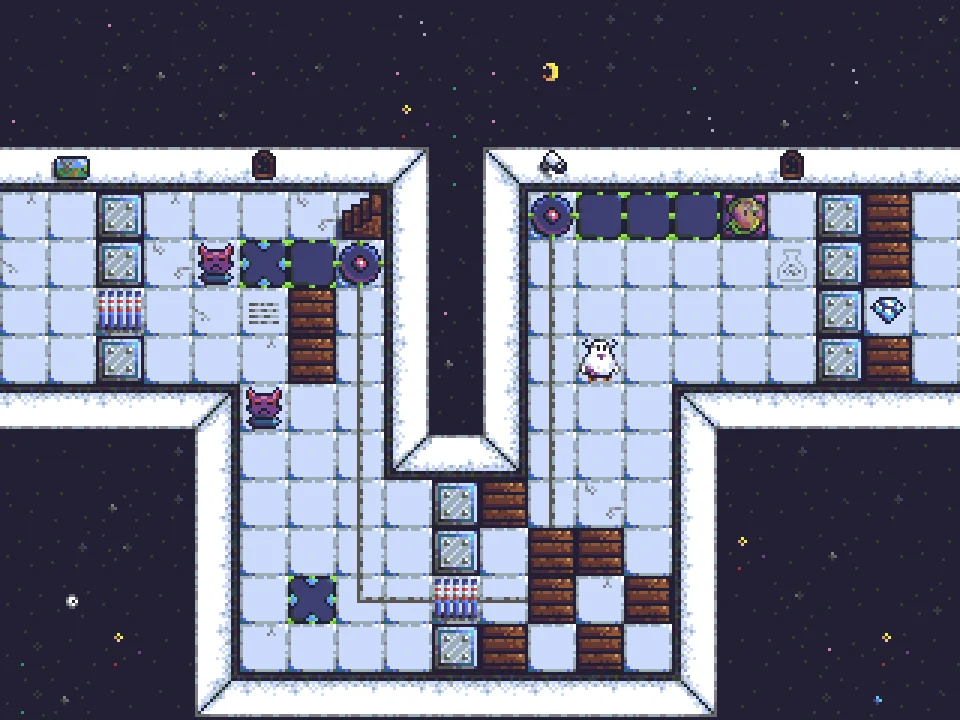
You are a small owl in a frozen laboratory full of strange circuitry, and every room stands between you and the stairs that lead to the next floor. Cirkoban takes the classic block-pushing puzzle and wires it into a little electrical circuit. Some blocks only need to go from here to there. Others are about the electricity: emitters send pulses along the wires, switches on the floor and on the walls change what the circuit does, and gates open or close depending on whether a pulse is passing through. Often you push a block onto a switch to decide when a pulse arrives, and the tricky part is getting the timing right.
The rules come in one at a time. The first rooms are tutorials, and each new piece (a floor switch, a bomb, a logic gate, a warp that carries a pulse somewhere else) is introduced in a safe spot before it turns up in a harder room. Later floors add small creatures that wander the rooms and make you plan around them. Every room also hides a gem for anyone who wants an extra challenge, usually in a spot that takes a second, more careful solution.
Cirkoban was made by the Spritely Institute for the Spring Lisp Game Jam 2024, as a showcase for Guile Hoot, a compiler that turns Scheme into WebAssembly. The game is written in Scheme and runs here as WebAssembly in your browser.
How to play
Use the arrow keys to move. Pushing a block moves it one tile, and you cannot pull. Press Z to take back your last move; you can keep pressing it to go back as far as you like, and nothing is lost, so experiment freely. Space opens a menu with Select Level and Credits. Progress is stored in this browser, so you can come back to the floor where you stopped.
On a phone or tablet, an on-screen D-pad and an A button (undo) appear. The page needs a browser with WebAssembly garbage collection, which means a current Chrome or Firefox; Safari support depends on its version.
Tips
Watch the wires. Follow each wire from the emitter to what it feeds before you move anything. Most rooms are solved by working out where the pulse goes.
Undo is part of the game. If a pulse does something unexpected, step back with Z and try the other order.
Leave gems for later. Finish the room first. Going back for the gem teaches you how the circuit works.
FAQ
Is there sound? Yes, a looping soundtrack and short effects. Your browser may wait for the first key press before playing audio.
Why does it not load in my browser? The game relies on WebAssembly features that older browsers and some Safari versions lack. Try an up-to-date Chrome or Firefox.
Can I pick a level? Yes, open the menu with Space and choose Select Level.
Credits and licence
Cirkoban is by David Thompson, Juliana Sims and Christine Lemmer-Webber of the Spritely Institute. In the game's credits: game design by Christine Lemmer-Webber; level design by Christine Lemmer-Webber, Juliana Sims and David Thompson; pixel art by Christine Lemmer-Webber; music by EncryptedWhispers and Christine Lemmer-Webber; programming by Amy Grinn, Juliana Sims and David Thompson. The code is under the Apache License 2.0. The images and music are under Creative Commons Attribution-ShareAlike 4.0 (CC BY-SA 4.0), the sound effects, the Monogram font by datagoblin and the on-screen controls by Kenney are CC0. The Guile Hoot runtime is Apache 2.0, with a few LGPL-3.0-or-later modules linked in; we host the source of both the game and Hoot next to the build, together with the licence texts. We did not change the game, except that we removed the itch.io script from its page so that nothing loads from outside this site.