
 Portugues
Damka
Saved games stay in this browser only.
About the game
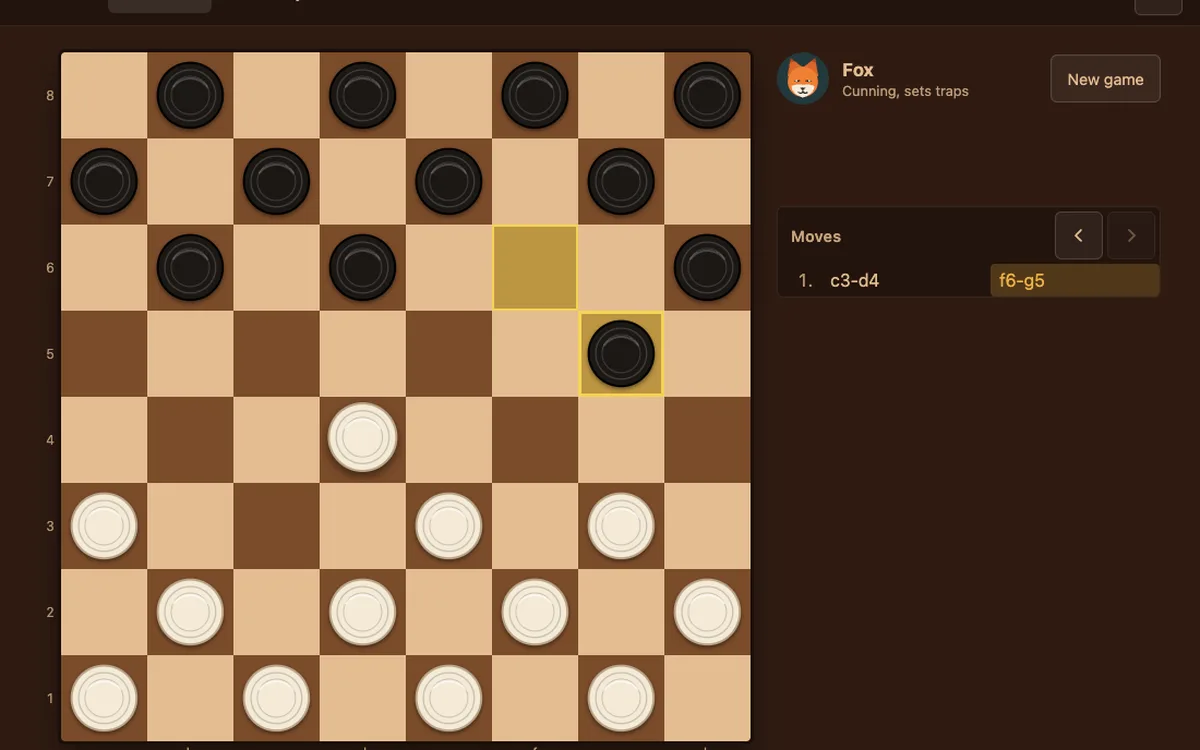
Damka is a small, careful checkers program that plays three games on one board. The main one is Russian checkers, also called shashki: 12 men a side on an 8x8 board, men that capture backwards as well as forwards, flying kings that cross the board, and captures that are always compulsory. You may choose any capture sequence, not only the longest one, and a draw is called when fifteen moves go by with only kings moving and no capture.
The second game is giveaway, known in Russian as poddavki: the same rules, turned inside out. The player who loses all their pieces, or can no longer move, wins. Giving pieces away is the whole point, and a king you can't get rid of becomes a burden. The third is corners (ugolki in Russian), a race: each side starts with nine men packed in a corner and has to bring all of them into the opposite corner by steps and chains of jumps, with no captures at all.
You can play any of them against one of five opponents, each with a character and a strength: Kitten goes wherever its eyes lead, Hare moves fast and thinks later, Fox sets traps, Owl is in no hurry and notices everything, and Raven remembers all your mistakes. Choose a friend beside you instead and two people can share the same screen. Opponents also talk, with short remarks about a move that was just played, and offer a draw or a resignation when the game is clearly decided. You can play with or without a clock, with a bank of minutes and a time increment per move, and give the opponent a different time than yours as a handicap.
Under the hood Damka searches with iterative deepening and a transposition table in a background worker, and for checkers it reads endgame tables for every position with five pieces or fewer, so the computer plays those endings perfectly. After the game a screen shows how it went, with a graph of the material lead move by move, and you can step back through the game at any time.
Damka was made by Anton Medvedev in 2026 and released as free software under the MIT License. The interface of the original is in Russian; here it is translated into English, and nothing else about the game was changed.
Playing it here
Everything runs in your browser, the opponent included, and nothing is sent anywhere. Your last choices (game, opponent, colour and time) are remembered in this browser; clearing the site's data erases them. The endgame tables are loaded only as the game needs them. This version has no sound.
Controls
| Input | Action |
|---|---|
| Click a piece, then a marked square | move |
| Drag a piece to a marked square | move |
| Ctrl+Z (Cmd+Z) | take back a move |
| Ctrl+Shift+Z (Cmd+Shift+Z) | bring a move back |
| Arrows above the move list | step through the game |
| Flip button in the top bar | turn the board around |
The rules in short
Checkers. White moves first. A man moves one square diagonally forward and captures an adjacent enemy piece by jumping over it, forwards or backwards, onto the empty square behind. A man that reaches the far row becomes a king, which moves any distance along a diagonal and captures from a distance. Capture is compulsory and a capturing piece keeps going while it can. You win by taking every enemy piece or leaving the opponent with no move.
Giveaway. Same moves, opposite goal: you win when you have no pieces left or no move to make.
Corners. Nine men a side, moved by steps and chains of jumps, no captures. Move all your men into the opponent's corner. Men left in your own corner after move 40 count against you, so get them out early.
Tips
Always check the captures. Because capturing is compulsory, you can force the opponent's piece to a square you choose, and the same works against you.
Keep your back row as long as you can. It stops the opponent from making kings.
Start with the Kitten and climb. The five opponents are a ladder: win against one, then try the next.
FAQ
Is this the same as the checkers I know? The first game is Russian checkers, which differs from English checkers: men capture backwards, kings fly and the capture does not have to be the longest one.
Why is the page in English if the game is Russian? The author's interface is in Russian; this version has been translated.