
 Portugues
Evasion
Saved games stay in this browser only.
About the game
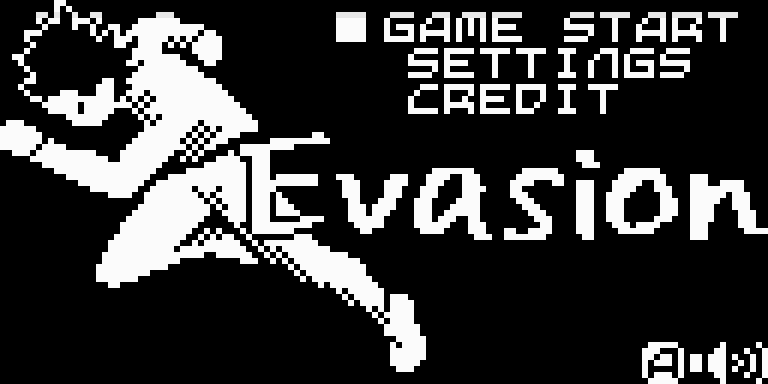
Evasion is as simple as an arcade game gets. A little runner sprints forward through an endless field of pillars that rush towards the screen in 3D, and you steer left and right to slip between them. The score is the distance, and the first pillar you hit ends the run.
What gives it depth is the settings screen. You can change the starting speed, whether and how fast the run accelerates, how dense the pillars are and how thick they are, so the same game can be a relaxed warm-up or a frantic test of reflexes. A simple mode is there too, for playing with as little menu as possible.
OBONO made it in 2020 for the fifth Arduboy game jam.
Playing it here
This is a homebrew game made for the Arduboy, the open, credit-card-sized handheld with a tiny black-and-white screen: a new game by an independent developer, not a commercial release. It runs here in Ardens, an Arduboy emulator. Click Play now and use the menu on the title screen.
The game remembers its records in the emulated memory of the Arduboy, and that is kept in this browser automatically. F2 also saves the complete state of the game at any moment, and F4 brings it back. A gamepad works too.
Controls
| Key | Arduboy button | Action |
|---|---|---|
| Left / right | D-pad | dodge |
| Z | A | menu (continue, restart, title) |
| X | B | start again after a crash; choose in menus |
| F2 / F4 | — | save / load the state |
A few things worth knowing
Look ahead, not at your feet. The pillars grow as they approach; the ones still small in the distance tell you where the next gap will be.
Small taps. Holding a direction too long carries you straight into the next pillar. Short corrections keep you in the middle of the gaps.
Tune it. If the default run feels too easy or too harsh, the settings change the speed, acceleration, density and thickness of the pillars.
Credits and licence
Evasion was designed, programmed, drawn and scored by OBONO, who has been making small games for the Arduboy since 2016. It is free software under the MIT licence. It is built with the Arduboy2 5.2.1 library (BSD licence, plus a music player adapted from ArduboyPlaytune, MIT). The licence texts are linked from this page, and the source code is in the author's ArduboyWorks repository.