
 Portugues
GhostHop
Saved games stay in this browser only.
About the game
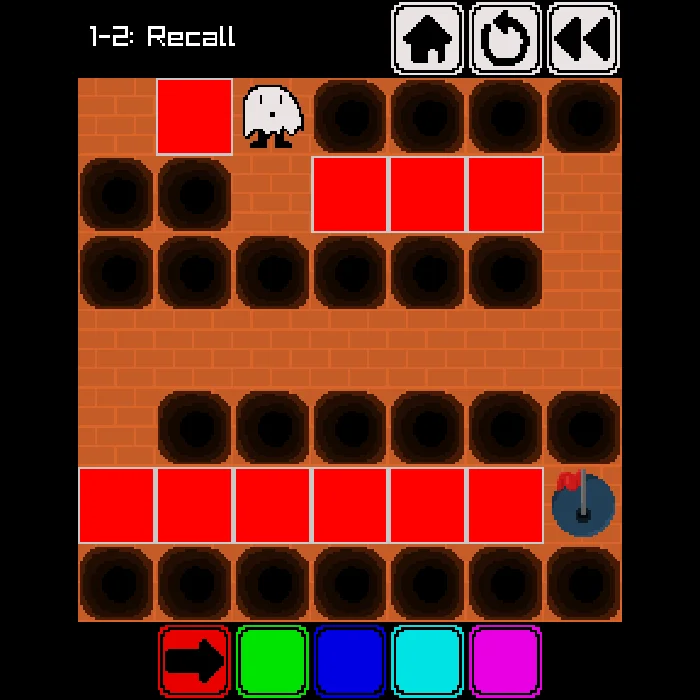
GhostHop is a puzzle game about a small ghost that has to reach a flag across a floor full of holes. The ghost can slide over plain tiles, crates block the way, and stepping on a dark hole loses the room, which you fix with undo or restart. What makes it a puzzle is the coloured tiles. A red, green, blue, cyan or purple tile does nothing by itself. The first time the ghost lands on one, you decide what that colour means by pressing an arrow, and the ghost hops that way. From then on the colour always means the same direction, and every other tile of that colour does the same thing. A tile can also hold a short sequence of colours, so a single landing can send the ghost along several hops in a row.
You are, in effect, assigning meanings to names and then working out what the level does with them, which is the kind of idea that suits a Lisp jam. The levels are grouped in three sets of seven, each with a one-word title: Result, Recall, Revise and so on in the first set, then a second set whose names begin with Con and a third with Di. They start with a single tile and a flag and grow into rooms where the colour you choose first changes what is reachable later.
GhostHop was made by Mason Cutting for the Spring Lisp Game Jam 2024. It is written in Scheme, using the small s7 interpreter on top of the raylib game library, and the soundtrack is "Lines of Code" by Trevor Lentz.
How to play
On the title screen press the play button, or Z or Enter, to see the level list, and pick a room with the arrow keys or by clicking. Inside a room, move with the arrow keys or WASD, or swipe on a touchscreen. The buttons at the top return to the list, restart the room and undo the last step; the same actions are on C or U (undo), V or R (restart) and X or Backspace (back). The row of colour buttons below the room shows the direction you have given each colour so far. Z or Enter starts the next level after a win.
Tips
Choose the first direction on purpose. The first time a colour is used it is fixed for the whole level, so look at where its other tiles sit before you step on it.
Undo is free. If a colour sends the ghost the wrong way, undo and try a different direction.
Read the whole room. Count the tiles of each colour and picture where each choice would take the ghost.
FAQ
Is it long? There are 21 rooms. The first few are over in seconds, and the later ones ask for more planning.
Does it save my progress? The game does not store progress. The level list is open, so you can choose any room.
Is there sound? Yes, a music loop and small sound effects.
Credits and licence
GhostHop is by Mason Cutting. According to the README, all the gameplay code and assets were made during the jam, except the music "Lines of Code" by Trevor Lentz (https://opengameart.org/content/lines-of-code), which is licensed under Creative Commons Attribution-ShareAlike 3.0 (CC BY-SA 3.0) and is included unchanged. The game is released under the GNU General Public License version 3. It uses the raylib library (zlib licence) and the s7 Scheme interpreter (0BSD). We compiled it ourselves with Emscripten, with three small changes: the exit button on the title screen is hidden, because a web page cannot be closed by the game, the raylib build uses WebGL 2, and a fix to a generated file so that the build is reproducible. The full source of this build, the patches and the build script are hosted next to the game and linked from this page.