
 Portugues
Greed
Saved games stay in this browser only.
About the game
Greed is a small number puzzle that Matthew T. Day wrote in C in 1989, for Unix terminals, and shared it through the Unix source archives. In the README he says he did not invent the game: he had seen it on an IBM computer and wrote his own version. Day left the project in 1990 and Eric S. Raymond has looked after it since. The 4.x versions keep the score list in a new format and, as the version history says, the 4.4 release was hardened with the help of an AI tool, which is why this page mentions it.
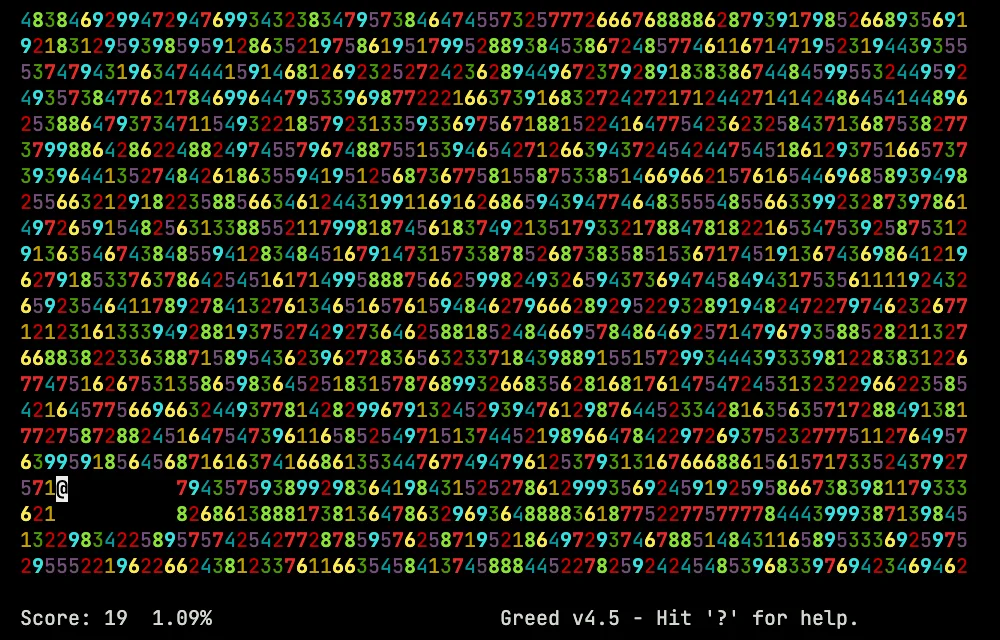
The board is a grid full of digits from 1 to 9, filled at random, and you are an @ somewhere in it. Every move goes in a straight line, in one of eight directions, and the number you are heading for says how many squares you eat and move over: if you go right and the next square is a 7, you eat seven squares to the right and end up on the last one. Eaten squares disappear, you cannot cross or land on them, and you cannot leave the board. The game ends when no move is possible, and your score is the number of squares you ate, shown with the percentage of the board.
The fun is in planning. A 9 is worth a lot, but it can also lock you in a corner, and a safe-looking route may close off the rest of the board. Colours help you read the board at a glance, one for each digit, and the p command highlights the moves you can make right now.
Playing it here
This is Greed 4.5, compiled for the browser from its source code, with no change to the game. The board is the full text screen, in colour, and there is no sound. The best scores are kept in this browser and listed when the game ends. The game is in English and needs a keyboard (touch screens get on-screen keys).
Controls
| Key | Action |
|---|---|
| arrow keys, numeric keypad, h j k l | move left, down, up, right (hold the key to repeat if your keyboard does) |
| y u b n | move diagonally (up-left, up-right, down-left, down-right) |
| p | show or hide the possible moves |
| ? | help |
| Ctrl+L | redraw the screen |
| q | quit (after you confirm with y) |
Tips
Think about where each move leaves you. A large number takes you far, but the last square you land on decides your next options.
Eat towards the middle later. Clearing the edges first can leave you with fewer routes than clearing a strip through the middle.
Use the p command while you are learning to see which moves are open.
FAQ
How is the score calculated? It is the number of squares you have eaten, and the game also shows what percentage of the board that is.
Can I choose the board size? The original game has options for that on the command line, but this version starts with the standard board.