
 Portugues
Hanafuda Koi-Koi
Saved games stay in this browser only.
About the game
Hanafuda is the Japanese deck of flower cards, with twelve months of four cards each, and Koi-Koi is the best-known game played with it. Two players take turns. On each turn you play a card from your hand on the field: if it is of the same month as a card face up on the table, you take both; if it is not, it stays on the field. Then you turn over the top card of the stock and play that the same way. The cards you collect are sorted into four kinds: brights, animals, ribbons and plain chaff cards, and particular sets of them form scoring combinations called yaku, such as three brights, the boar-deer-butterfly trio or red poem ribbons.
The heart of the game is the moment you complete a yaku. You can say Stop to end the round and score the points, or you can say Koi-Koi, which means to go on: the round carries on and the points you score at the end are doubled, but if your opponent stops first, you score nothing that round. A match lasts a number of rounds, with the dealer changing each time.
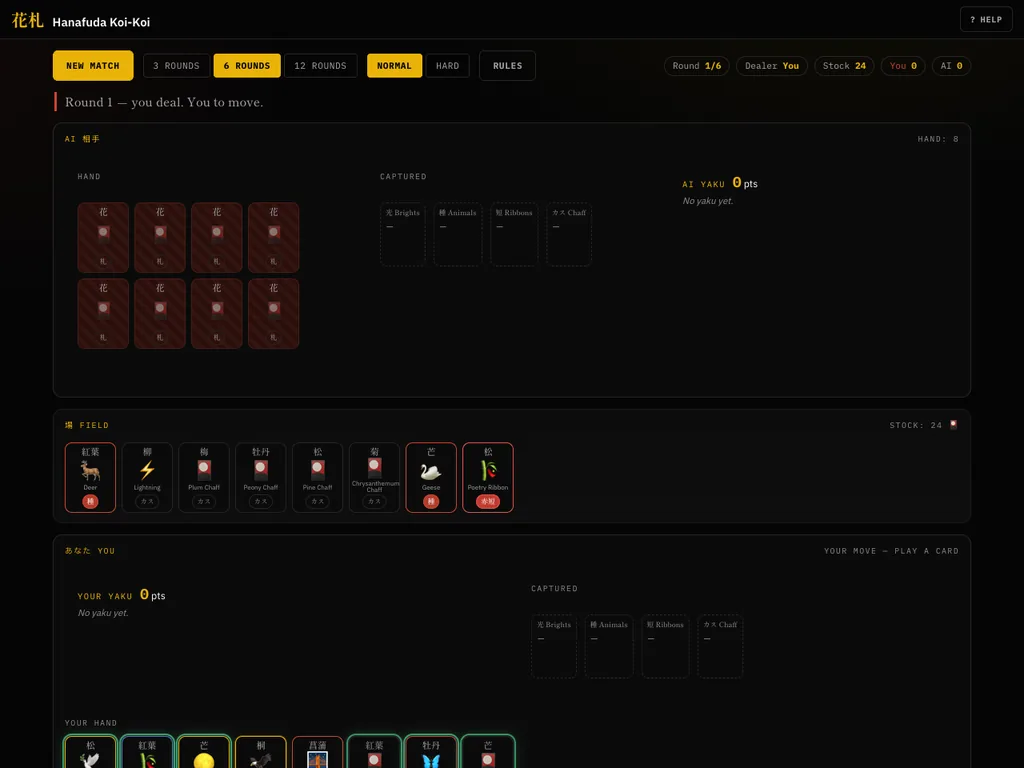
This version is part of the Asobi collection by Miguel Carino, written in plain HTML5 and JavaScript with AI tools, which the author declares in the repository. The 48 cards are drawn as colour tiles with the month, the kind and an emoji symbol, so there are no image files, and the computer is an opponent that plays towards yaku it can still reach. The interface follows your browser language in English, Spanish, Portuguese, Japanese and Russian. The card names, the yaku and the months stay in their original names with a translation in the tile.
Playing it here
Click Play. Choose a match of 3, 6 or 12 rounds and the difficulty, Normal or Hard, then press New match. Click a card in your hand: if exactly one card on the field is of the same month, the pair is taken at once; if two match, click the one you want; if nothing matches, the card is laid on the field. After your play, the game turns up the top card of the stock and plays it the same way, asking you to choose when two cards match. When you complete a yaku, a window asks if you want to Koi-Koi (play on) or Stop (take the points). The panels show the points of each side, the yaku you have, the cards in the stock and the round. The Rules button (or the ? key) opens the help screen. A match is not saved between visits.
Controls
| Input | Action |
|---|---|
| click a card in your hand (then the field card of the same month, if two match) | capture the pair |
| click a card in your hand with no match | lay it on the field |
| Koi-Koi / Stop | go on, or end the round and take the points |
| New match, rounds and difficulty buttons | start a match of 3, 6 or 12 rounds at Normal or Hard |
| Rules or ? | open the help screen |
| F | full screen |
A few things worth knowing
The brights are worth a lot. The five bright cards score from five points for three of them up to ten for all five, so keeping an eye on them is half the game.
Know when to stop. The computer will not forgive a greedy Koi-Koi: if it stops first, you get nothing. When the yaku is small, go on if the cards you still need are about to come, and when it is big, take the points.
Keep the sake cup in mind. Together with the moon or the cherry blossoms the sake cup forms a yaku of five points, which is easy to miss in the middle of a round.
Credits and licence
Hanafuda Koi-Koi was created by Miguel Carino as part of Asobi and is released under the GNU Affero General Public License, version 3 or later. The fonts (IBM Plex, Red Hat Display and Shippori Mincho) are under the SIL Open Font License 1.1. The full source of the exact version served here is published next to the game, as the licence requires, and the licence texts are linked from this page. This version has been changed by FredyGames: the author's navigation bar and branding were replaced by a page of our own for this game alone.