
 Portugues
Houseki Gem Puzzles
Saved games stay in this browser only.
About the game
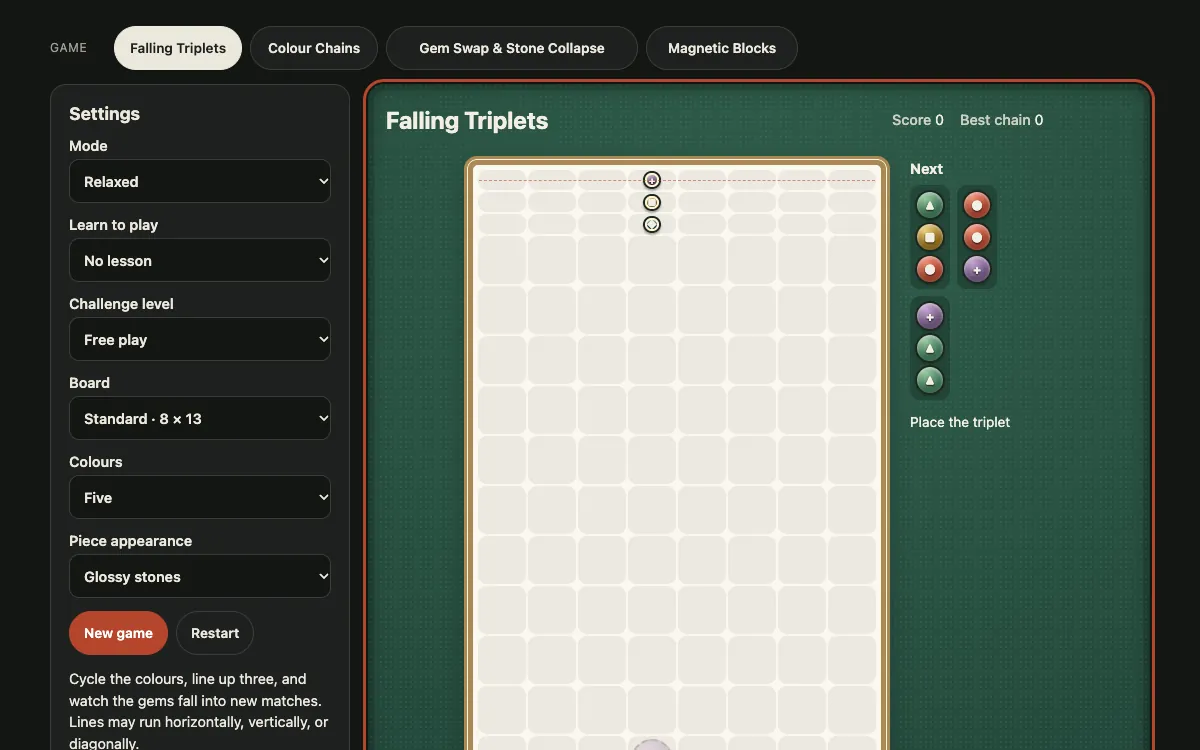
Houseki, "gem" in Japanese, packs four different match-and-fall puzzle games into one page, each with its own rules and its own set of graded challenges. In Falling Triplets a vertical column of three gems falls; you cycle the colours, place it, and line up three of a colour horizontally, vertically or diagonally to watch the gems cascade. Colour Chains drops pairs that you rotate, and four or more of one colour connected set off chains, with optional magnetic stones and weather. Gem Swap and Stone Collapse are full-board puzzles: swap neighbours to make special gems, or pick connected stones and plan the order in which they leave. Magnetic Blocks drops bonded squares onto a floor that turns magnetic on a schedule.
Each game has a relaxed mode where you plan with no clock, an arcade mode where the pieces fall by themselves, and a daily challenge. There are 684 graded challenges across the four games, plus short lessons that teach the rules.
Playing it here
Click Play. The row of game names near the top switches between the four games; each opens on its own page of the same site. On the left are the settings: the mode (Relaxed or arcade), a lesson, a challenge level or free play, the board size, the number of colours, the look of the pieces and the board material. New game starts it and Restart replays the same challenge. In Falling Triplets use the arrow keys or the buttons under the board: left and right move the triplet, Cycle changes the order of its gems, Place drops it and Pause stops the game. The checkboxes turn animation, reduced motion and sound effects on and off. Progress and settings stay in this browser.
Controls
| Input | Action |
|---|---|
| arrow keys left / right | move the falling piece |
| up arrow, Z, X | cycle the piece (reverse or forward) |
| down arrow | soft drop |
| Space | place or drop |
| Escape | pause |
A few things worth knowing
Start in Relaxed mode. You can plan each placement without any clock, which is the best way to learn how chains work.
Do the lessons. Each game has a few interactive lessons before its first challenges.
Leave room for cascades. Placing a piece so that a collapse triggers another match is worth more than clearing right now.
Questions
Do I need to know the rules in advance? No. Each game has interactive lessons and graded challenges that add rules one at a time.
Is progress saved? Yes, in this browser only.
Credits and licence
The code, the drawings and the puzzle levels are by John Morris, under the MIT licence; nothing else is bundled with the game.