Portugues
KazuGrid
Saved games stay in this browser only.
About the game
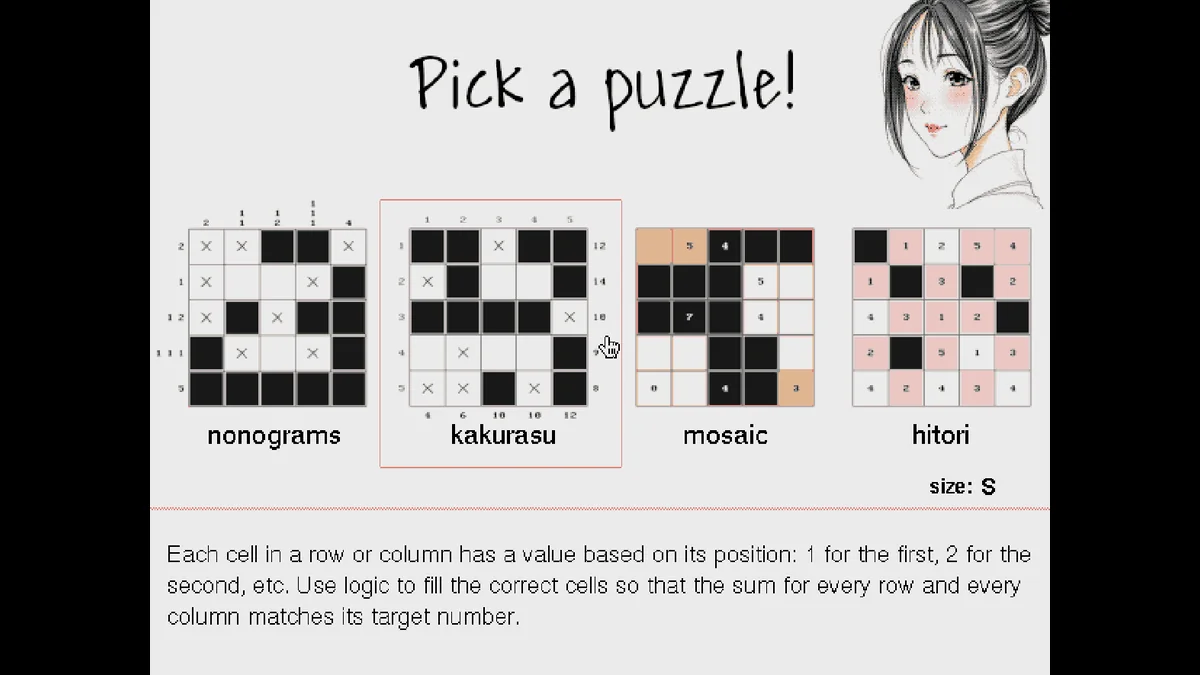
KazuGrid is a small collection of grid puzzles, the kind that are solved with logic alone: no guessing and no arithmetic beyond simple sums. The first screen offers four of them, each with a short explanation under the picture when the pointer rests on it.
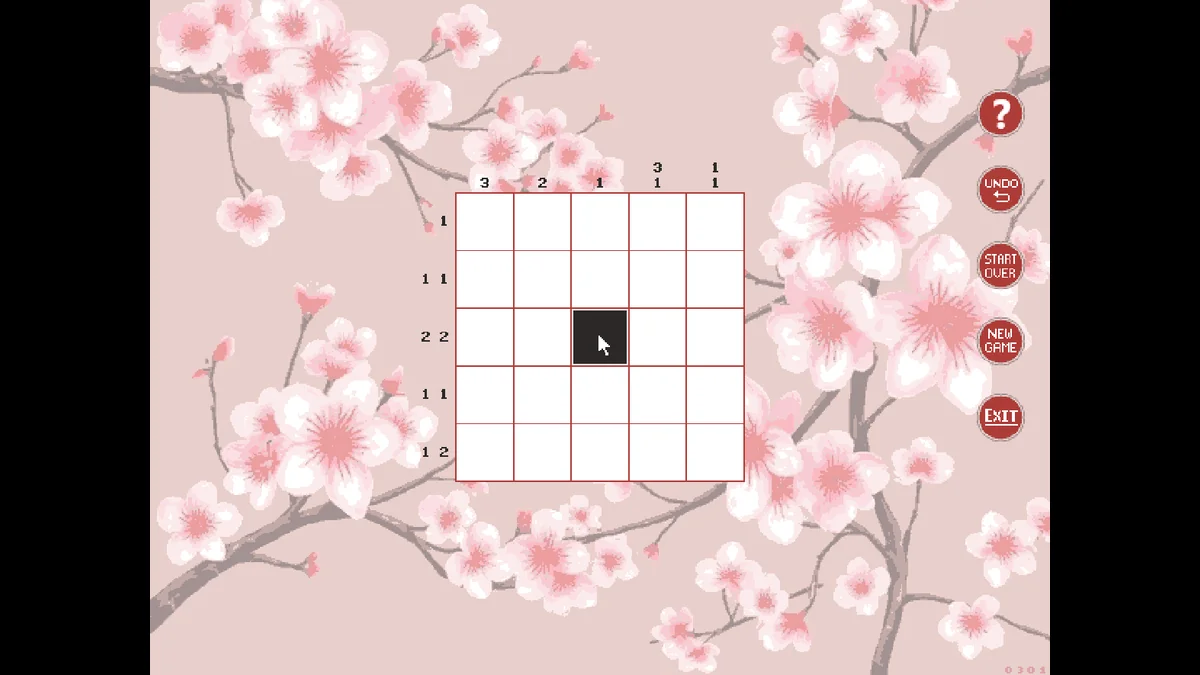
- Nonograms. The numbers beside each row and above each column give the lengths of the runs of black cells in that line, in order. Fill the right cells and the hidden pattern appears.
- Kakurasu. Each cell is worth its position in the row or column: 1 for the first, 2 for the second and so on. Fill cells so that every row and every column adds up to its target number.
- Mosaic. A number counts the black cells in the three-by-three square around it, itself included. Use the overlaps between the numbers to find them.
- Hitori. Shade cells so that no number appears twice in a row or column, without two black cells touching side by side and without cutting the white cells into separate groups.
Each type comes in four grid sizes, chosen on the first screen, from a quick five-by-five to large grids that take a good while.
Mateusz Viste, who also wrote Sudoku86, made KazuGrid in 2025 for DOS PCs with a VGA card. It runs on anything from an 8088 up, and the author recommends a 286 with some extended memory.
Playing it here
Click Play and the "Pick a puzzle!" screen appears. Click "size" at the bottom right to cycle through S, M, L and XL, then click one of the four puzzles. In the puzzle, click a cell to fill it. On a phone or tablet a tap works as a click.
Controls
| Input | Action |
|---|---|
| Click a puzzle (first screen) | start that puzzle type |
| Click "size" (first screen) | switch between S, M, L and XL |
| Click a cell | fill it |
| ? | rules of the puzzle |
| UNDO / START OVER | take back a move / clear the grid |
| NEW GAME / EXIT | another puzzle / back to the first screen |
A few things worth knowing
Start small. The S grids are five by five and teach the logic of each type in a few minutes. The rules are the same on the larger sizes, only longer.
Nonograms: begin with the big numbers. A run that fills most of a line always covers its middle cells, whatever its exact position, so those cells can be filled at once.
Kakurasu: look for the only sums. A target of 1 can only mean the first cell; a target equal to the sum of all positions means the whole line.
Hitori: shade around pairs. When a number repeats in a line, one of the two must go black, and the cells next to a black cell must stay white.
FAQ
Where do the pictures come from? The author's notice in the package says the pictures were created with DeepAI.org, an image generator, and are public domain under that service's terms.
What does NEW GAME do? It gives you another puzzle of the same type and size; START OVER keeps the puzzle and clears your work.
Can I play it on a phone? Yes. Everything is done with clicks, and a tap is a click in the DOS player.
Credits and licence
KazuGrid was written by Mateusz Viste and released under the MIT licence; the pictures were generated with DeepAI.org, as the author states in the package. It runs here in js-dos (DOSBox), from version 1.0 on the author's site.
Screenshots