Portugues
Mirror Magic II
Saved games stay in this browser only.
About the game
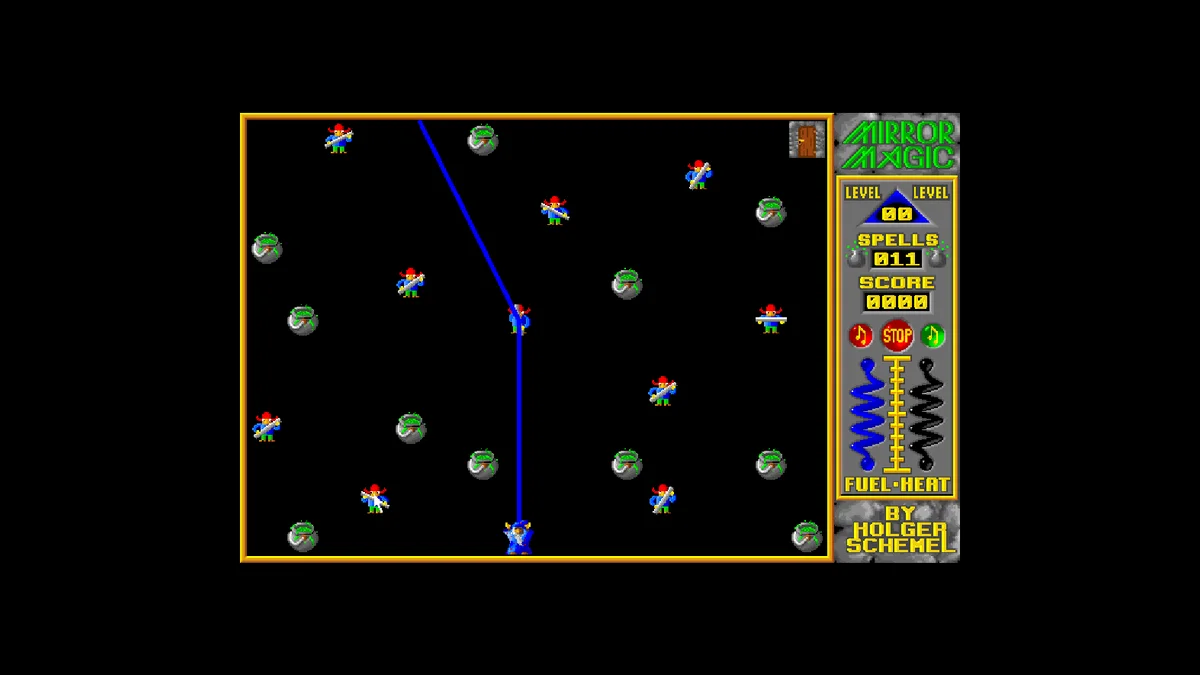
A magician stands at the edge of a walled board and fires a beam of magic in a straight line. Scattered around the board are gnomes in red hats, each holding a mirror, and magic kettles full of spell ingredients. Click a gnome and its mirror turns; the beam bounces off at the new angle and runs on until it hits a wall, a mirror or something else. Your job is to route the beam so it touches every kettle. When the last one is collected, a magic door opens, and one more bounce into that door wins the level.
Two meters keep the pressure on. The blue fuel bar is your magic energy and drains while you think, so every level is also a race. The red heat bar shows when the beam is overheating, and if it reaches the top the level is lost. Later levels add more pieces with their own rules, from walls that block or absorb the beam to objects that move around the board; the info screen in the main menu shows every element.
Holger Schemel wrote the game on the Amiga in 1989 as Mindbender, a take on the Commodore 64 game Deflektor, and later rewrote it for Unix, DOS and Windows as Mirror Magic II. This is the DOS build of version 2.0.2, from 2003, the same author who made Rocks'n'Diamonds.
Playing it here
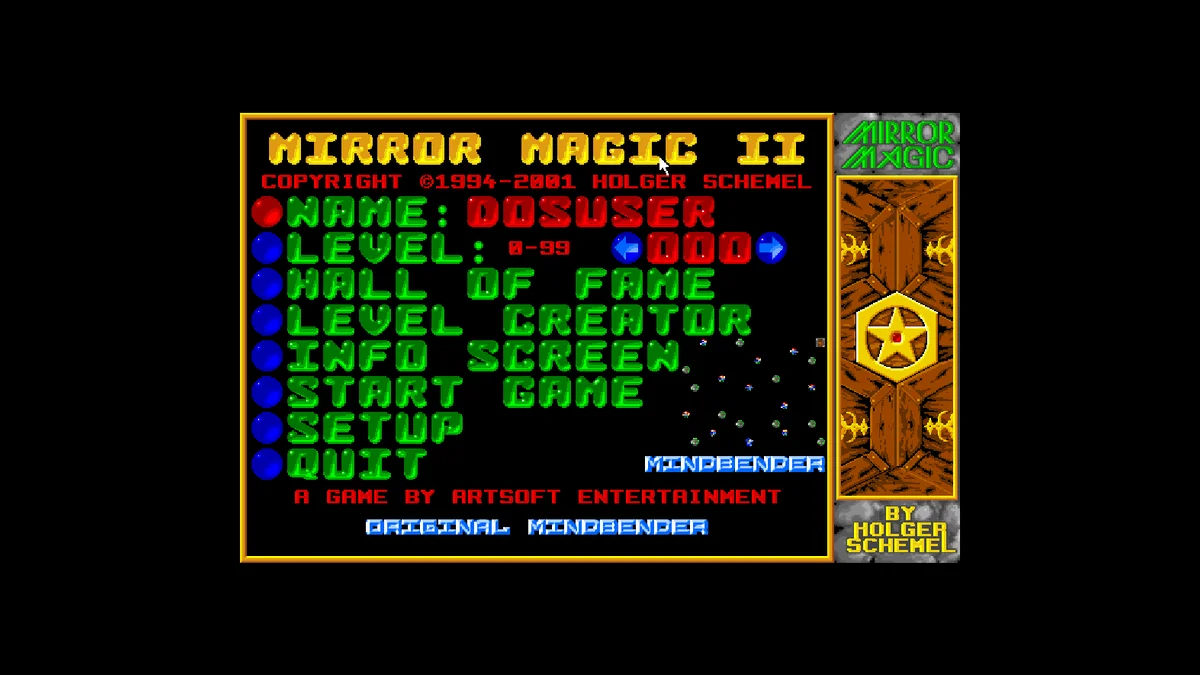
Click Play and the main menu appears with eight blue buttons on the left. Click a button to use that menu entry; it turns red while it is active. Click Start game to play the level shown in the level field. The game is played entirely with the mouse, and the pointer moves the cursor of the game directly.
This copy has two differences from the author's package. The background music has been removed, because the music modules in the package were made by other musicians and do not carry a licence that allows use on this site; the sound effects are still there. And only the level set that the menu calls Mindbender, with the author's own levels, is included: the set of levels imported from Deflektor was taken out.
Controls
| Input | Action |
|---|---|
| Left click on a menu button | choose that menu entry |
| Left click on a gnome | turn its mirror one way |
| Right click on a gnome | turn its mirror the other way |
| Stop button (right panel) | pause, then confirm to quit the level |
A few things worth knowing
Plan the path before you click. Fuel drains the whole time, but nothing penalises a pause to trace the route from the magician to each kettle in your head first.
Watch the heat bar. If the red bar starts to climb, the current beam path is overheating; change it before the bar reaches the top. The two mouse buttons turn a mirror in opposite directions, so the shorter way round is always one button away.
Use the info screen. It shows every element that appears in the levels, so a new piece in a later level does not have to be a surprise.
Levels unlock in order. The level field in the main menu only lets you pick levels up to the highest one you have won, so progress is your handicap. The higher-numbered levels at the end of the range are empty on purpose, ready for the level creator.
FAQ
Why is there no music? The music in the original package came from other artists, and their terms do not allow it to be redistributed here, so this build plays sound effects only.
Can I make my own levels? Yes. Pick one of the empty high-numbered levels in the level field, then choose Level creator. Elements are on the right; place them on the board with the mouse, and Exit saves after asking.
Is my progress kept? The game keeps your player name, scores and highest level in its own files, and the DOS player stores changed files in this browser. Clearing the site data, or playing in a private window, starts you over.
Credits and licence
Mirror Magic II is by Holger Schemel (Artsoft Entertainment) and is free software under the GNU General Public License, version 2. This copy comes from the FreeDOS 1.3 package of the game, without the third-party music and the Deflektor level set, and with the CWSDPMI r7 DOS extender. The source of this release is hosted next to the game, as the licence requires, and the author's page is at artsoft.org.
Screenshots