
 Portugues
Möbius Trip
Saved games stay in this browser only.
About the game
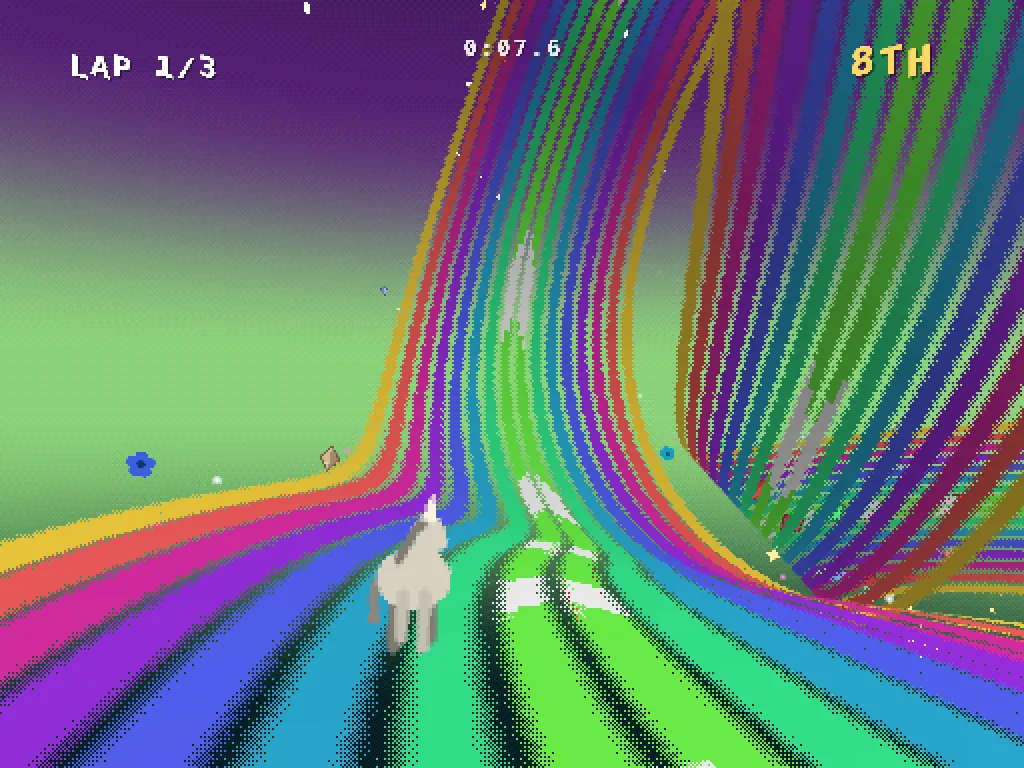
Möbius Trip is a 3D race on a rainbow ribbon in the middle of a starry nowhere. The ribbon is a Möbius strip, the famous twisted loop that has only one side, so as you race around it the road turns over and what was the left edge becomes the right. The world swings around you, the colours smear into stripes and the unicorn, seen from behind, keeps galloping through it all.
You race against seven other unicorns for three laps. Before the start you choose how hard they try: Foal, Stallion or Alicorn. The track has rails on both sides, and scraping one at an angle costs speed, so the line through the twists matters. Crossing the middle line of the strip gives a short speed boost, and the rivals toot as they get theirs, so you can hear who is using it. A HUD shows the lap, the time and your place, for example 8th.
László Matuska made Möbius Trip for js13kGames 2026, where the whole game, zipped, had to fit in 13 kilobytes. The 3D track, the sprites and the sounds are all produced by code as you play, and the picture is drawn with WebGL.
Playing it here
Click Play, click inside the game and press 1, 2 or 3 to pick the opponents: the race begins at once with a short flyover and a countdown. You need a browser with WebGL. Nothing is saved between visits, and R after the results screen starts over.
Controls
| Input | Action |
|---|---|
| Up or W | throttle |
| Down or S | brake |
| Left / Right or A / D | steer |
| 1, 2, 3 (title screen) | start against Foal, Stallion or Alicorn opponents |
| R | race again after the results |
| Two on-screen buttons | steer, on a phone (throttle is always on) |
A few things worth knowing
Cross the middle for a boost. Wiggle across the centre line of the strip and you get a short burst of speed, but only once in a while.
Stay off the rails. A scrape costs more speed than a clean turn, so ease into the twists.
Start with Foal. It is the easiest way to learn how the strip turns over.
Credits and licence
Möbius Trip was created by László Matuska and is released under the MIT licence. The licence text is linked from this page, and the source code is on GitHub.