
 Portugues
Monsterz
Saved games stay in this browser only.
About the game
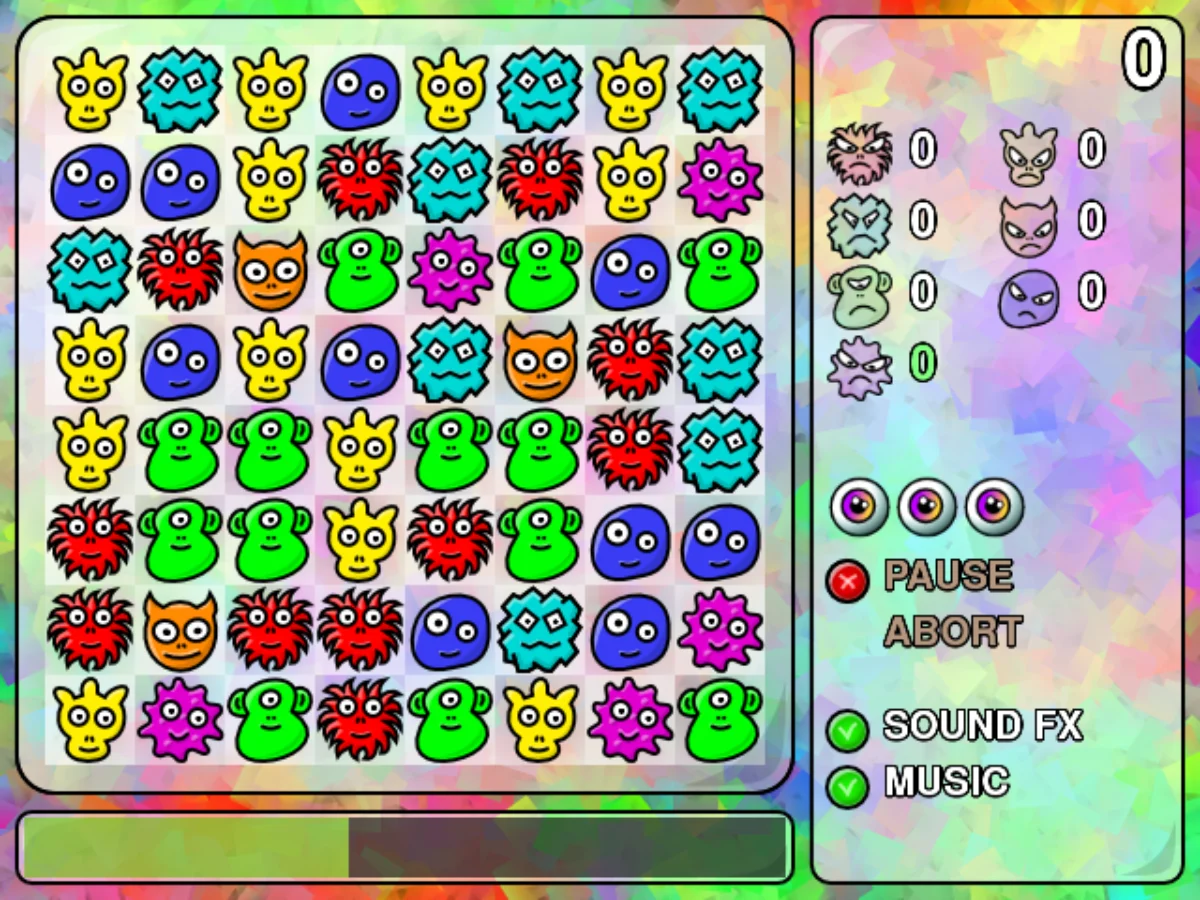
Monsterz is a match-three puzzle with a lot of personality. You get a board of eight by eight round-faced monsters of seven kinds, and a move is a swap: click one monster and then a neighbour to trade places. If that makes a line of three or more of the same kind, in a row or a column, they pop, the monsters above fall into the gap and new ones drop in from the top. A swap that makes no line is undone.
In the classic mode each level asks for a number of monsters of every kind, and a time bar runs down while you play. Every pop adds time to the bar, and once the quota is cleared you move on to the next level, which asks for more monsters and goes a little faster. The three eyes on the right are your spare chances, and you win one back every 10,000 points. Chains pay off: when a pop causes another pop, the points double, then quadruple and so on. Each level also names a lucky monster whose pops are worth twice as much.
There are two more ways to play. The puzzle mode has ten hand-made boards, each with a small goal to complete. The training mode has no time bar and lets you choose how many kinds of monsters there are and how fast the game goes, so you can practise at your own pace.
Playing it here
The first time you click Play the page downloads the Python runtime and the pygame library (about 23 MB), which takes a few seconds; after that a "click to start" message appears, and one more click opens the menu. Nothing is loaded from other sites. The high scores and the sound settings are saved in this browser only. When a level starts, the intro screen waits for a click before the board appears.
The whole game is played with the mouse. S and M turn the sound effects and the music off and on (the two switches on the right of the screen do the same). The "quit" item of the menu simply takes you back to the title, since there is nothing to quit to on a web page.
Controls
| Input | Action |
|---|---|
| Click a monster, then a neighbour | swap them |
| S | sound effects on and off |
| M | music on and off |
A few things worth knowing
Look for the long lines. A line of four or five is worth more than a line of three, and it is the quickest way to fill your quota before the time bar is gone.
Plan for chains. A swap near the bottom shakes the whole board, and a good one sets off a second and a third pop on its own, doubling the points each time.
The lucky monster pays double. The level screen shows which one it is. If it is within reach, take it first.
Training is for learning. With no time limit you can look at the board for as long as you like, and the puzzle mode is a good way to practise the swap that you can only see after a long look.
Frequently asked questions
Does it save my progress? The high-score table and the settings are saved in your browser. The levels of a game are not saved; a game starts again from level 1.
Does it work on a phone? The game was made for a mouse, and we have not tested it with a touch screen.
Is it free? Yes: the code and the graphics are under the WTFPL, the music is in the public domain and the sound effects come from free software projects.
Credits and licence
Monsterz was made by Sam Hocevar (code and graphics), with code by Brendan Rackley. The music is "MenTaLgrOOvE" by MenTaLguY (public domain). The sound effects come from Barrage (Michael Speck), OpenOffice.org (Sun Microsystems), Battle for Wesnoth (David White and the Wesnoth project) and Kismet (Mike Kershaw). The code and the graphics are released under the WTFPL, the sound effects under the GPL and LGPL. The version served here is the one that Debian packages for Python 3 (their patches are included), with a few more changes to run in a browser, and the music converted to a format the browser plays; the complete source, the changes and the licence texts are linked from the Licenses page. The game runs on pygame-ce (LGPL-2.1) and CPython, whose licences and source are linked there too.