Portugues
Nonogram
Saved games stay in this browser only.
About the game
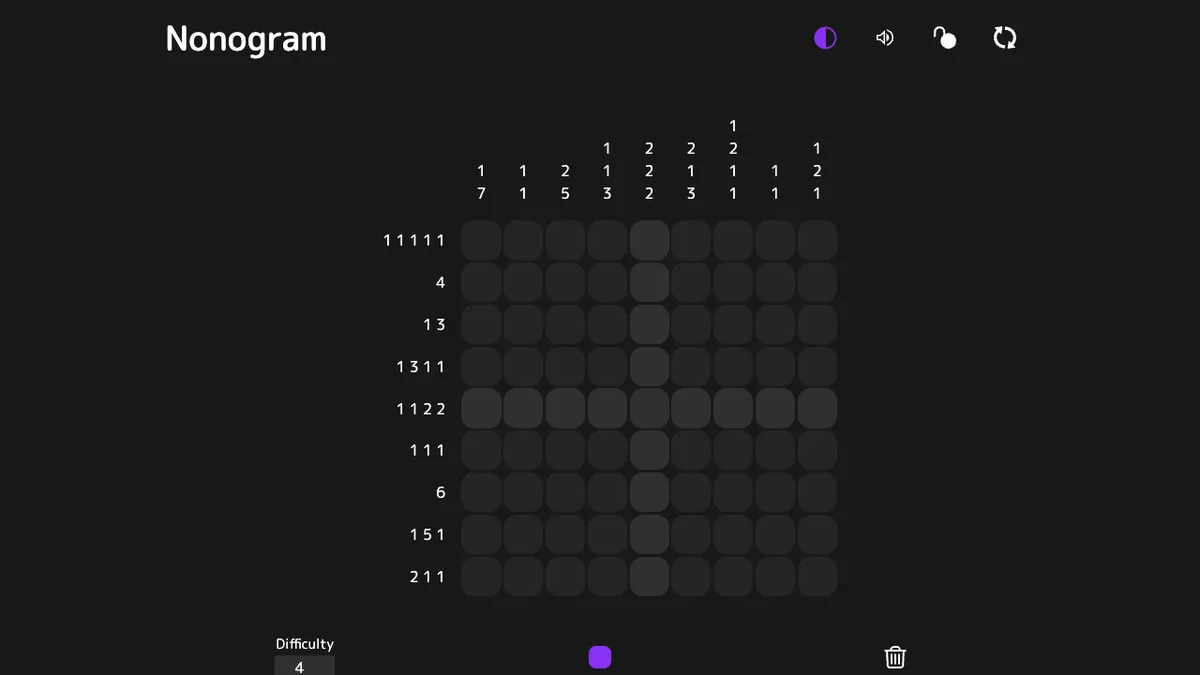
A nonogram (also called a griddler or picross) is a logic puzzle drawn as an empty grid. Next to each row and above each column is a list of numbers, and each number is a run of filled squares, in that order, with at least one empty square between runs. A row marked "3 1" holds a run of three, a gap, and a single square. Using the clues of the rows and columns together, you work out which squares are filled.
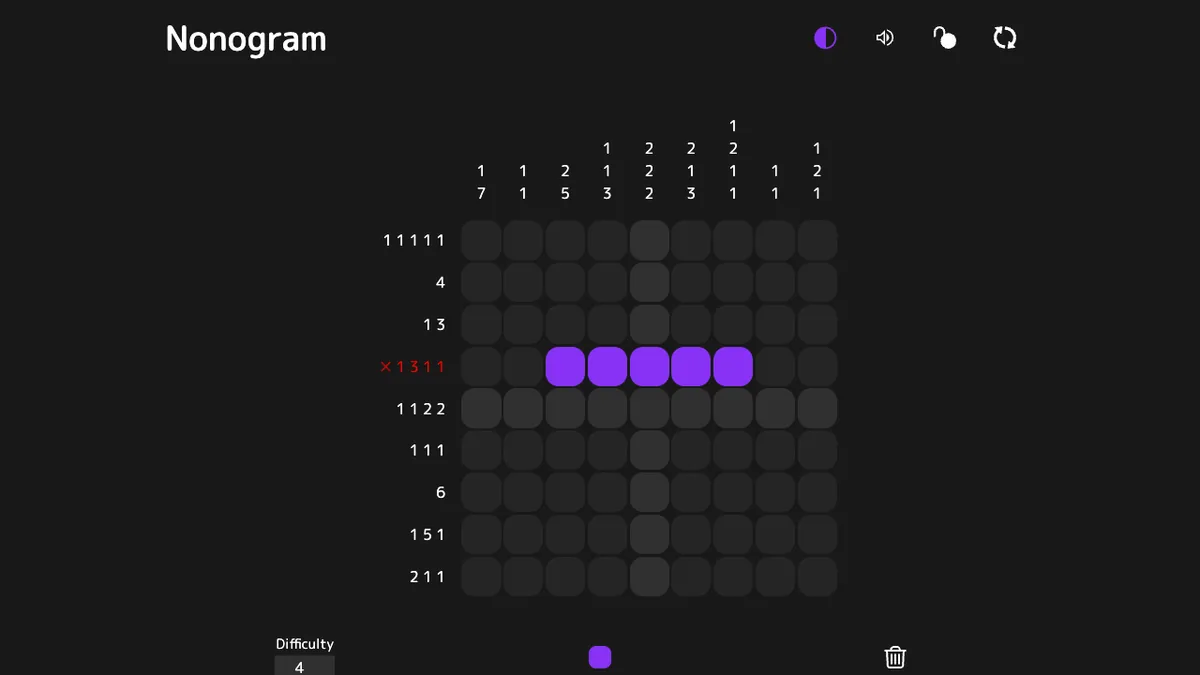
This version, by Adil Hanney, generates a new 9 by 9 puzzle every time, so it never runs out. It was made first for phones: drag a finger along a row to fill several squares at once, and switch to the cross marker to note squares you know are empty. Clues turn red when a row or column no longer matches them, which catches mistakes early. The difficulty setting goes from 1 to 10 and controls how many squares of the grid are filled.
When the grid matches every clue, a message congratulates you and offers a new puzzle.
Playing it here
Click Play and the first puzzle appears. It works with a finger on phones and tablets and with a mouse on a computer; on a phone the page gives it a tall frame. The current puzzle, your progress and the difficulty are remembered in this browser, so you can close the page and continue later.
Controls
| Input | Action |
|---|---|
| Touch / click a square | fill it (or cross it in cross mode) |
| Drag along a row or column | fill or cross several squares |
| Cross button | switch between filling and marking empty |
| Lock button | freeze the squares you have marked so far |
| Refresh button | new puzzle |
| Bin button | clear the grid |
| Half-moon button | high-contrast black-and-white mode |
A few things worth knowing
Start with the big numbers. In a 9-square row, a clue of 6 must cover the middle three squares wherever it starts. Fill those first.
Cross out what you know is empty. A row whose clue is already complete has all its other squares empty; crossing them helps the columns.
Use the lock before guessing. Locking keeps your certain squares safe, so a wrong guess can be cleared without losing them.
FAQ
Is there always a single solution? The puzzles are generated at random and the game checks your grid against the clues, so any grid that matches all the clues counts as solved.
What does the difficulty change? How many squares are filled. Higher settings fill fewer squares, so the clues are shorter and give away less, and you need to combine rows and columns more often.
Why is there no zoom? The author's app has pinch-to-zoom from a separate module that is not part of the published source. Here the board scales to fit the screen instead.
Credits and licence
Nonogram was made by Adil Hanney and is released under the GNU GPL 3.0. The font is M PLUS Rounded 1c (SIL Open Font License), the interface uses Bootstrap 5.1.3 (MIT), and the icons are from svgrepo.com (CC0) and Google's Material Symbols (Apache 2.0). Our page is a static version of the author's PWA: it leaves out the install and store links, uses sounds we generated instead of the original Pixabay effects, and has no pinch zoom. The licence texts, the exact source and our changes are linked from this page; the original repository is on GitHub.
Screenshots