
 Portugues
Server Survival
Saved games stay in this browser only.
About the game
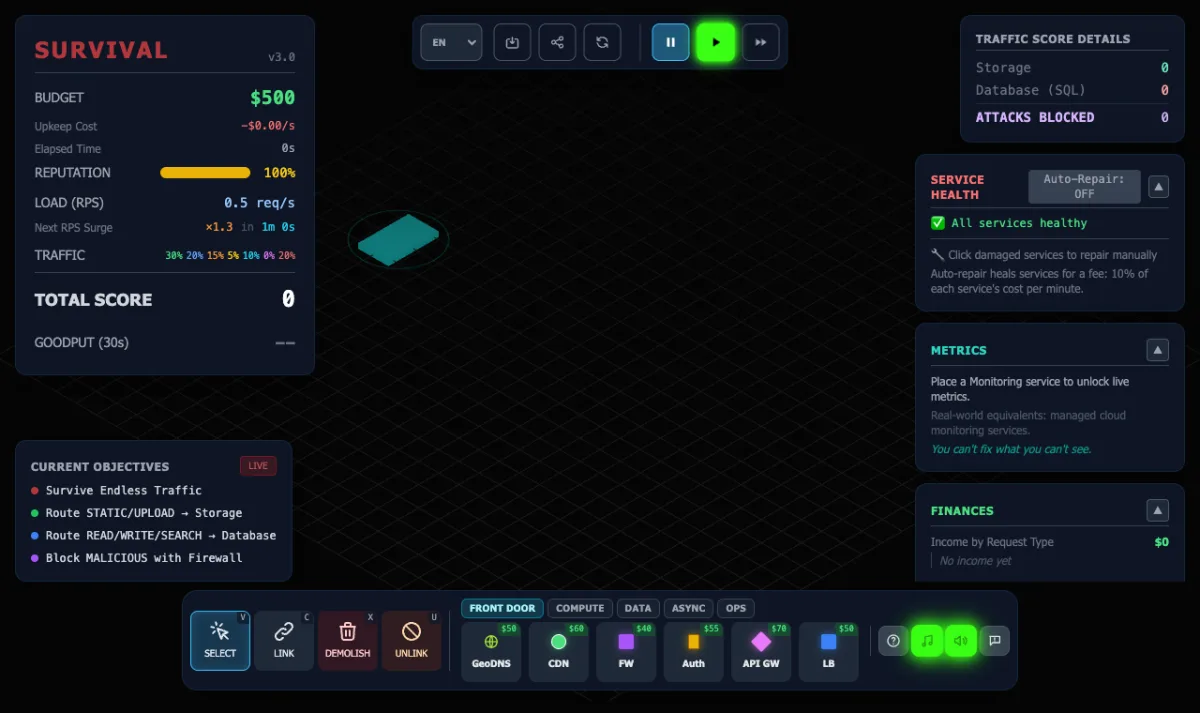
Server Survival turns the running of a web service into a tower defence game. Coloured packets stream in from the Internet: static files, database reads and writes, uploads, searches, AI generation requests, and red malicious traffic that has to be blocked. You earn money for each request that reaches the right place, and you lose reputation when one fails or when an attack slips through. The game ends when your reputation hits zero or the budget runs deep into the red.
Your towers are services you place on a 3D board and link with arrows: firewalls, load balancers, compute servers, caches, databases, file storage, queues, a CDN and more, 26 in all. Each has a price, a capacity and a running cost per minute, and each only accepts certain kinds of links, so the shape of your design matters as much as the number of boxes. Upgrade tiers, switch a compute node to autoscaling and watch it warm up new instances, or place a monitoring node to unlock a live dashboard with charts of load, errors and latency.
There are three ways to play. Survival is the endless mode, with traffic that keeps accelerating and random events such as price spikes, lost capacity and outages. The Campaign has 25 levels in five chapters, each one with a pre-built diagram and a single idea to learn: caching, throttling, circuit breakers, retries, multi-region failover, and in the last chapter GPU batching and the power budget of an AI cluster. Sandbox gives you unlimited money and no game over, to try designs with every service.
It is a game that teaches as it goes. Dropped requests pop a small badge on the node that dropped them and say why (no route, no capacity, wrong kind of store), and every campaign level ends with a short debrief.
Playing it here
Click Play. A short tutorial walks through placing a first service, and you can reopen it from the menu. The game can be played in English or Portuguese (the EN / PT-BR switch is at the top of the screen). Saves stay in this browser: use the save button to keep a Survival game, and the Campaign remembers the levels you have cleared. Music and sound effects start muted; the buttons at the top turn them on.
Controls
| Input | Action |
|---|---|
| Left click | pick a tool, place a service, link two nodes |
| Right click and drag | pan the camera |
| Scroll | zoom |
| W A S D or arrows | pan the camera |
| V / C / U / X | select, link, unlink, demolish |
| 1 to 5 | toolbar tabs |
| Shift and click | select several nodes, or keep linking from one source |
| Delete | remove the selected nodes |
| R | reset the camera |
| T | switch between the angled and top-down view |
| H | hide or show the panels |
| Esc | pause menu |
A few things worth knowing
Wire it in order. Traffic flows in the direction of the arrow. A typical stack goes Internet, firewall, load balancer, compute, then a database or storage. The hint under each service in the toolbar lists what it can connect to.
Block the red traffic early. A leaked attack costs far more than a failed request, so put a firewall in front of everything that faces the Internet.
Do not just buy bigger. Upkeep is paid every minute. A queue in front of a busy compute node, or a cache in front of a database, is often cheaper than another tier.
Pause to think. The speed buttons at the top let you pause or slow the clock while you rebuild.
Credits and licence
Server Survival was made by Kostyantyn Pshenychnyy (github.com/pshenok/server-survival) and is released under the MIT licence. It draws with three.js r128 and styles its panels with Tailwind CSS 3.4.17, both MIT, whose licence texts are linked from this page. For this site the game was kept as the author published it, with these changes: the three audio files were left out because the repository gives no credit or licence for them, so clicks make short synthesised tones and the background music is silent; the two libraries are served from this site instead of a CDN; only the English and Portuguese texts are included; the names of real cloud providers and their products were replaced by generic ones in the on-screen text; and the page does not connect to any server.
FAQ
Is it multiplayer? No. It is a single-player game, and nothing leaves your browser.
Why is there no music? The original music files could not be included, so the music button does nothing. The click sounds are generated in the browser.
Do I need to know cloud computing? No. The tutorial and the campaign introduce each idea one at a time, and the game's own explanations are plain-language.