
 Portugues
Loopy (Simon Tatham's Puzzles)
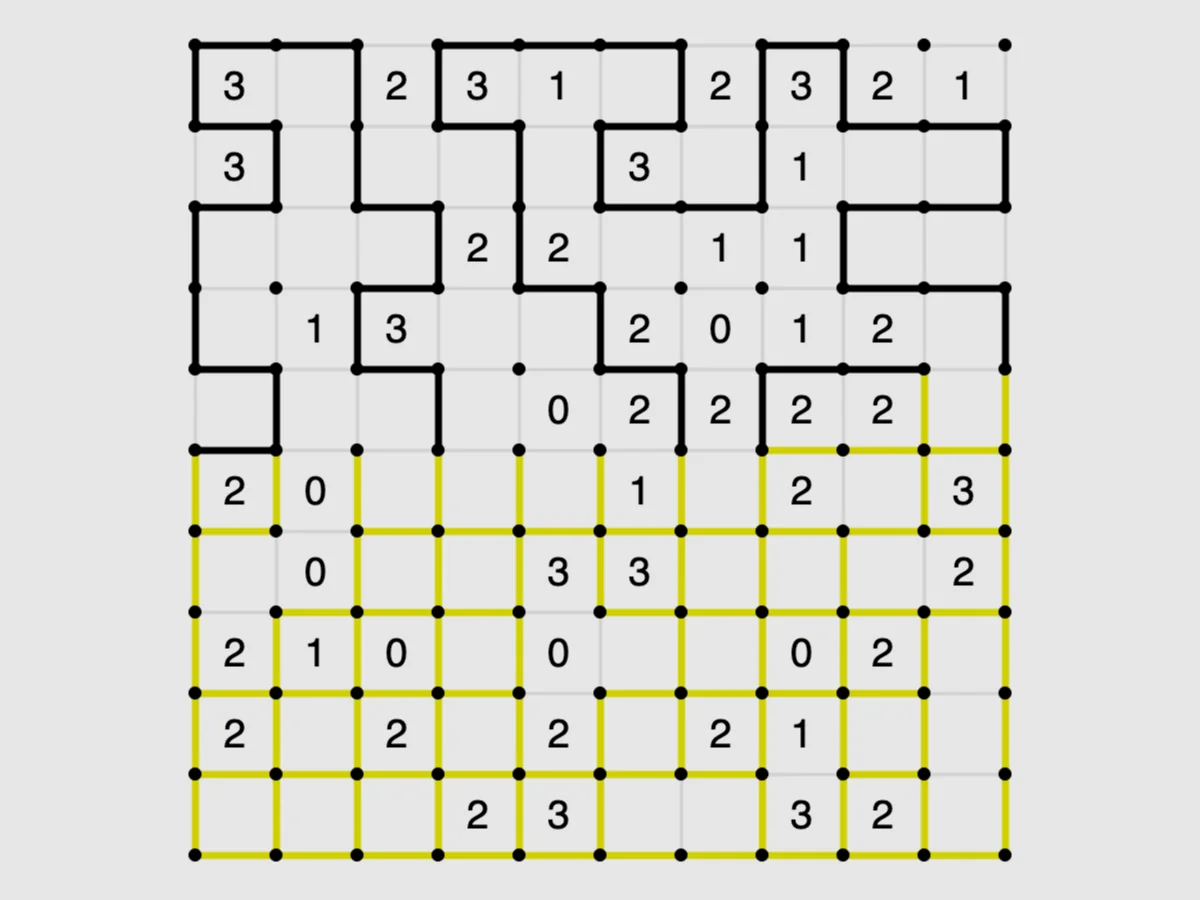
Saved games stay in this browser only.
About the puzzle
Loopy is a grid of dots joined by faint yellow lines, with numbers in some of the spaces between them. Your goal is to draw one closed loop, a single path that returns to where it started, by choosing some of those lines. Each number says how many of the lines around its space belong to the loop.
The puzzle comes from the Japanese publisher Nikoli, where it is known as Slitherlink. Mike Pinna wrote Loopy for Simon Tatham's collection in 2005, and Lambros Lambrou later extended it to play on all sorts of grids besides the square one: triangles, hexagons, Cairo pentagons, Penrose tilings and even the aperiodic "hat" and "spectre" tiles discovered in 2023.
Rules
- The loop runs along the grid lines, from dot to dot.
- It is a single closed loop: it never branches, never crosses itself and there is only one of it.
- A number in a space tells how many of the lines around that space are part of the loop.
- Spaces without a number can have any number of loop lines around them.
Controls
| Input | Action |
|---|---|
| Left click on a line | draw it as part of the loop (click again to return it to yellow) |
| Right click on a line | rule it out (click again to return it to yellow) |
| N / U / R | new game / undo / redo |
Lines you rule out are drawn faintly, so you can still see the grid. The game marks clear mistakes in red, such as a number with too many lines or a dot where the loop would branch.
How to solve it
Zeros first. A 0 means none of its sides is in the loop: rule them all out. On the square grid, a 3 next to a 0 is then forced into a fixed shape.
Every dot has 0 or 2 loop lines. This is the rule that drives everything. If a dot already has two lines, rule out the rest. If it has one line and only one other way to go, the loop must go that way. If it has no way out, rule out its last line.
Corners and the edge of the grid. On a square grid, a 3 in a corner of the grid uses both outer sides of the corner; a 1 in a corner cannot use them at all, so rule them out.
Two 3s side by side. Two adjacent 3s on the square grid always share their middle line and the two lines parallel to it, on both outer sides. Two 3s touching diagonally have their outer corners drawn.
Inside and outside. The loop divides the board into inside and outside. When you are stuck, pick a space and ask whether it is inside: crossing a loop line always switches sides, which can decide a line far away.
Rule out generously. Ruled-out lines are information, just like drawn ones. Mark every line you know is empty and the forced moves become visible.
Grids and difficulty
The Type menu has 7x7 and 10x10 square grids at Easy, Normal and Hard, and a long list of other tilings at Hard: triangular, snub square, Cairo, kites, Penrose, honeycomb, great hexagonal, kagome, octagonal, floret, several dodecagonal grids, hats and spectres. The square, triangular and honeycomb grids are the most regular and the least confusing; the others are worth trying once the basic rules feel natural. Custom sets the size, the grid type and the difficulty. In Preferences you can hide ruled-out lines completely or have the game follow forced paths automatically when you click.
Playing here
Click Play to open the puzzle. The menu above the board has New game, Restart, Undo, Redo and Solve (which you can undo to keep going on your own), the Type menu with the grids, and the Game menu, where you can type in a game ID or a random seed, download the current game as a file, load a saved file and change the preferences. Your game in progress is kept in this browser and comes back with its whole undo history the next time you open the page.
On a touch screen, a tap draws a line; turn on the Mark button above the board to rule lines out with your taps.
Credits and licence
Loopy was written by Mike Pinna and extended to other grids by Lambros Lambrou, for Simon Tatham's Portable Puzzle Collection, which Simon Tatham maintains with code contributed by several other authors and distributes with its source code under the MIT licence. This page runs a WebAssembly build made by FredyGames from the author's official source snapshot, with no changes to the puzzle; the source and the build script are hosted with the game, and the licence text is linked from this page.