
 Portugues
Singles (Simon Tatham's Puzzles)
Saved games stay in this browser only.
About the puzzle
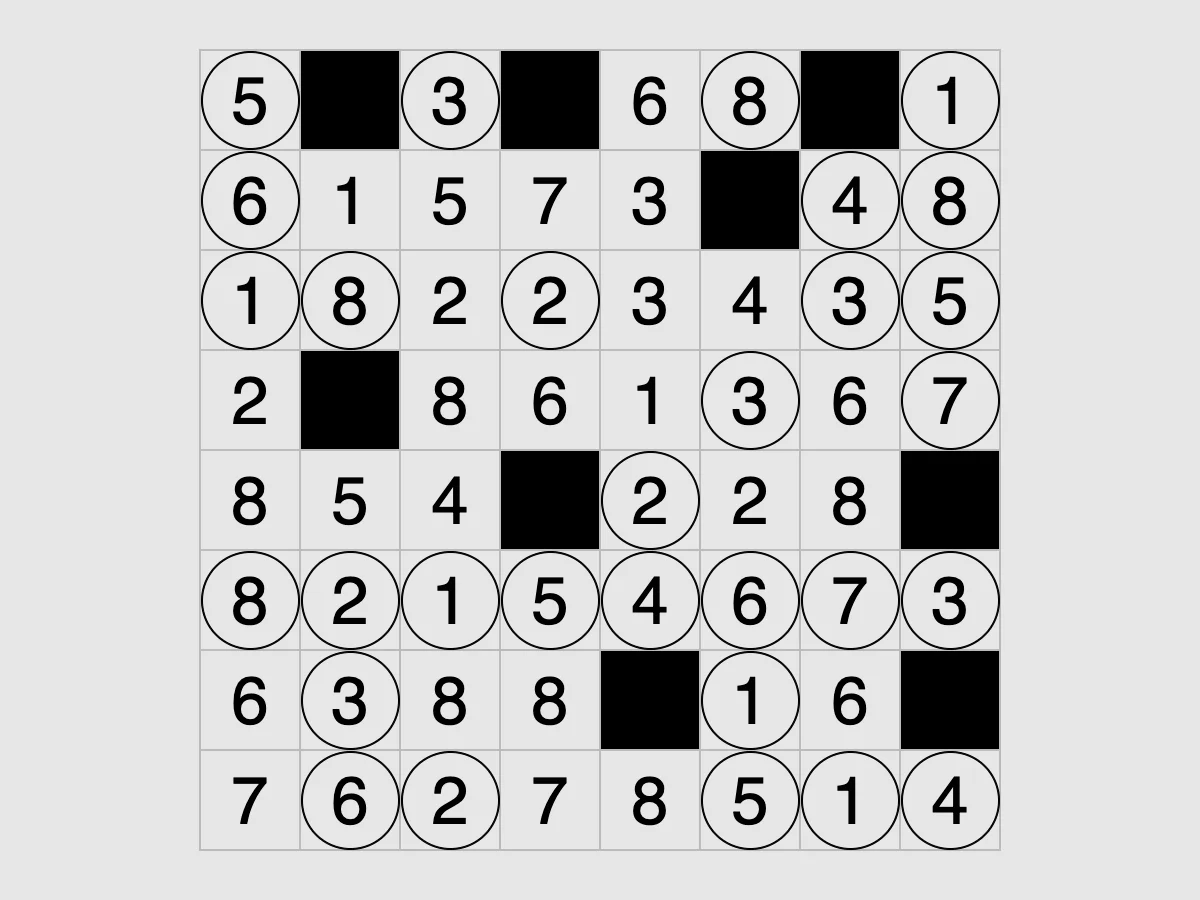
Singles starts with a grid full of numbers, with plenty of repeats in every row and column. You remove numbers by shading their squares black until each row and column has every remaining number only once. The catch is in the other two rules: black squares may not touch side by side, and the white squares left over must stay in one connected piece.
Credit for the puzzle goes to the Japanese publisher Nikoli, who call it Hitori. James Harvey wrote this version for Simon Tatham's collection.
Rules
- No number appears more than once among the white squares of any row or column.
- No two black squares are next to each other horizontally or vertically (touching at a corner is fine).
- All white squares form one connected area, joined through their sides.
Controls
| Input | Action |
|---|---|
| Left click on a square | shade it black, or restore the number |
| Right click on a square | add or remove a circle (this square stays white) |
| Click outside the grid | show the numbers on black squares in dark grey, or hide them |
| Arrow keys | move the cursor |
| Enter / Space | shade / circle the square under the cursor |
| N / U / R | new game / undo / redo |
Preferences can make the visible numbers on black squares the default.
How to solve it
Circle around every black square. As soon as a square is black, its four neighbours must be white. Circle them; any other copy of a circled number in the same row or column must then be black.
The sandwich. In a pattern like 4 7 4 in a row, the 7 in the middle is white. One of the 4s has to go, and if the 7 were black both 4s would have to stay white next to it.
A pair and a stray. If a row has two equal numbers next to each other and a third copy further along, the stray one is black: one of the pair must be black and the other white, and that white one already uses up the number.
Unique numbers are free. A number that appears only once in both its row and its column never needs to be shaded. Circling these early makes the rest easier to read.
Don't cut off the white area. A shading that would wall off a square or a group of squares from the rest is wrong, so the other choice is right. This matters most along the edges and in the corners, where a diagonal line of black squares can easily seal off a pocket.
Sizes and difficulty
The Type menu has 5x5, 6x6, 8x8, 10x10 and 12x12 grids at Easy and Tricky difficulty. Custom sets any width and height.
Playing here
Click Play to open the puzzle. The menu above the board has New game, Restart, Undo, Redo and Solve (which you can undo to keep going on your own), the Type menu with the sizes, and the Game menu, where you can type in a game ID or a random seed, download the current game as a file, load a saved file and change the preferences. Your game in progress is kept in this browser and comes back with its whole undo history the next time you open the page.
On a touch screen, tap a square to shade it; turn on the Mark button above the board to put circles instead.
Credits and licence
Singles was written by James Harvey for Simon Tatham's Portable Puzzle Collection, which Simon Tatham maintains with code contributed by several other authors and distributes with its source code under the MIT licence. This page runs a WebAssembly build made by FredyGames from the author's official source snapshot, with no changes to the puzzle; the source and the build script are hosted with the game, and the licence text is linked from this page.