
 Portugues
Slant (Simon Tatham's Puzzles)
Saved games stay in this browser only.
About the puzzle
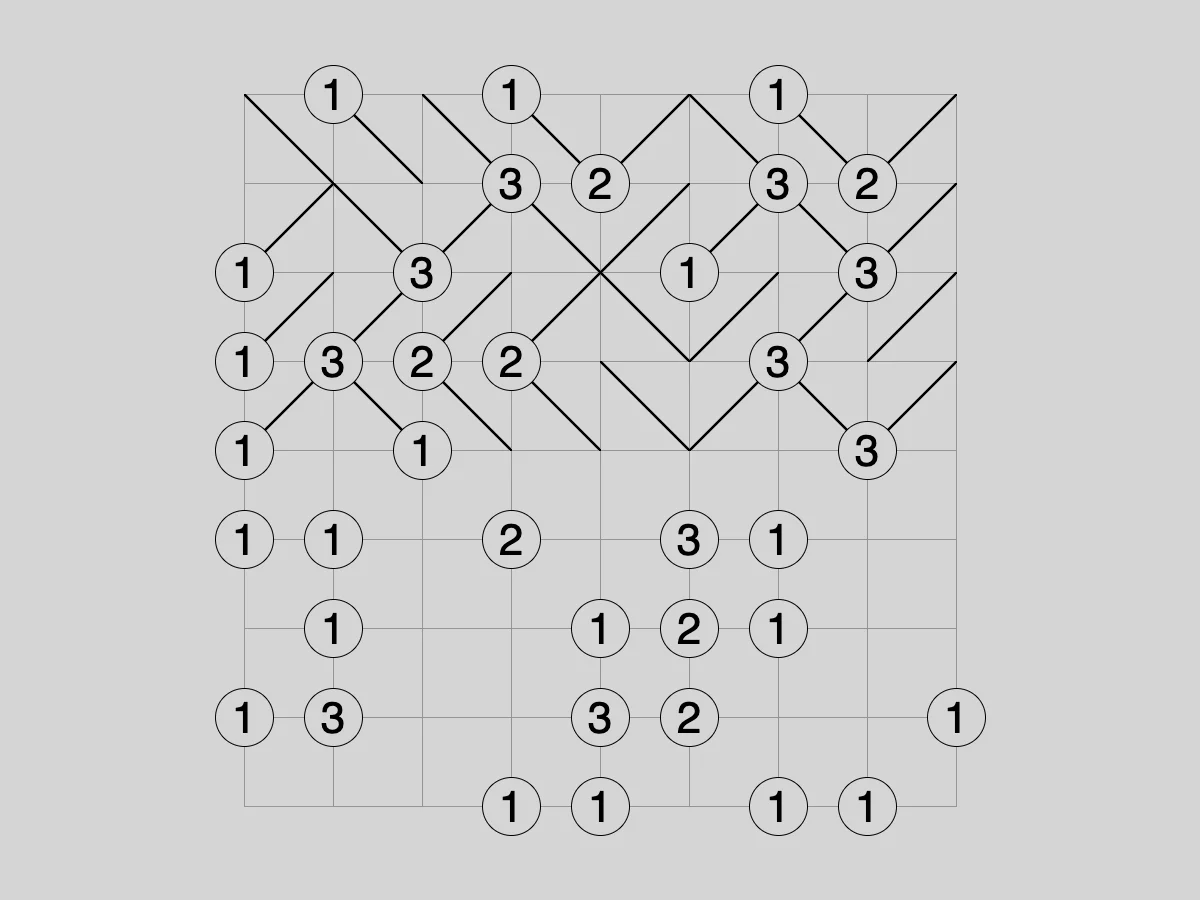
Slant gives you an empty grid with circled numbers on some of the points where the grid lines cross. Every square needs one diagonal line, either leaning one way or the other, and the numbers tell you how many of those lines touch each point. The other rule keeps it honest: the diagonals may never form a closed loop, so the finished picture is a tangle of branching paths, like a maze.
The puzzle comes from the Japanese publisher Nikoli, and it is also known as Gokigen Naname. Simon Tatham's version generates new grids of any size, at two levels of difficulty.
Rules
- Draw exactly one diagonal in every square, either \ or /.
- A circled number on a point is the number of diagonals that end at that point (from 0 to 4).
- The diagonals never form a loop of any size.
A point on the edge of the grid can touch at most two diagonals, and a corner point at most one. A 0 can never appear in the middle of the grid, because the four diagonals around it would form a diamond.
Controls
| Input | Action |
|---|---|
| Left click on a square | blank, then \, then /, then blank again |
| Right click on a square | blank, then /, then \, then blank again |
| Arrow keys | move the cursor |
| Enter / Space | cycle the square starting with \ / with / |
| \ and / keys | set that diagonal directly |
| Backspace | clear the square |
| N / U / R | new game / undo / redo |
Preferences can swap the mouse buttons. The game highlights a number that has too many or too few lines and any loop you close.
How to solve it
Edges and corners first. A 0 on the edge fixes its two squares to point away from it; a 1 in a corner fixes the corner square towards it, and a 2 on the edge fixes both squares towards it. A 4 in the middle fixes all four squares into a cross.
Count what is left. Each point in the middle touches four squares. When a number already has as many lines as it needs, the other squares around it must slant away; when it can only reach its number by using every remaining square, they all point at it.
Never close a loop. Before each diagonal, ask whether it would join two ends of the same tree of lines. If it would, the square must slant the other way. On a nearly finished board this rule decides many squares on its own.
Two 1s side by side. Two 1s next to each other along a grid line share two squares, and each of those squares sends exactly one line to one of the two points. Both 1s are therefore served by the shared pair, and every other square around them slants away.
Pairs of 3s. By the same count, two 3s next to each other in the middle get only two lines from the squares they share, so the four squares on their far sides must all point inwards.
Sizes and difficulty
The Type menu has 5x5, 8x8 and 12x10 grids at Easy and Hard difficulty. At Hard you sometimes have to reason about how two squares relate to each other before you know either of them, but guessing is never required. Custom sets any width and height.
Playing here
Click Play to open the puzzle. The menu above the board has New game, Restart, Undo, Redo and Solve (which you can undo to keep going on your own), the Type menu with the sizes, and the Game menu, where you can type in a game ID or a random seed, download the current game as a file, load a saved file and change the preferences. Your game in progress is kept in this browser and comes back with its whole undo history the next time you open the page.
On a touch screen, tap a square to cycle its diagonal; turn on the Mark button above the board to start the cycle with the other diagonal.
Credits and licence
Slant is part of Simon Tatham's Portable Puzzle Collection, written by Simon Tatham with code contributed by several other authors, and distributed with its source code under the MIT licence. This page runs a WebAssembly build made by FredyGames from the author's official source snapshot, with no changes to the puzzle; the source and the build script are hosted with the game, and the licence text is linked from this page.