
 Portugues
Twiddle (Simon Tatham's Puzzles)
Saved games stay in this browser only.
About the puzzle
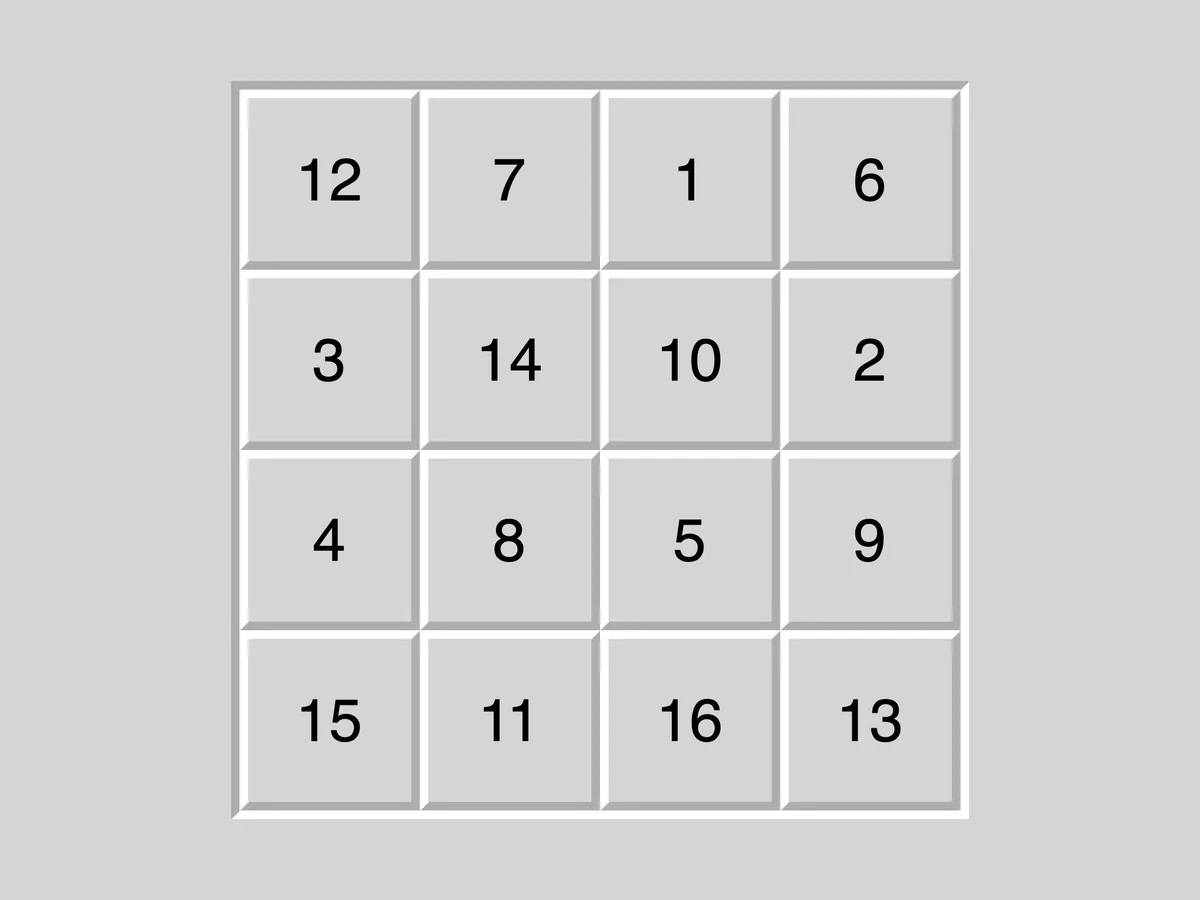
Twiddle shows a grid of numbered tiles in a jumble. Your only move is to grab a small square block of them, 2x2 at first, and turn it a quarter turn. Use those turns to put the numbers back in order, 1 in the top left corner and the highest number in the bottom right.
Simon Tatham came across a special case of this puzzle in the GameCube game Metroid Prime 2, where a door in the Main Gyro Chamber has to be unlocked by turning parts of it, and in 2005 he generalised it into a puzzle of its own for the collection.
Rules
- A move turns a square block of tiles a quarter turn about its centre, either clockwise or anticlockwise.
- The basic block is 2x2; harder settings turn 3x3 or larger blocks.
- The puzzle is solved when the numbers read in order from left to right and top to bottom.
- In the orientable versions, each tile also carries a triangle that turns with it, and every triangle must end up pointing up.
- In the rows only version, all tiles in a row share the same number, so only the rows matter: all the 1s go in the first row, the 2s in the second, and so on.
Controls
| Input | Action |
|---|---|
| Left click at the centre of a block | rotate it anticlockwise |
| Right click at the centre of a block | rotate it clockwise |
| Arrow keys | move the outline of the block over the grid |
| Enter / Space | rotate the outlined block anticlockwise / clockwise |
| N / U / R | new game / undo / redo |
The centre of a 2x2 (or 4x4) block is the corner point where its tiles meet; for a 3x3 block it is the middle tile. The status bar counts your moves.
How to solve it
Fill the grid from the top. Get the first row in place, then the second, using blocks that lie below the finished rows so you never disturb them. Each tile can be walked towards its home by turning blocks along the way.
Mind the last two rows. Once only two rows are left, every 2x2 block you turn touches both of them. Solve them a column at a time from the left, pairing the tile for the upper row with the one below it.
Use combinations that move only a few tiles. Turn one block clockwise, then a block that overlaps it by a single tile (its diagonal neighbour) clockwise, then turn the first block back and the second block back. Only three tiles change places. Two blocks side by side, done the same way, swap two pairs of tiles instead. These are the tools for the final corner.
In orientable mode, count the turns. Turning the same block four times brings every tile in it back to its place and upright. When the numbers are in order but triangles point the wrong way, look for short sequences that return the tiles to their squares but leave them turned.
Try short shuffles. In Custom you can ask for an exact number of shuffling moves. Undoing a three-move shuffle in three moves is a good way to learn how the turns combine.
Sizes
The Type menu has 3x3 grids in rows only, normal and orientable versions, 4x4 normal and orientable, a 4x4 grid with 3x3 blocks, a 5x5 grid with 3x3 blocks and a 6x6 grid with 4x4 blocks. Custom sets the width, height, block size, the rows only and orientation options, and an optional exact number of shuffling moves.
Playing here
Click Play to open the puzzle. The menu above the board has New game, Restart, Undo, Redo and Solve (which you can undo to keep going on your own), the Type menu with the sizes, and the Game menu, where you can type in a game ID or a random seed, download the current game as a file, load a saved file and change the preferences. Your game in progress is kept in this browser and comes back with its whole undo history the next time you open the page.
On a touch screen, tap the centre of a block to turn it anticlockwise; turn on the Mark button above the board to turn blocks clockwise.
Credits and licence
Twiddle is part of Simon Tatham's Portable Puzzle Collection, written by Simon Tatham with code contributed by several other authors, and distributed with its source code under the MIT licence. This page runs a WebAssembly build made by FredyGames from the author's official source snapshot, with no changes to the puzzle; the source and the build script are hosted with the game, and the licence text is linked from this page.