Portugues
Smiley
Saved games stay in this browser only.
About the game
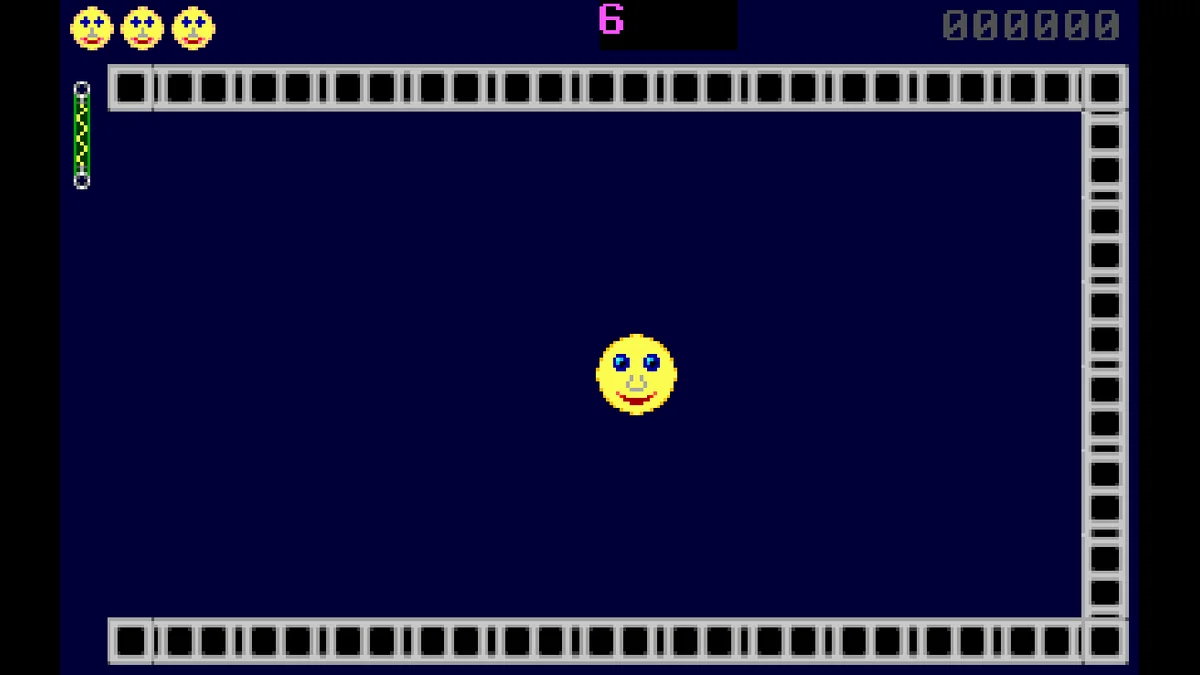
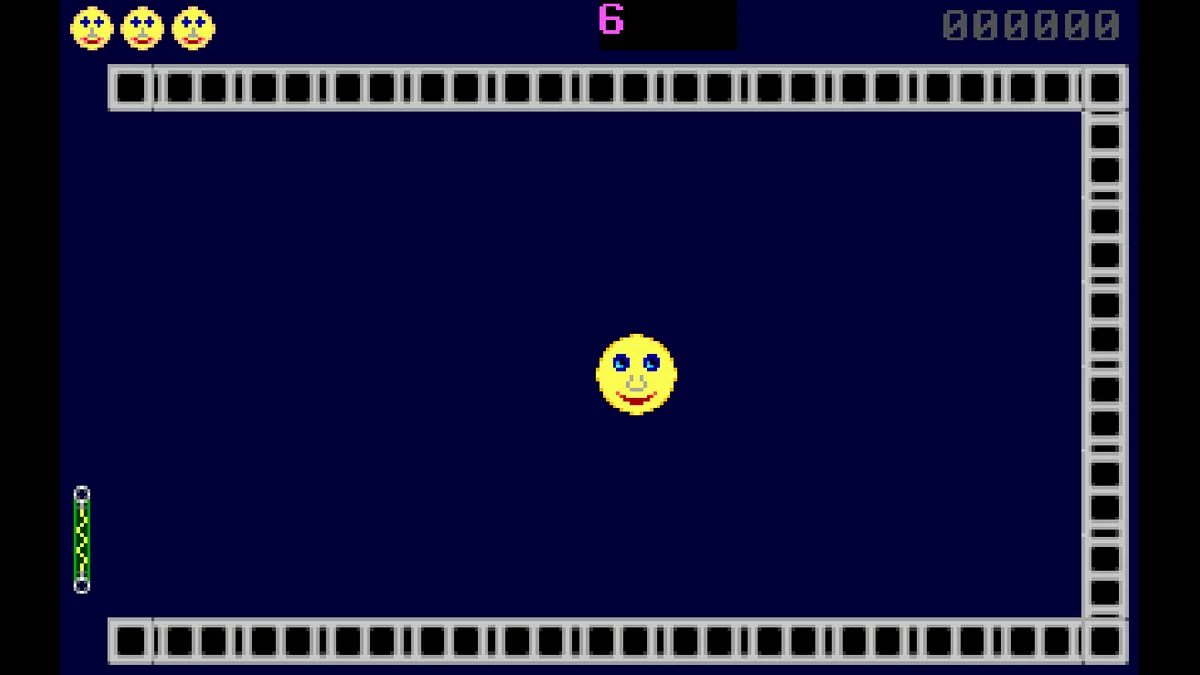
Smiley is Pong for one. A yellow smiley face bounces around a box with walls on three sides, and the fourth side, on the left, is yours: a short paddle that slides up and down. Every time the smiley comes back you have to be there; if it gets past the paddle, you lose one of the smileys shown in the top-left corner.
The walls are not just walls. When the ball hits one, it shakes for a moment and the hit adds to your score, shown at the top right, and returning the ball with the paddle scores too. As the score grows the game speeds up, and every 250,000 points brings an extra life, up to six. You start with three.
Jerome Shidel made Smiley in 2021 as a test bed for the Danger Engine, his own graphics and game engine for DOS, and the author calls it an alpha: a short, simple game rather than a finished product. It is still a pleasant few minutes of reflexes, and the mouse makes the paddle feel direct and quick.
Playing it here
Click Play. The box appears with the smiley waiting in the middle. Click inside the game (or press Space) to launch it, then move the mouse up and down to follow it. On a phone or tablet, tap to launch and slide your finger up and down to steer.
Controls
| Input | Action |
|---|---|
| Mouse up / down (or Up / Down keys) | move the paddle |
| Click / Space | launch the ball |
| Esc | quit |
A few things worth knowing
Watch the angle, not the ball. The smiley moves in straight diagonal lines, so after a bounce off the top or bottom wall you can tell where it will come back and be there early.
Keep the paddle near the middle. From the centre you reach both ends of the side in time; waiting near one corner leaves the other one open.
The pause between lives is short. After a miss the smiley returns to the middle and waits for a click, so take a breath before launching it again.
FAQ
What happens when I run out of lives? The game ends and you are back at the DOS prompt. Type SMILEY and press Enter to play again, or reload the page.
Does it keep a high score? No, the score is only shown during the game.
Why is it so short? It is an early alpha made to test the engine, and the author published it as such in the FreeDOS software repository.
Credits and licence
Smiley was written by Jerome Shidel and released under the BSD 3-Clause licence; the source is in the FreeDOS package and on GitLab. It runs here in js-dos (DOSBox), from the package in the FreeDOS 1.3 software repository.
Screenshots