
 Portugues
SolarWolf
Saved games stay in this browser only.
About the game
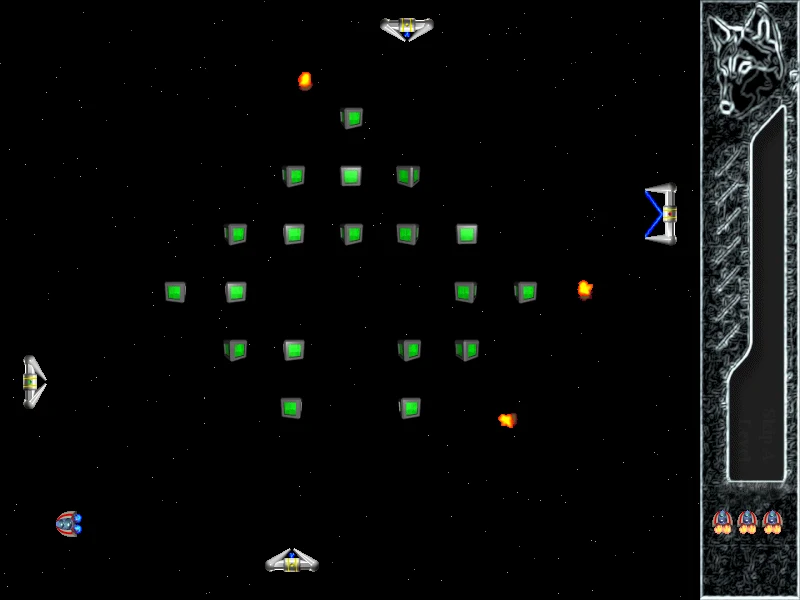
SolarWolf is an arcade game of nerves, in the spirit of the old Atari classic that inspired it. Each level is one screen of deep space with a pattern of glowing power cubes in the middle. Your job is to fly the ship over every cube before the level ends. There are no weapons: the only thing your ship can do is steer, and the guardians that sit at the edges of the screen shoot at you the whole time. Bullets come in lines and arcs, and the later levels add asteroids that crash through the screen, mines that can pop up anywhere and guardians that fire from point-blank range.
The ship never stops. Press a direction and it flies that way until you pick another one or reach the edge of the screen, so the game is all about timing: where the next volley will pass, which cube you can reach before it does, and when to turn. Some cubes are coloured and need more than one touch. Green power-ups drift in now and then and give you a shield, a burst of slow motion, a spare ship, a shot blocker that clears the screen of bullets or a bomb that blows up a guardian.
There is a big red timer on the right of the screen. If you clear a level before it runs out, the next level is skipped, so the best players can get through the sixty levels in a fraction of the time. Pilots who finish the whole game go into the hall of fame on the title screen.
Playing it here
The first time you click Play the page downloads the Python runtime and the pygame library (about 23 MB), which takes a few seconds; after that a "click to start" message appears, and one more click opens the game. Nothing is loaded from other sites. Your pilot names, how far each pilot has got and the sound settings are saved in this browser only.
This version differs from the original in a few small ways: the news page, which fetched news from the internet, and the Quit and Fullscreen options are gone, because a web page has no network and nothing to quit to or to make fullscreen. The music, which was written for a tracker program, was converted to a format the browser can play.
Controls
| Key | Action |
|---|---|
| Arrow keys (or H, J, K, L) | fly the ship |
| Space (hold) | Hyper Jets: fly faster |
| Space or Enter | choose in the menus |
| P | pause |
| Esc | go back |
A few things worth knowing
Plan the route, not the next step. Since you cannot stop, look at where you will be in two or three turns and which cubes you will leave behind. A good path takes the cubes on the edge of the pattern first.
Use the Hyper Jets in short bursts. Holding Space makes the ship faster, which helps to cross the screen between volleys, but it is also easier to overshoot a turn. The shield power-up makes you faster as well.
Take the power-ups when they are close. The bullet-time power-up is the best way to pass a level with a crowd of bullets, and the shot blocker is a life saver when the screen is full.
Try for the skip. Clearing a level before the red timer runs out skips the next one, which saves you from one of the hardest levels and is how you finish the game with ships to spare.
Frequently asked questions
Does it save my progress? Yes. When you reach a level you can continue from, the game asks for a pilot name, and the pilot, the level and the ships are saved in your browser. Pick the same name on the next visit.
Does it work on a phone? It needs a keyboard, so it is meant for a computer.
Is it free? Yes: the game is free software under the LGPL, the graphics under the GPL.
Credits and licence
SolarWolf was made by Pete "ShredWheat" Shinners, with graphics by Eero Tamminen, music by "theGREENzebra" and code help from Aaron "APS" Schlaegel and Michael "MU" Urman. The code is released under the GNU LGPL 2.1 and the graphics under the GNU GPL 2. The version served here is the one that Debian packages for Python 3 (their patches are included), without the Atari screenshot that was on the credits screen and with a few more changes to run in a browser; the complete source, the changes and the licence texts are linked from the Licenses page. The game runs on pygame-ce (LGPL-2.1) and CPython, whose licences and source are linked there too.