
 Portugues
Tafl Variants
Saved games stay in this browser only.
About the game
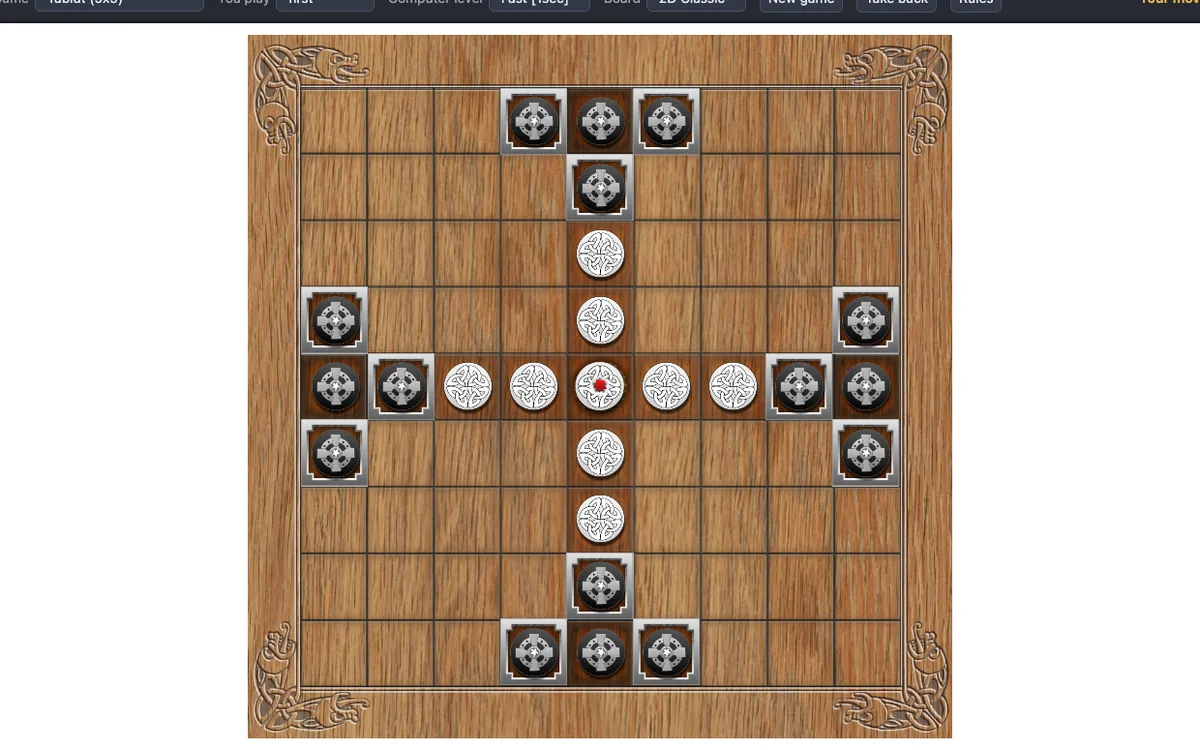
Tafl games are old board games of the Norse and Celtic peoples, played for centuries across northern Europe. They are asymmetric: a king with a small band of defenders sits in the middle of the board, and a larger army of attackers surrounds them. The defenders win if the king escapes to the edge of the board, and the attackers win if they capture him. Few of the original rules survive in writing, so every version here is a modern reading of the old games.
| Game | Board | Notes |
|---|---|---|
| Brandubh | 7x7 | The Irish game, small and quick; pieces move one square at a time. |
| Tablut | 9x9 | The Sami game, from Lapland. |
| Hnefatafl | 11x11 | The large Viking board, with many pieces. |
| Ard Ri | 7x7 | A Scottish relative of Brandubh; pieces move one square at a time. |
| Tawlbwrdd | 11x11 | The Welsh game. |
| Alea Evangelii | 19x19 | The big Anglo-Saxon board with a large army. |
Pieces move like a rook in chess, any number of empty squares in a straight line (in Brandubh and Ard Ri, one square only). A piece trapped between two enemy pieces, on opposite sides, is taken, and the king is captured when four attackers surround him. The central square is the king's throne: only the king can stop on it, and it counts as hostile to everyone when empty. A draw is called when the same sequence of moves is played three times.
Playing it here
This page runs Jocly, a free library of board games with a computer opponent that thinks in the background while you wait. Pick a game in the Game menu at the top; You play chooses first, second or both sides (to play against a friend on the same screen), Computer level sets how hard the computer thinks, and New game starts again. Take back undoes your last move together with the reply, and Rules opens the rules of the game you picked. Everything runs in your browser and nothing is sent anywhere. Your choices (game, side, level and board) are kept in this browser; clearing the site's data erases them. The game is in English and has no sound.
Controls
| Input | Action |
|---|---|
| Click or tap a piece, then a marked square | move the piece |
| Game menu | choose the game |
| You play | the first side, the second or both |
| Computer level | from quick replies to longer thinking |
| Board | switch between the board looks |
| Take back | undo your last move and the reply |
Tips
As the king's side, aim for open lines. One clear line to an edge forces the attackers to answer, and two at once win the game.
As the attackers, close the corners and edges first. Build a ring rather than chasing the king around, and keep your pieces in pairs so they cannot be trapped one by one.
Watch for the sandwich. A piece you move between two enemy pieces is safe; one that is left there on their turn may not be.
Credits
Jocly was made by Michel Gutierrez, who wrote the games and the computer player, and Jérôme Choain, who did the graphic design, and it is free software under the GNU Affero General Public License. Only the flat boards of the library are used here, not its 3D views, and its sound files are left out.
FAQ
Which side moves first? It depends on the game; the page shows whose move it is, and You play lets you choose whether you take the defenders or the attackers.
Why do the rules differ from what I read elsewhere? The historical rules are not fully known, and Jocly uses one modern interpretation of each game.