
 Portugues
Backgammonics
Saved games stay in this browser only.
About the game
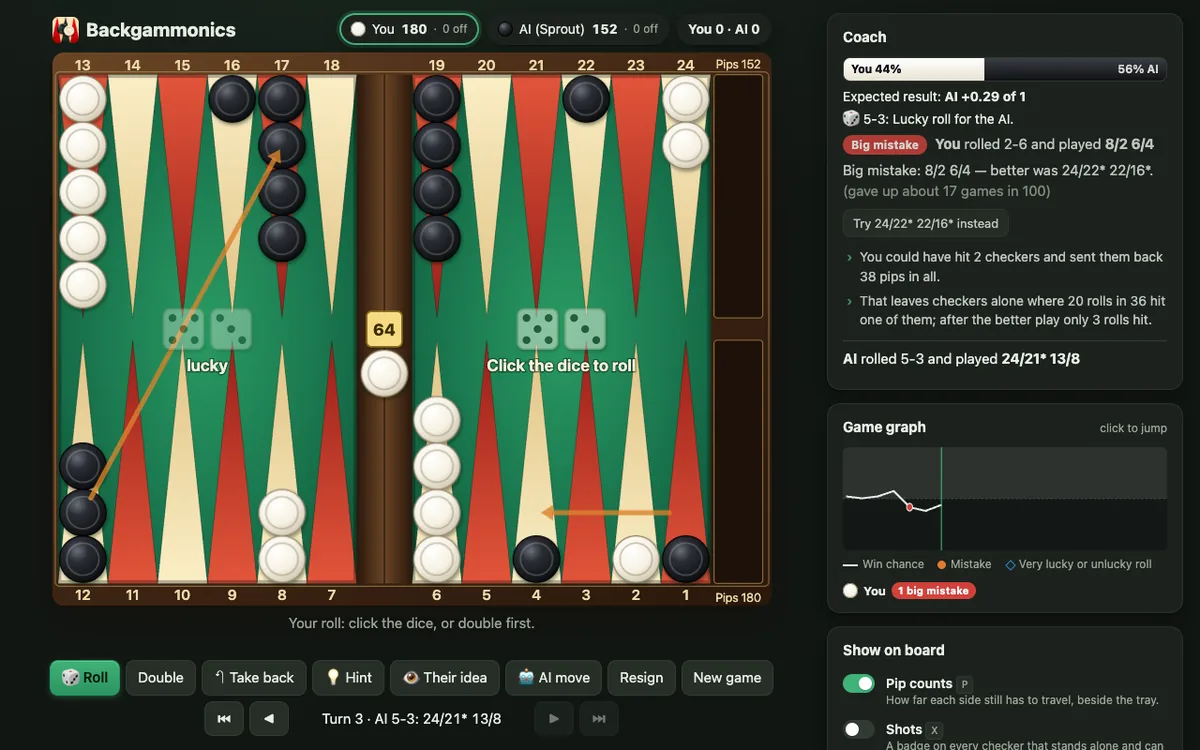
Backgammonics is backgammon built to teach. You play the light checkers against an AI, and beside the board a coach follows every move: a bar shows who is winning, each of your plays gets a grade from Best to Blunder, and when something goes wrong the coach says why in plain words. You left a checker where 20 of the 36 rolls hit it; you could have hit two checkers and sent them back; the race is now yours. Point at its suggestion to see the better play on the board, and click it to play that instead.
The AI comes in nine levels, from Pebble, which has just learned the rules and hits whenever it can, to Phoenix, which reads two moves ahead and considers more candidates. Every level is the neural network of GNU Backgammon, the free program long used by strong players to study the game, rebuilt to run inside your browser; the lower levels are held back on purpose so that their mistakes look like a learner's. Win a game and the next one is a level up; lose and it steps down.
The doubling cube is in, and the coach grades your doubles, takes and passes too. If you would rather leave it out, switch it off when you start a new game.
Backgammonics was made by Frank Force in 2026 and released as free software.
Playing it here
This is the game as its author publishes it, unchanged. Everything runs in your browser, the AI included, and nothing is sent anywhere. Your current game, the score against the AI and your settings are kept in this browser; clearing the site's data erases them. Save game and Load game in the settings keep a game as a file. The game is in English.
Controls
| Input | Action |
|---|---|
| Click the dice, or Space | roll |
| Click a ringed checker, then a ringed point | move a checker |
| Backspace | put the last checker back |
| U | take back the whole move |
| D | offer the doubling cube (T takes, P passes when you are offered one) |
| H | hint: the coach's best plays for your roll |
| O | their idea: what the AI hopes to roll next |
| Tab, then the arrow keys and Enter | play from the keyboard |
The letter keys P, X, M, V, L, B, G and N switch the board overlays (pip counts, shots, points to make, destinations and more). Speak announcements in the settings reads every roll, move and comment aloud.
The rules in short
Each side has 15 checkers and moves them around the board towards its home board, then bears them off; the first to take all 15 off wins. Each die is a separate move, and doubles are played four times. A checker can land on an empty point, on its own checkers, or on a single enemy checker, which is hit and goes to the bar; it can't land on a point held by two or more enemy checkers. A hit checker must come back in, in the other side's home board, before anything else moves.
A game won before the loser has borne off a single checker is a gammon and counts double. The doubling cube lets either player raise the stake before rolling: the other side can take and play on for twice as much, or pass and lose at the old stake.
The game itself has a one-minute guide to the rules and short lessons on hitting, making points, the race, bearing off and the cube, under Learn.
Tips
Watch the shots. Turn on Shots (X) and every checker standing alone shows how many of the 36 rolls hit it. Leaving fewer shots is often worth more than moving faster.
Make points in your home board. Each point you hold there makes it harder for a hit checker to come back in. Points next to each other build a wall the other side has to get past.
Tell bad moves from bad dice. The coach marks very lucky and unlucky rolls on the game graph, so a lost game doesn't have to mean you played badly. After each game, Key moments picks the few decisions most worth a second look.
Try it yourself first. With Find better moves yourself on, the coach won't name its play after a mistake: you get another try first.