
 Portugues
Blasphemer
Saved games stay in this browser only.
About the game
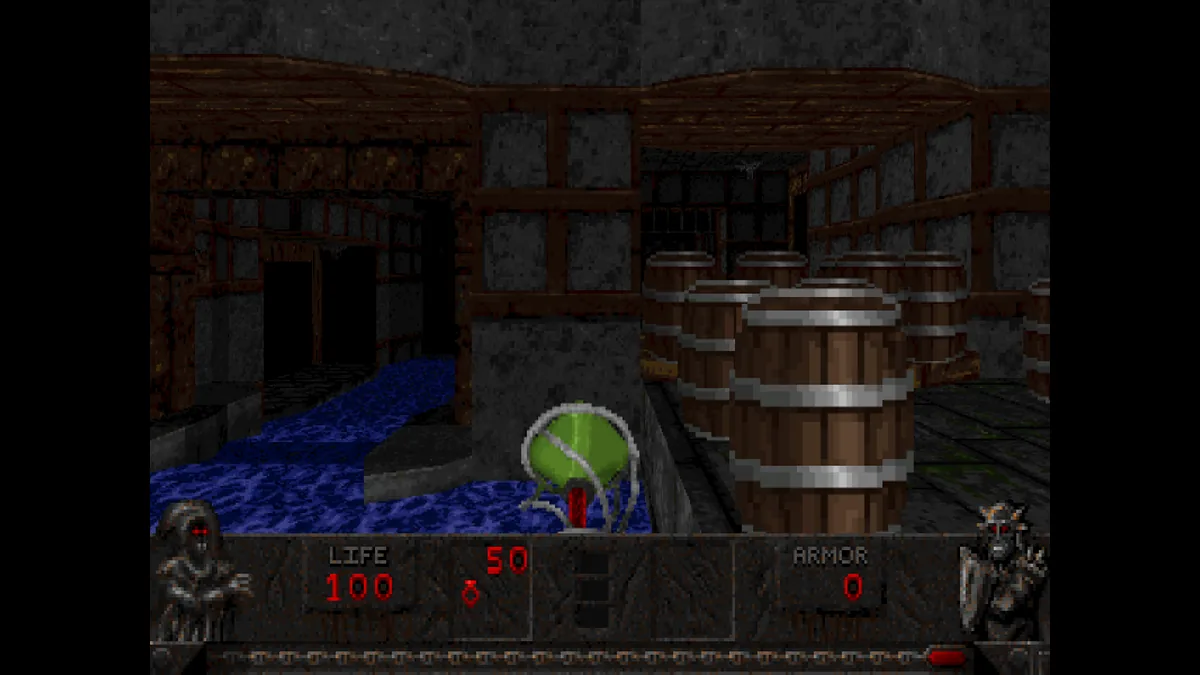
Blasphemer is a first-person shooter in the style of the 1990s: you walk through big, twisting levels, look for coloured keys to open doors, find secrets and fight everything that moves. Instead of guns it has magic and relics: claws and blades up close, a crossbow that fires plague bolts, a rod that throws fire, and a few stranger things you will find along the way. The look is dark fantasy with a metal-album mood, with a red gothic title, black stone, torches and a cast of nasty creatures.
It is a community project. Since 2010, volunteers have been drawing the graphics, recording the sounds, composing the music and building the levels so that fans of this kind of game can have a complete adventure that is free for everyone to share. Every level is the work of a different map maker, so no two of them look alike.
The game has three episodes, with 25 levels in all. The two secret levels of the second and third episodes are still small empty rooms, which the project has not filled yet. Many levels are big and take some exploring, so it is a good idea to take your time.
Playing it here
Click Play now and the game downloads (about 7 MB) and starts on its title screen: press Enter for the menu, choose New Game, an episode and a skill level. Saved games and settings stay in this browser. Music and sound start as soon as the game does.
The engine is Crispy Doom 7.2, built for the browser without any changes to its code. It runs the original rules of this kind of game, but without the old limits that made big levels crash in older engines. The game data is the official Blasphemer release 0.1.8, from which we removed the unfinished episodes (they only had deathmatch maps or empty rooms).
Some of the messages and menu texts (the names of the episodes, of the weapons and ammunition, of the pickups and the skill levels) come from the engine, so they are not the ones the project wrote for its own items. It is only the text on screen: the levels, graphics and sounds are all Blasphemer's.
On a Mac, Ctrl with the arrow keys may switch desktops instead of firing. Fire with the mouse instead: click inside the game first.
Controls
| Key | Action |
|---|---|
| Arrow keys | move forward and back, turn |
| Ctrl / left mouse button | fire |
| Space | open doors, press switches |
| Shift (held) | run |
| Alt + arrows, or , and . | strafe |
| 1 to 7 | pick a weapon |
| Enter | use the selected artifact |
| [ and ] | choose an artifact |
| Tab | automap |
| F2 / F3 | save / load |
| F11 | brightness |
| Esc | menu |
A few things worth knowing
Keys open the way. A coloured door needs the matching key, found somewhere else in the level. If a door will not open, the key is behind you.
Use the automap. Tab shows everything you have seen. Doors you skipped and corridors you did not follow are where the keys and secrets are.
Artifacts are your emergency kit. Healing flasks, a protective shield, a cloak and a tome that makes your weapons stronger turn up in pickups; choose one with [ and ], use it with Enter, and keep some for the bigger fights.
Walls can hide rooms. A texture that looks a little different, or a corridor that seems to lead nowhere, often opens with Space.
Save often. F2 saves into one of six slots, and the levels are long.
Frequently asked questions
How long is it? There are 25 levels in three episodes, and many of them are big, so it is a long game if you explore.
Are the saves kept? Yes, in this browser. They do not follow you to another browser or device, and clearing the site's data erases them.
Does it work on a phone? It needs a keyboard, or at least a mouse.
Is it free? Yes. The game data is released under the 3-clause BSD licence and the engine is free software under the GNU GPL; the source code of the engine is available from this page.
Credits and licence
Blasphemer is made by the Blasphemer project and its many contributors; the list is in the licence text linked from this page. The game data is released under the 3-clause BSD licence. The engine, Crispy Doom, was created by Fabian Greffrath and contributors from Chocolate Doom, by Simon Howard and contributors, and is free software under the GNU General Public License, version 2 or later. The licence texts and the complete source code of the engine are linked from this page.