
 Portugues
Cellular: Automata
Saved games stay in this browser only.
About the game
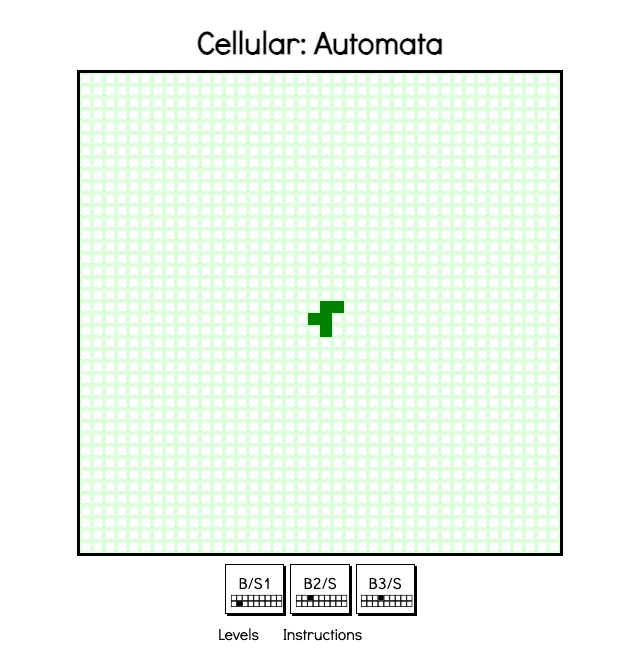
Conway's Game of Life is a grid of cells that live or die by a simple rule: a living cell with two or three living neighbours survives, and an empty cell with exactly three neighbours becomes alive. Cellular: Automata turns that rule into a hand of cards.
Each card shows a rule in the usual short notation. The digits after the B (birth) say how many living neighbours make a new cell appear in an empty square, and the digits after the S (survival) say how many a living cell needs to stay alive. So the card B3/S23 is the classic rule, and B2/S is a rule where a cell never survives, and new ones appear where an empty square has exactly two neighbours. When you play a card the whole grid is updated once with that rule, and the card is used up.
The goal is to play every card in an order that leaves at least one cell alive. If the grid goes empty before you run out of cards, you lose, and you can undo or restart. The first puzzles have a few cards and a tiny pattern. The game also has a level editor of sorts: you can paste your own levels, or a whole pack, into a text box.
The author made it for Ludum Dare 46, after the news that John Horton Conway, the inventor of the Game of Life, had died.
Playing it here
The game is played with the mouse or a finger and runs in the page. It remembers the level you were on and the solutions you found in this browser's storage. It is a tiny download, about 40 kB. The interface is in English; the Instructions button explains the cards.
Controls
| Input | Action |
|---|---|
| Click / tap a card | play that rule on the grid |
| Levels | choose a puzzle (or add your own) |
| Undo | take back the last card |
| Restart | start the level again |
Tips
Think about the next state, not only the current one. A card changes the whole grid at once, so look at what each of your cards would do to the cells that are alive right now.
Order matters. The same cards in a different order can give a different result. If one order kills everything, try the cards in another order before giving up.
Use Undo. It is free, and it lets you test an order and look at the grid.
Credits and licence
Cellular: Automata was made by Ilya Baturinsky (baturinsky) for Ludum Dare 46 and released under the MIT licence. The page is built with Preact (MIT) and the font is Didact Gothic by Daniel Johnson (SIL Open Font License 1.1); both licences are in the text linked from this page. In this version the stylesheet no longer points to a copy of the font on a Google server, and the page has a policy that blocks any request outside this site. The source, the patch and the build script are linked from this page.
FAQ
What do the letters and digits on a card mean? B is "born" and S is "survives". B3/S23 means an empty cell with three living neighbours is born, and a living cell with two or three neighbours survives.
Does it save my progress? Yes, in this browser's local storage: the last level you opened and the solutions you found.
Can I add my own levels? Yes, there is a text box for custom levels in the level list.