
 Portugues
Cinderbelt
Saved games stay in this browser only.
About the game
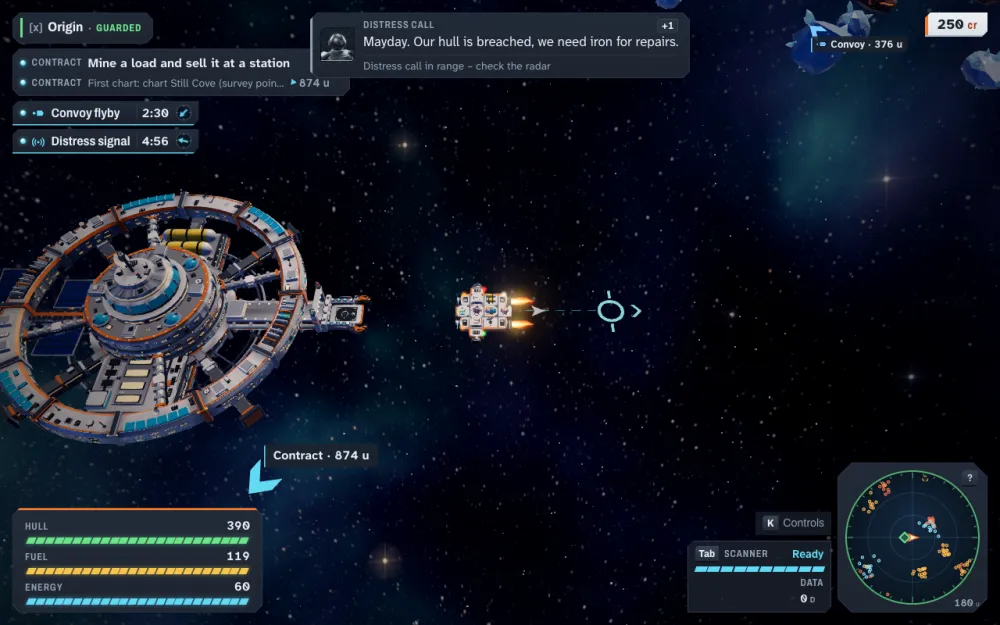
Cinderbelt is a top-down space game in 3D. You start docked at Origin Base with a small training hull and a little money, and the rest is up to you: mine ore and ice from asteroids with a laser that overheats if you hold it too long, sell the cargo at a station, and put the credits into a better ship. The ship is not a menu choice. You assemble it yourself on a grid in the shipyard from engines, gyroscopes, cargo holds, reactors, weapons and armour plates, and the game simulates the result as a single body, so where you place an engine or a heavy cargo hold changes how the ship turns, drifts and stops.
Space is an endless universe built from a seed and divided into named sectors, each with its own security level (Quiet, Guarded, Contested, Pirate), sky and music. There are trade convoys to join, contracts to carry out (deliveries, mining, hunting, rescue, survey, escort), derelict stations and ship graveyards to explore with the scanner, and a sector map where you leave your own notes. Pirate clans fly ships built from parts just as yours is, so a lucky shot can sever a section from a hull and leave it floating as a wreck you can tow and salvage. Progress comes from a research tree and from your home station, a hangar for several ships and four death penalties, from "lose nothing" to hardcore.
The author says the game is "early but playable", and it is large for a game that runs in a page. The design, code, models and music were produced by the author directing AI coding agents (the project says so in its own README). The art is built by scripts and the adaptive music is composed by code, so there are no samples or photographs from anywhere else.
Playing it here
Click Play, wait for the models to load (about 60 MB, then cached by your browser), and choose New game. The first choice is the difficulty and the death penalty, then an optional universe seed (the same seed makes the same universe) and one of four save slots. The Guild training teaches flying, mining and building a ship in about fifteen minutes, and you can skip it. The game is in English, Slovak and German; the language buttons are at the bottom right of the menu. Saves go to this browser, you can also export one to a file, and F5 saves at any moment. It is made for a keyboard and a mouse on a computer with a decent graphics card.
Controls
| Key | Action |
|---|---|
| W / S | thrust forward / back |
| A / D | turn |
| Q / E | strafe |
| Mouse + left button | fire the cannons |
| Mouse + right button | mining laser |
| Z | inertial dampers on or off |
| F | dock, undock, salvage |
| Tab | scanner (tap to pulse, hold to analyse) |
| T | tractor beam: grab or release |
| Y / X | pay or refuse a pirate toll |
| M / J / L / G / I | map / journal / radio log / objectives / storage |
| H | tow when out of fuel |
| Mouse wheel | zoom |
| F5 | save |
| Esc | pause |
| K | show or hide the controls help |
In the shipyard, R rotates a part, M mirrors the layout, C centres the view and Home shows the top view.
A few things worth knowing
The first trip is short. Undock, mine the nearest rock, come back and sell. Ice is also your fuel (one ice makes two fuel), so keep some in the hold.
Dampers are your brakes. Z switches the inertial dampers. With them on the ship slows down by itself; with them off it keeps drifting the way it was going, which is useful for sweeping past a target but harder to park.
Pirates are fought by parts. Shots hit the part they reach and shields absorb first, so put armour in front of the parts you cannot afford to lose.
Choose your risk. The death penalty and the number of enemies are set when you start a game and cannot be changed later.
Credits and licence
Cinderbelt was made by the Cinderbelt contributors (the repository is at github.com/amoreo140/cinderbelt). The code is under the MIT licence. All of the art (models, textures, icons, skyboxes) and the music are under the Creative Commons Attribution 4.0 licence: "Cinderbelt contributors, https://github.com/amoreo140/cinderbelt, CC BY 4.0". The fonts, Archivo and Atkinson Hyperlegible Next, are under the SIL Open Font License 1.1, and three.js and Preact are under the MIT licence. The texts are linked from this page. This version was built from the author's source with only three changes: the page contains just the game (no sound lab or style guide pages), it cannot make any network connection outside this site, and the error card no longer links to the project's issue tracker.