
 Portugues
Colour Chained
Saved games stay in this browser only.
About the game
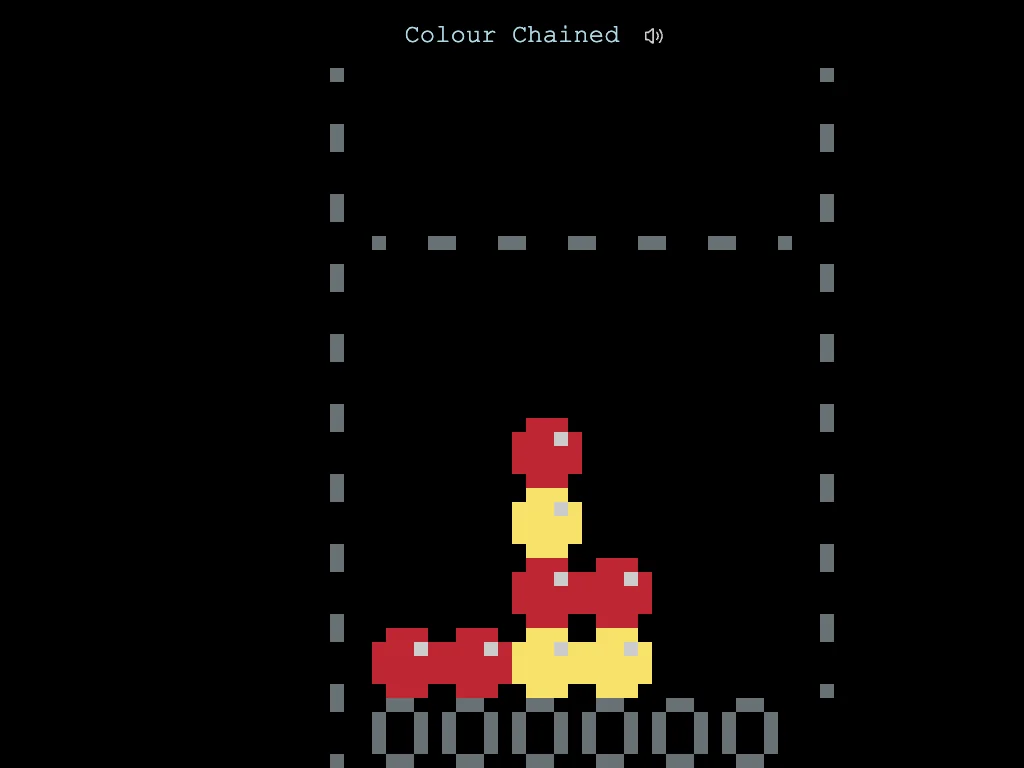
Colour Chained is a puzzle about falling pairs of coloured balls. Each level starts with a few balls already sitting in a narrow well, and a pair waits at the top. You slide the pair left or right, turn it and let it fall; when three or more balls of one colour touch, they disappear and everything above them drops, which can set off a chain. Your job is to clear every ball from the board using the pairs you are given, and the preview area shows the one that comes next.
It is a set of small puzzles rather than an endless stacker: there are eleven boards, from a handful of balls in two colours to crowded wells with four, and each is built so that only a careful placement clears it. The game keeps a score counter at the bottom, and an endless mode opens once the levels are done. The whole game is a short text file for the PuzzleScript engine, and its look comes from the engine's own pixel graphics.
Playing it here
Click Play and press X to start. Your progress is kept in this browser, and the game picks up at the level where you stopped. On a phone or tablet, on-screen buttons appear. Nothing is sent anywhere.
Controls
| Input | Action |
|---|---|
| Left / Right (or A / D) | move the falling pair |
| Up or X | rotate the pair |
| Down (or S) | drop the pair |
| R | restart the level |
| X, C or Space | continue past a message |
A few things worth knowing
Look at the preview. The pair waiting above the well is the one you get next; plan two drops ahead.
Do not top out. If a ball ends up on the border above the well, the level is lost; press R and try again. This game has no undo.
Use the chains. Balls above a vanished match fall and can match again, which is often how the last stragglers go.
Credits and licence
Colour Chained was made by Dennis Au and published under the MIT licence in the repository mechturk/PuzzlescriptGames. The licence text, together with the licence of the engine, is linked from this page. The page is the standard standalone export of the PuzzleScript engine (MIT, Stephen Lavelle) with the game text inside; we only removed the link to the author's site and the "hack" button, which would send the code to another site, and replaced the one small part of the engine that was under another licence (GPL) with our own code.