
 Portugues
Cursed Elevator
Saved games stay in this browser only.
About the game
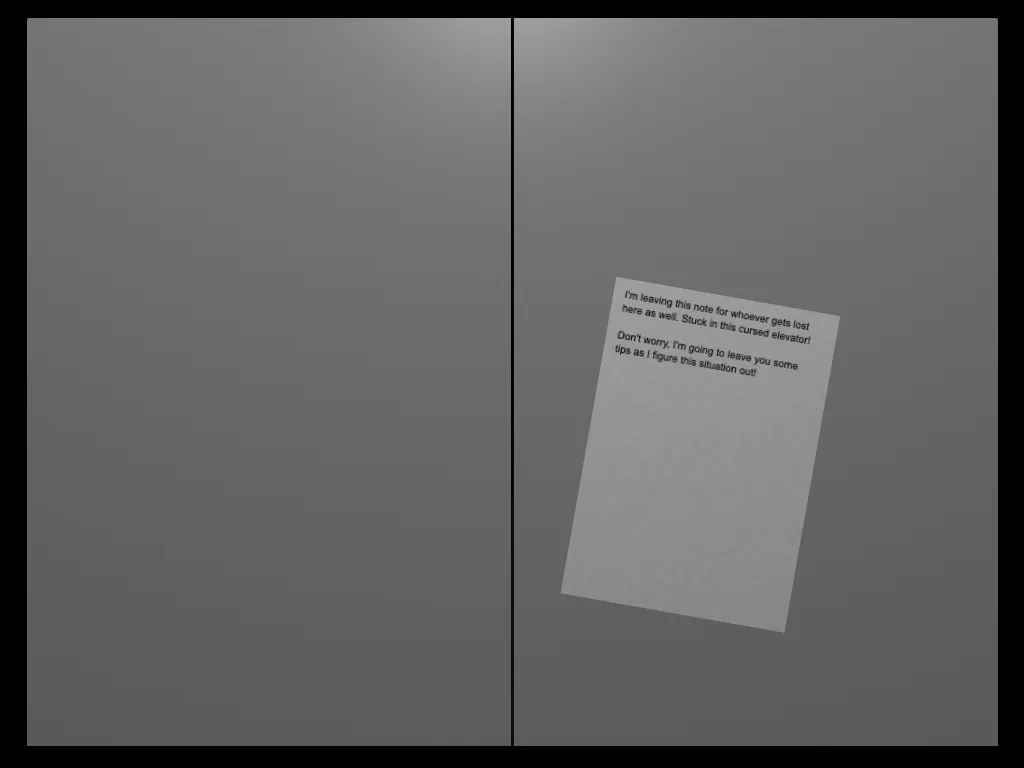
You stand inside an elevator. You cannot walk around: you stay in the middle of the car and can only look around, at the doors, the floor numbers and whatever else is in there with you. Someone has been here before. A note on the wall is addressed to whoever gets lost in the elevator next, and it promises a few tips about how to get out of this situation.
Cursed Elevator is a small story told through that car. You click on what you see to interact with it, read the notes, and as the trips go on, other figures show up and talk to you in short lines of dialogue. The goal is floor 13, as often as you have to go there. The game is about what you find out along the way, so it is best played without being told much more than that.
Sebastian Dorn made it for js13kGames 2024, whose theme was Triskaidekaphobia, the fear of the number 13, with the whole game fitting in 13 KB. The 3D scene is drawn by a small WebGL2 framework, the textures are generated by code and the sounds are tiny synthesised effects.
Playing it here
Click Play and then Start. Look around with the arrow keys or W, A, S and D, or turn on pointer lock with P to look with the mouse; if you turn on pointer lock, the mouse moves the view without the cursor. Press E, Enter or click to interact with what is in the middle of the screen. The game saves your progress in your browser.
Controls
| Key | Action |
|---|---|
| W A S D / arrow keys | look around |
| R | reset the camera |
| P | toggle pointer lock (mouse look) |
| E / Enter / mouse click | interact |
| Escape / 1 | pause and resume |
A few things worth knowing
Read everything. The notes on the walls are part of the story.
Pointer lock is optional. Without it, the arrow keys are steadier, and with it the mouse is faster. Press P to switch whenever you like.
Press R if the view gets lost. It centres the camera again.
Credits and licence
Cursed Elevator was created by Sebastian Dorn and is released under the MIT licence. It embeds ptex and the W WebGL framework by xem (both public domain) and ZzFX by Frank Force (MIT). The licence texts and credits are linked from this page.