
 Portugues
Dyker
Saved games stay in this browser only.
About the game
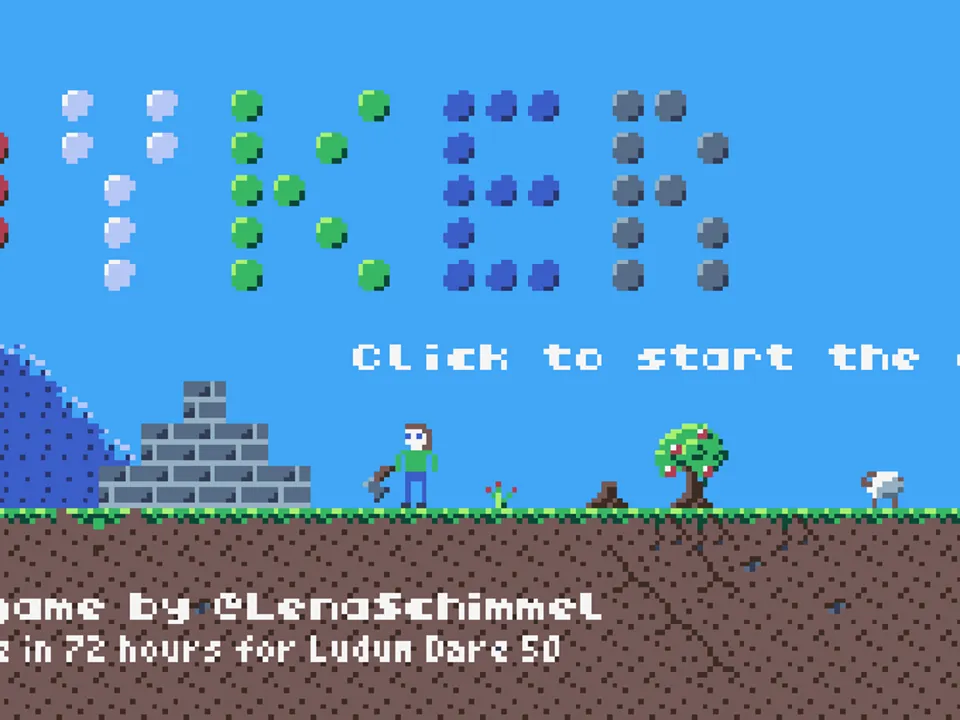
A flood wave is coming, and the only way off the island is a ticket that costs coins. Dyker gives you a small strip of land, a few stones, some wood and a handful of coins, and asks you to make enough money before the water reaches you. The wave comes in from the left and moves one tile at a time. The clever part is that it moves only when time does, and time passes only when you walk, work, or choose to wait. You can stop and think for as long as you like.
Everything you can do costs a little time, and almost everything you can do earns or spends one of three resources: stone, wood or coins. Stone builds dykes, which stop the water and also work as steps, as long as you build them like pyramids, never as upright walls. Trees give apples for coins, or wood if you cut them down. Sheep give wool, or more coins as meat. Rocks and mines give stone. Wells make the trees grow faster, and chests hold a card. Cards are the card-game part: you play them to buy objects, trade wood for coins or get a temporary bonus. An axe and a pair of boots are permanent upgrades that make cutting and walking faster.
There are three islands. The first asks for 70 coins, the second for 100 and the third for 130, and each is bigger and trickier than the last. The third island has a house full of books you can study to find more cards, which takes a lot of time.
Playing it here
Dyker was made for TIC-80, a fantasy console: an imaginary 1980s-style computer with a 240 by 136 screen and 16 colours, for which independent developers write new games. Lena Schimmel built it in 72 hours for the Ludum Dare 50 jam in April 2022, and it runs here in the official TIC-80 web player.
Click Play, wait for "Click to start" and click again. The game is played with the primary mouse button only, and works best with a real mouse: on a touch screen you cannot hover over the icons, which is how the game shows what each one costs. Hover over anything to read a description at the top of the screen. Nothing is saved, and every island can be restarted with the icon at the top right. Esc opens the TIC-80 menu. The game has no sound, and its text is in English.
Controls
| Input | Action |
|---|---|
| Mouse move | hover an icon or a tile to see what it does and what it costs |
| Left click on an action icon | choose walk, build, collect, cut, play a card or wait |
| Left click on the island | do the chosen action there |
| Pointer at the screen edge / mouse wheel | scroll the island (from the second island on) |
| Restart icon (top right) | start the island over |
| Esc | TIC-80 menu |
A few things worth knowing
Nothing moves while you think. Use that: check what an action costs in time before you commit to it, because every tile the water advances is a tile you cannot take back.
Dykes need a base. Build them as steps with a wider foot, like a pyramid; a single tile stacked on its own is refused.
Start with what is cheap. Apples and rocks near you turn into coins and stone quickly, and the first island is a good place to find out how the cards and the trade rate work.
Credits and licence
Dyker was created by Lena Schimmel, who made the code and the graphics; she published it under the MIT licence, which allows redistribution. The game was made under the roof of Pistacchio Studios and is based on the same idea as Shepherd's Island by flauschzelle and blinry, but the two share no code. It runs here in the TIC-80 web player (MIT licence). The licence text is linked from this page.