
 Portugues
Kazu Number Puzzles
Saved games stay in this browser only.
About the game
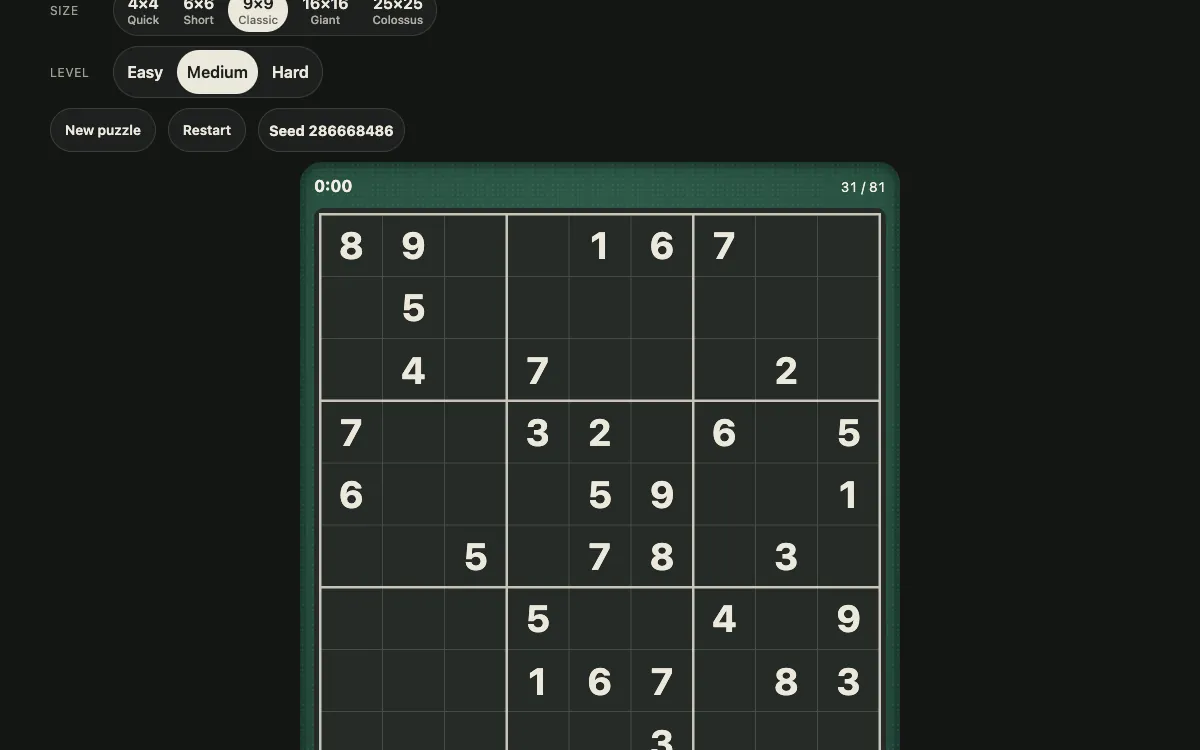
Kazu is Japanese for "number", and this page gathers a whole shelf of grid logic puzzles under one roof. The first page offers six number-placement puzzles on one square grid: Sudoku, Jigsaw Sudoku, Diagonal Sudoku, Killer Sudoku, Futoshiki and Skyscrapers, from 4 x 4 up to 25 x 25. Along the top are further pages for other pencil-puzzle families: Shikaku, Hitori, Nurikabe, Akari, Juosan, Loop, Masyu, Yajilin, Ripple Effect, Cross Sums, Regions and Heyawake.
Every puzzle has exactly one answer, found by reasoning, never by guessing. You choose the size and the level (easy, medium or hard), and every puzzle comes with a seed so that you can come back to it. The hint does not just fill a cell: it tells you which cell to look at next and the reason, so it works as a teacher. Pencil marks, undo and a mistake checker are there if you want them, or you can switch the helpers off for a purer solve.
Playing it here
Click Play. The row of pill buttons at the top opens the other puzzle families (each one is its own page on the same site); the row under it chooses the number puzzle, the size and the level. "New puzzle" deals another, "Restart" clears your entries, and the seed button shows the number that identifies the puzzle. Tap a cell and then a number on the pad (the cross clears it). Pencil turns note-taking on, Undo steps back, Check counts your mistakes (or marks them, or is off) and Hint can fill the cell, point at it or be off, depending on what you chose under "While you play". The clock starts on your first move.
Controls
| Input | Action |
|---|---|
| tap a cell, then a number | fill the cell |
| Pencil | toggle note-taking |
| Hint | say which cell to fill next, and why |
| Check | count or mark mistakes |
| Undo | step back |
A few things worth knowing
Use notes. Pencil marks turn a hard puzzle into a series of small deductions.
Ask for hints that only point. Set Hint to "Points only" to learn the reasoning without being handed the answer.
Move up in size slowly. Quick and short sizes (4 x 4, 6 x 6) are a good place to learn a new puzzle type.
Questions
Can a puzzle have more than one answer? No. Each puzzle is generated and checked to have exactly one.
Where do the puzzle names come from? They are the traditional names of these pencil-puzzle types, which many publishers use.
Credits and licence
The code, the drawings and the puzzle levels are by John Morris, under the MIT licence; nothing else is bundled with the game.