
 Portugues
LinCity-NG
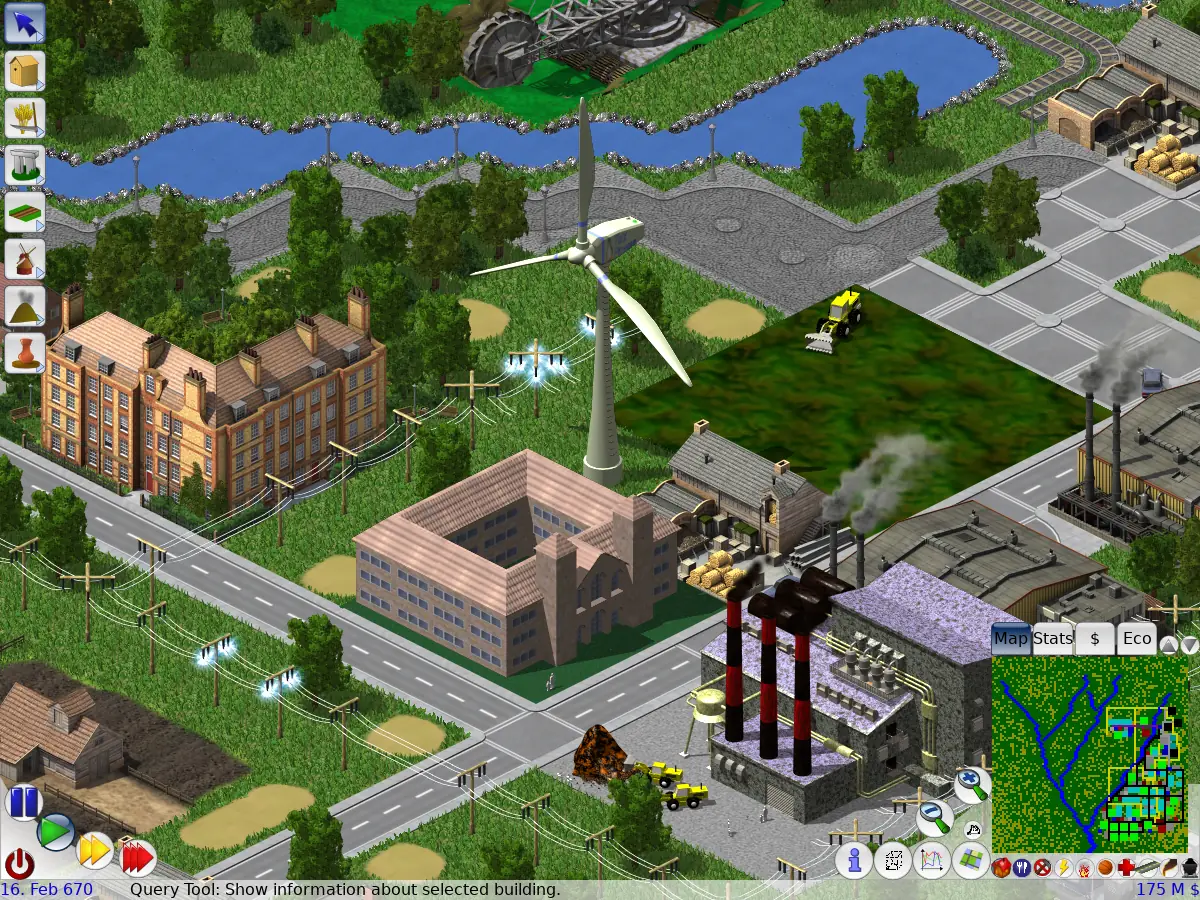
Saved games stay in this browser only.
About the game
LinCity-NG is a city builder in which nothing works on its own. Houses need food, water and jobs; farms need workers and water; mills, potteries and factories need raw materials and send their products somewhere else; and everything has to reach the people through markets and transport. You start from a small village with a few farms, a well, some communes and houses, and each new building you add either fixes a shortage or creates a new one.
The heart of the city is the market. Producers sell to the markets in their reach and consumers buy from them, so a building that cannot find a market with what it needs, or a market with room for what it makes, simply stops. As the city grows you link markets with tracks, roads and rails, dig coal and ore, build power stations, steel works and industry, and keep an eye on pollution, fires, health and unemployment. Research at schools and universities raises the technology level, which unlocks new buildings such as solar power, recycling centres and, eventually, the rocket launch pad.
There are two ways to "win". You can reach a sustainable economy, where mining, trade, money, population, technology and fire cover all stay stable for long enough, and keep playing afterwards. Or you can build rockets and evacuate your whole population to another planet, which ends the game. You lose only if everybody dies of hunger or pollution.
LinCity-NG is the "next generation" of LinCity, the city simulation that Ian J. Peters started in 1995 and Greg Sharp maintained for years. The NG project gave it new isometric graphics, a new interface, sounds and music in 2005, and volunteers have kept improving it ever since. It is an independent open-source game, not connected with any commercial city builder.
Playing it here
This is LinCity-NG 2.15.0, the latest release, compiled for the browser from the project's source code. The download is about 55 MB, mostly building graphics and sounds, and the game plays offline once it has loaded. It opens in a window as large as the player, at least 1024×700, and the picture is scaled to fit. The game is in English.
Your saved cities and settings stay in this browser. Use Save in the main menu (the power button at the bottom left of the city returns to it) to keep a city in one of the slots, or F12 for a quick save. Clearing this site's data in your browser deletes them.
The game needs a mouse and does not support touch screens well.
Controls
| Input | Action |
|---|---|
| Left-click on a menu button | choose a building or tool |
| Left-click on the map | place the chosen building |
| Right-click on the map | show information about a building |
| Arrow keys, WASD or keypad | scroll the map (Shift scrolls faster) |
| Mouse wheel | zoom in and out |
| Middle-button drag | pan the map |
| Escape | go back to the query tool |
| B | toggle the bulldozer |
| P | jump to a building (press again for the next one) |
| 1 to 9, 0 and ` | switch the minimap between overlays (power, fire, health, pollution and more) |
| F1 | open the built-in help |
| F12 / F9 | quick save / quick load |
Getting started
Start with the village. Choose New Game and one of the four random maps (river delta, semi desert, temperate or swamp). You get a small working village to learn from. The named scenarios, such as Good Times, Bad Times or Extreme Arid, are harder starting points for later.
Read the help. Press F1 at any time. The built-in help has a tutorial (First steps, Advanced features, Aim of the game) and a page for every building, with what it consumes and what it produces.
Watch the information window. Right-click a building to see its stocks and problems in the panel at the bottom right. The tabs above it switch between the minimap, statistics, finances and economy graphs.
Tips
Markets first. Most problems come from a building that cannot reach a market, or a market that is full or empty. Put markets close to farms and houses, and connect distant buildings with transport.
Watch the money. Every building and every piece of road or rail has a yearly cost. Grow in steps and let the taxes catch up before the next expansion.
Use the overlays. The minimap overlays show at a glance where people are starving or out of work, where there is no power or fire cover, and where pollution is building up.
Plan for the long run. Coal and ore mines run out, and pollution and waste pile up. Recycling, solar and wind power and parks help keep a large city healthy, and they count towards a sustainable economy.