
 Portugues
Liquid War
Saved games stay in this browser only.
About the game
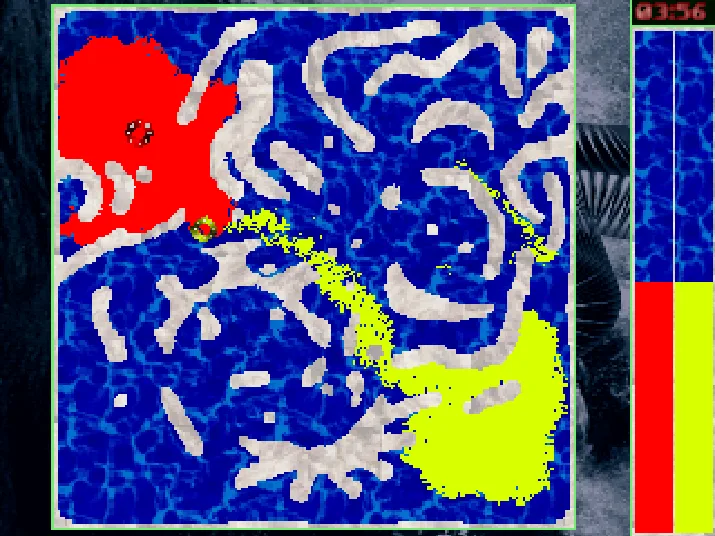
Liquid War is a war game with no units to click on. Each side is a liquid made of thousands of tiny fighters, and the only thing you control is a cursor. Every fighter in your army moves toward that cursor by the shortest route through the map, all at once, pouring around walls like water.
When two armies meet, the fighters that are pressed from behind win: a fighter that is attacked and cannot escape turns into the colour of its attacker. The total number of fighters never changes, only who they belong to. A game ends when one colour has swallowed the other, or when time runs out.
The idea came from Thomas Colcombet's work on shortest-path algorithms, and Christian Mauduit turned it into this game, released as free software.
Playing it here
This is the official DOS build of Liquid War 5.6.6, published by its author. Click Play now; when the menu appears, press Enter on Play to start a match against the computer. You control the red team with the arrow keys.
The DOS version has no network play, so matches are against the computer or between people sharing the keyboard.
Controls
| Key | Action |
|---|---|
| Arrow keys | move your cursor (team 1) |
| I / J / K / L | move the cursor of team 2, once enabled in Teams |
| Enter | choose in the menus |
| F1 / F2 | show or move the information bar |
| F3 | pause |
| Esc | leave the match or go back |
A few things worth knowing
Surround, do not charge. Fighters attacked from several sides at once change colour fastest. Lead your army around the enemy rather than straight into it.
Your cursor is also a bait. Parking it inside the enemy blob pulls your whole army into the fight from every direction it can reach.
The computer is a beginner. The author says so himself: Liquid War is meant for people. Turn a second team on in Teams and play against a friend.
Credits and licence
Liquid War was invented by Thomas Colcombet and programmed by Christian Mauduit, with maps, music and translations from many contributors. It is free software under the GNU General Public License, version 2 or later. The licence text and the complete source code of this build are linked from this page.