
 Portugues
Mare Mercatus
Saved games stay in this browser only.
About the game
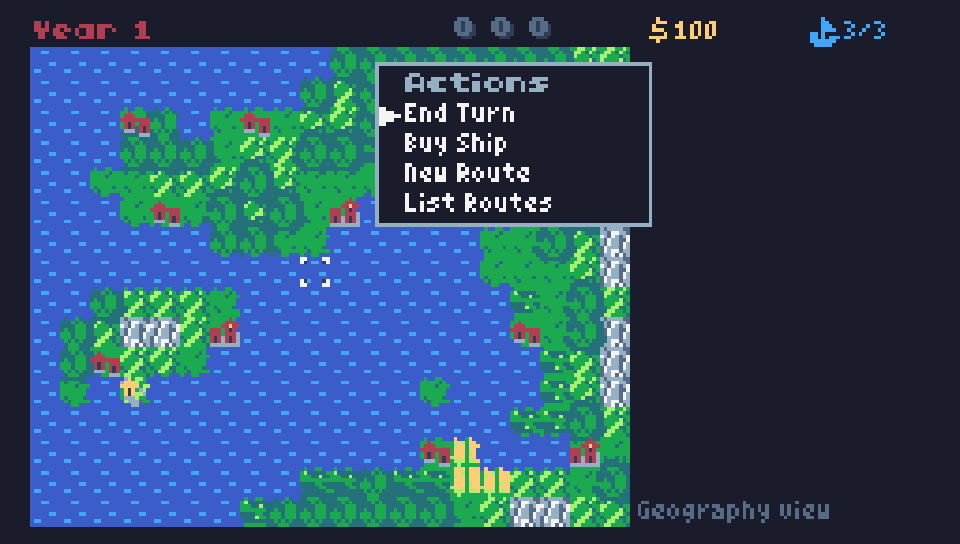
Mare Mercatus puts you in charge of a trading company in the Age of Sail. You look at a map of coasts, plains, forests and hills, and your job is to make the harbour towns on it richer by moving goods between them in ships. Each year is a turn, and each level gives you a handful of goals to reach, such as having a certain amount of money, a certain population across the map or a certain income in a single year.
Some tiles produce goods such as grain, tea or coffee, and a town collects what is produced around it. You set up shipping routes from one town to another and back, assign ships to them (you can only build a limited number each year, unless you build shipyards), and every trip earns money depending on how many ships you use, how much the goods are worth, how big the destination is and how rich it is. Towns that receive goods grow, and bigger towns buy more. With your profit you build plantations, workshops and other buildings that make new goods, so the economy you run keeps expanding.
The game is deeper than it first looks, but it teaches itself. Four map views (geography, production, wealth and population) show what each tile and town is doing, a briefing comes with each level, and the System menu has a manual with worked examples of how a route's income is calculated.
Playing it here
Mare Mercatus was made for TIC-80, a fantasy console: an imaginary 1980s-style computer with a 240 by 136 screen and 16 colours, for which independent developers write new games. It runs here in the official TIC-80 web player, and its code is written in Python. Click Play and wait a few seconds while the first map is generated, then press Z on the title to choose a level.
Your progress through the levels is saved in this browser. If the game feels slow, turn "Fancy Graphics" off on the title screen or in the System menu. Esc opens the TIC-80 menu. A gamepad works directly.
Controls
| Key | Gamepad | Action |
|---|---|---|
| Arrow keys | D-pad | move over the map |
| Z | A | confirm; open the construction menu on the map |
| X | B | cancel; open the action menu on the map |
| A | X | open the system menu (briefing, manual, give up the level) |
| S | Y | change the map view; change the page when looking at a town |
| Esc | — | TIC-80 menu |
A few things worth knowing
Read the manual once. The System menu (A key) has a short manual with the rules for towns, ships, routes and income. It is worth the two minutes.
Match goods to towns. A route earns money only up to the destination's population and wealth, and a town that already makes the same goods will not pay for them, so look for towns that are big, rich and missing something.
Build shipyards early. Without them you can add only one ship a year, which caps how fast your network can grow.
Frequently asked questions
Is my progress saved? Yes, your progress through the levels is saved in this browser. Clearing the site data in your browser deletes them.
Does it work on a phone? The on-screen buttons appear on touch screens, but the game uses four buttons and a lot of small text, so a keyboard is better.
Is it free? Yes. The authors released it under the MIT licence.
Credits and licence
Mare Mercatus was made by The Plush Girls, who also made Soft Toy Having a Hard Time. It is released under the MIT licence, chosen in the header of the cartridge, which holds the game's complete source code in Python. It runs here in the TIC-80 web player (MIT licence). The licence texts are linked from this page.