Portugues
Mineplacer
Saved games stay in this browser only.
About the game
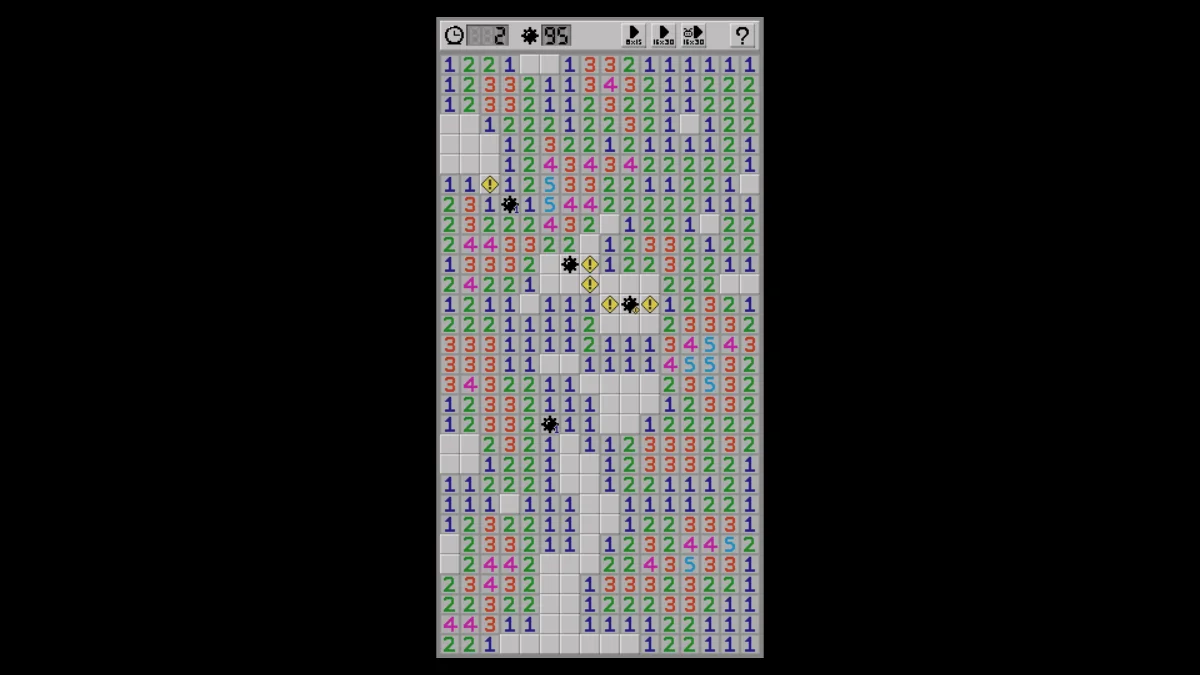
Mineplacer asks a funny question: what if, instead of clearing a minefield, you were the one who had to set it up? The board arrives full of numbers, the kind you know from Minesweeper, and no mines at all. Your job is to place the mines so that every number is right.
Each number tells how many mines belong in the square of nine cells around it, counting the cell itself. As you place mines, the numbers count down: when a cell reaches zero, its neighbourhood is complete and the digit disappears. Put down one mine too many and the cell shows a warning sign instead. Click a mine again to take it back. The puzzle is solved when every number has been brought to zero, and the clock at the top shows how long it took.
The logic is the reverse of the classic. In Minesweeper you read numbers to find where mines are not; here you read them to decide exactly where mines must go, and every mine you place changes several numbers at once. A 1 in a corner, a 9 in the middle of a block, two numbers that share only some of their cells: these are the footholds that let you solve the board without guessing.
There are three boards. The small one, 8 by 15, is a warm-up. The large one, 16 by 30 with 99 mines, is a real puzzle. The third adds wormholes: some of the cells are hidden, so parts of the board give you no information and you have to reason around the gaps.
Playing it here
The game runs in the page with a mouse or a touch screen. The download is about 170 KB. Nothing is saved; each board is a fresh puzzle. The ? button opens a short summary of the rules.
Controls
| Input | Action |
|---|---|
| Click or tap a cell | place a mine, or take it back |
| 8x15 button | start a small board |
| 16x30 button | start a large board |
| 16x30 button with the wormhole icon | start a large board with hidden cells |
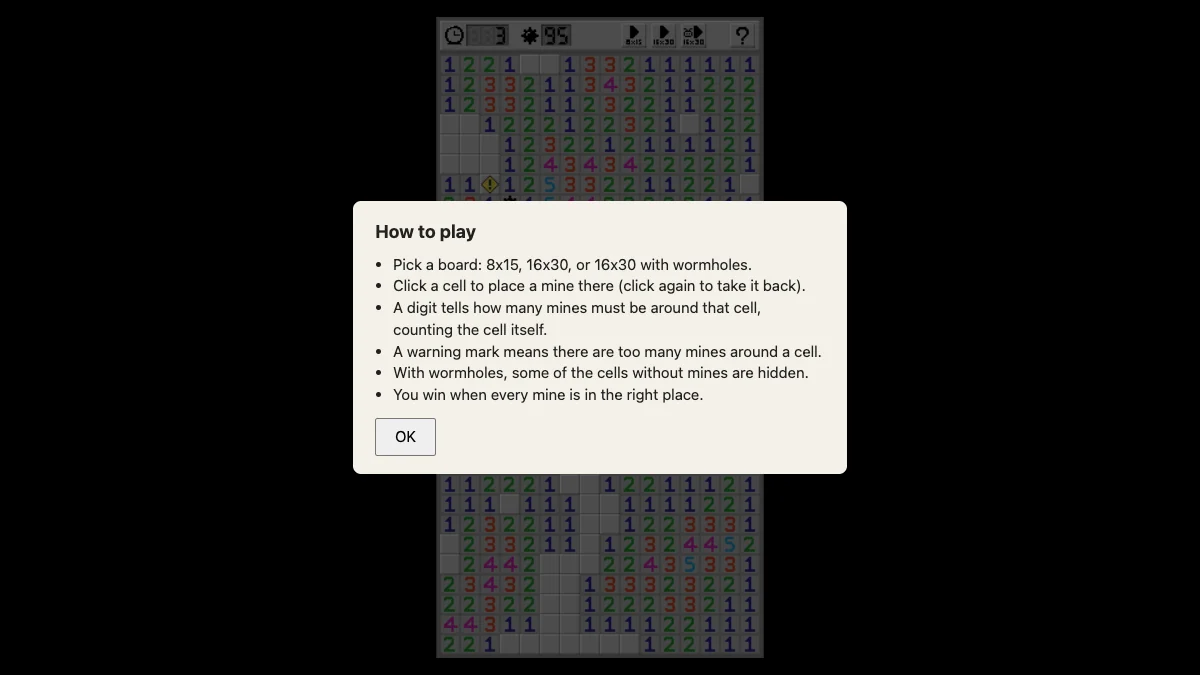
| ? button | show the rules |
Tips
Start with the extremes. A cell that needs as many mines as it has neighbours (9 in the middle, 4 in a corner, 6 on an edge) is full of mines; a cell next to a zero area has fewer options than it seems.
Compare neighbours. Two numbers next to each other share six cells. The difference between them tells you about the three cells only one of them sees.
Watch the warnings. A warning sign means that some mine around it is wrong; look for the mine that also makes another number go below zero.
Count what is left. The counter at the top shows how many mines you still have to place.
Credits and licence
Mineplacer was made by Takeru Ohta on the author's own engine, pagurus, and released under the MIT or Apache 2.0 licence. The licence texts, the source, the lock file we added to build it and the page we wrote around it are linked from this page.
FAQ
How do I win? Bring every number on the board to zero, with no warning signs left.
Can I remove a mine? Yes, click it again.
What are wormholes? In the third mode some cells are hidden and show no number, so you solve the board with less information.
Is there a custom size? The author's version reads a custom size from the page address; this version keeps the three standard boards.
Screenshots