
 Portugues
nono
Saved games stay in this browser only.
About the game
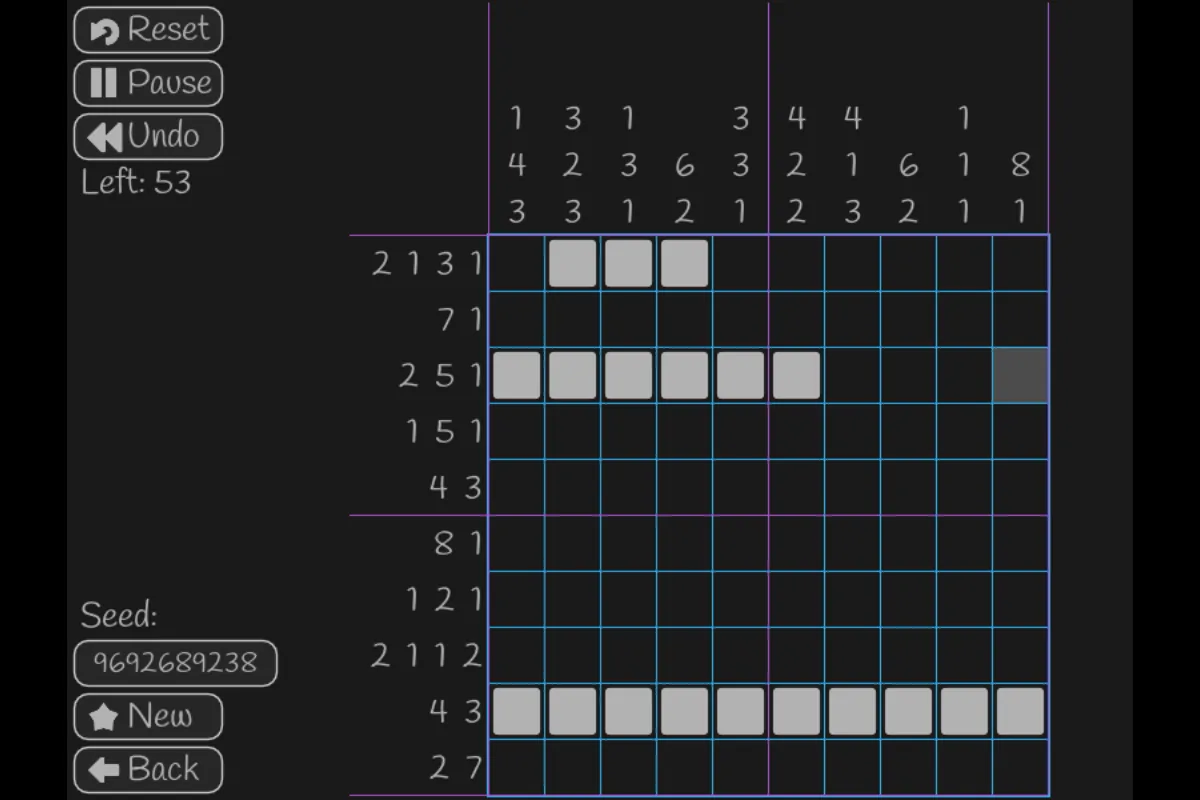
nono is a nonogram game, also known as picross or griddlers. You get an empty grid with numbers beside every row and above every column. Each number tells you the length of a run of filled cells in that line, in order, with at least one empty cell between runs. A row that says 3 1 has a run of three filled cells and, later in the row, a single filled cell. From these numbers alone you work out which cells must be filled and which must stay empty, and when you are done, the filled cells make a pattern.
Every puzzle is random. The game makes a grid from a seed number and shows the seed on the side, so you can write a seed down or share it, and type it back later to get the same puzzle. In the options you choose the size of the grid, from 4 to 25 cells on each side, so you can have a five-minute puzzle or a long one, and you can pick a theme, choose whether puzzles must have a single solution and turn the sounds on or off. A counter shows how many cells are still left to fill, and Undo takes back a move if you slip. When you finish, the game shows how long you took.
The look is calm: a dark screen, soft lines in blue and purple, a hand-written font and quiet clicks. It is a good game for a few minutes of focus.
Playing it here
nono was written for the LÖVE framework, and it runs in the browser compiled to WebAssembly. Click Play and then New Game on the menu. The whole game is played with the mouse. Your puzzle is not kept between visits, but the seed lets you come back to the same one.
Controls
| Control | Action |
|---|---|
| Left mouse button | fill a cell; drag to fill a line of cells |
| Right mouse button | mark a cell as empty; drag to mark several |
| Undo, Reset, Pause | the buttons on the left of the board |
| New | start a new random puzzle |
| Seed box | type a number to play that puzzle again |
A few things worth knowing
Start with the big numbers. In a row of ten, a 10 fills everything, and a 9 or an 8 leaves only a little room, so those lines tell you a lot at the start.
Mark the empty cells too. Right-click the cells that you know are empty. It keeps the board readable and helps you see what is left.
Use the seed. If you like a puzzle, note the seed number. If you are stuck, a smaller grid is a good way to practise.
Frequently asked questions
Can a puzzle have more than one solution? The puzzles are random patterns. In the options, "Solution" lets you choose Single, which makes puzzles with one answer, or Multiple, where any grid that fits the numbers is accepted.
Is my progress saved? The seed lets you come back to the same puzzle, but the game does not keep your filled cells between visits.
Does it work on a phone? It is played with the mouse, and touch works like a click, but right-click marks need a mouse.
Is it free? Yes. The code is MIT licensed and the assets are CC0.
Credits and licence
nono was made by monolifed with the LÖVE framework. The package says that it is based on a game by Michael Enger, with all of the code rewritten. The sounds are by Rubberduck (public domain), the icons by Kenney (CC0), the rest of the images by the author, and the font is Handlee by Joe Prince (SIL Open Font License). The code is under the MIT licence and the assets are CC0 on the game's itch.io page, and the package carries a zlib-style licence text. The version served here is the web version that the author publishes, without changes; the licence texts are linked from this page.