
 Portugues
Octat
Saved games stay in this browser only.
About the game
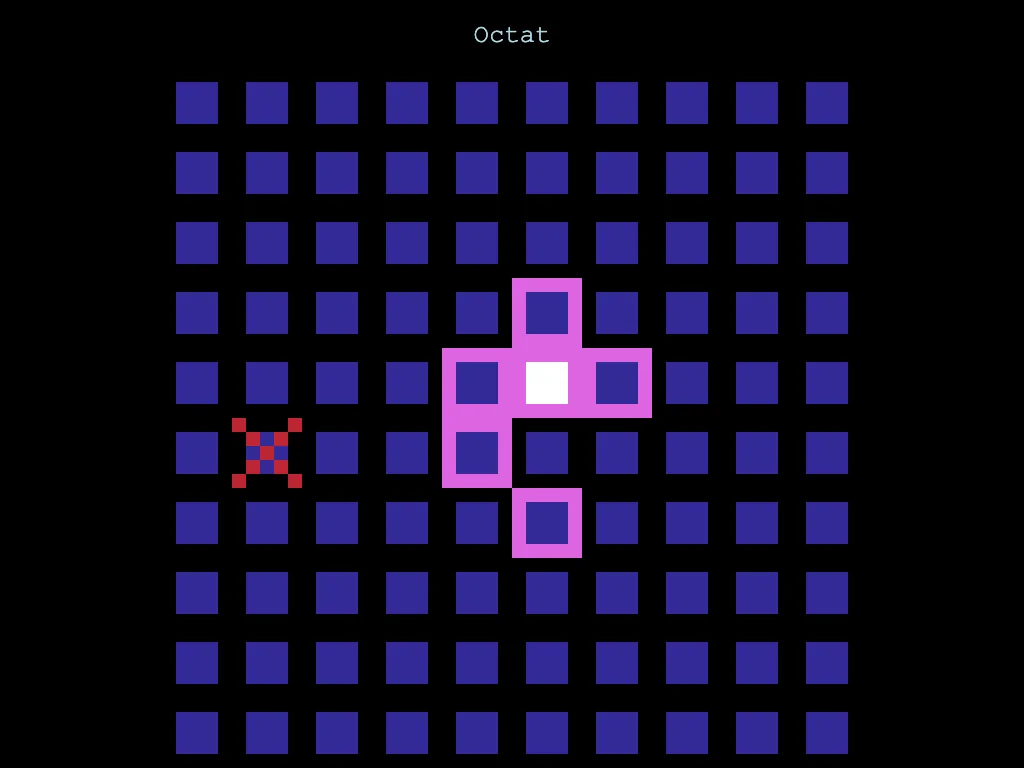
You are a white square on a grid of dark blue tiles, and somewhere on the board there is a red X you have to reach. The catch is that you can only step onto tiles that are lit in pink. The lit tiles are not fixed: every time you land on a square, the four squares next to it flip, the dark ones turn on and the lit ones turn off. So each move both takes you somewhere and rewrites the map of where you can go next.
Octat has eight levels, each introduced by a short "level n of 8" screen, and a closing message. The early boards are small enough to solve by looking; the later ones ask you to plan a few steps ahead, because a path that looks open can switch itself off behind you. It is a port of a Flash game by the author, written as a short text file for his PuzzleScript engine, with graphics and sounds generated by the engine.
Playing it here
Click Play and press X to start. There is no undo limit, and the game remembers the level you reached in this browser. On a phone or tablet, on-screen buttons appear. Nothing is sent anywhere.
Controls
| Input | Action |
|---|---|
| Arrow keys, W A S D or on-screen pad | step to a neighbouring lit tile |
| R | restart the level |
| X, C or Space | continue past a message |
Undo is switched off in this game, so restarting the level with R is the way to take a move back.
A few things worth knowing
Look at where you will land. The tiles that flip are the four around your destination, not around where you stand now.
You must move. A key press that does not take you onto a lit tile does nothing, so the pink squares around you are the only moves on offer.
Work backwards. If the X is hard to reach, ask which tile you would need to be on just before it and what has to be lit for that.
Credits and licence
Octat was made by Stephen Lavelle (increpare) and published under the MIT licence, together with the PuzzleScript engine it runs on, in the PuzzleScript repository. The licence text is linked from this page. The page is the standard standalone export of the engine with the game text inside; we only removed the link to the author's site and the "hack" button that would send the code to another site, and replaced the one small part of the engine that was under another licence (GPL) with our own code.