
 Portugues
Omega
Saved games stay in this browser only.
About the game
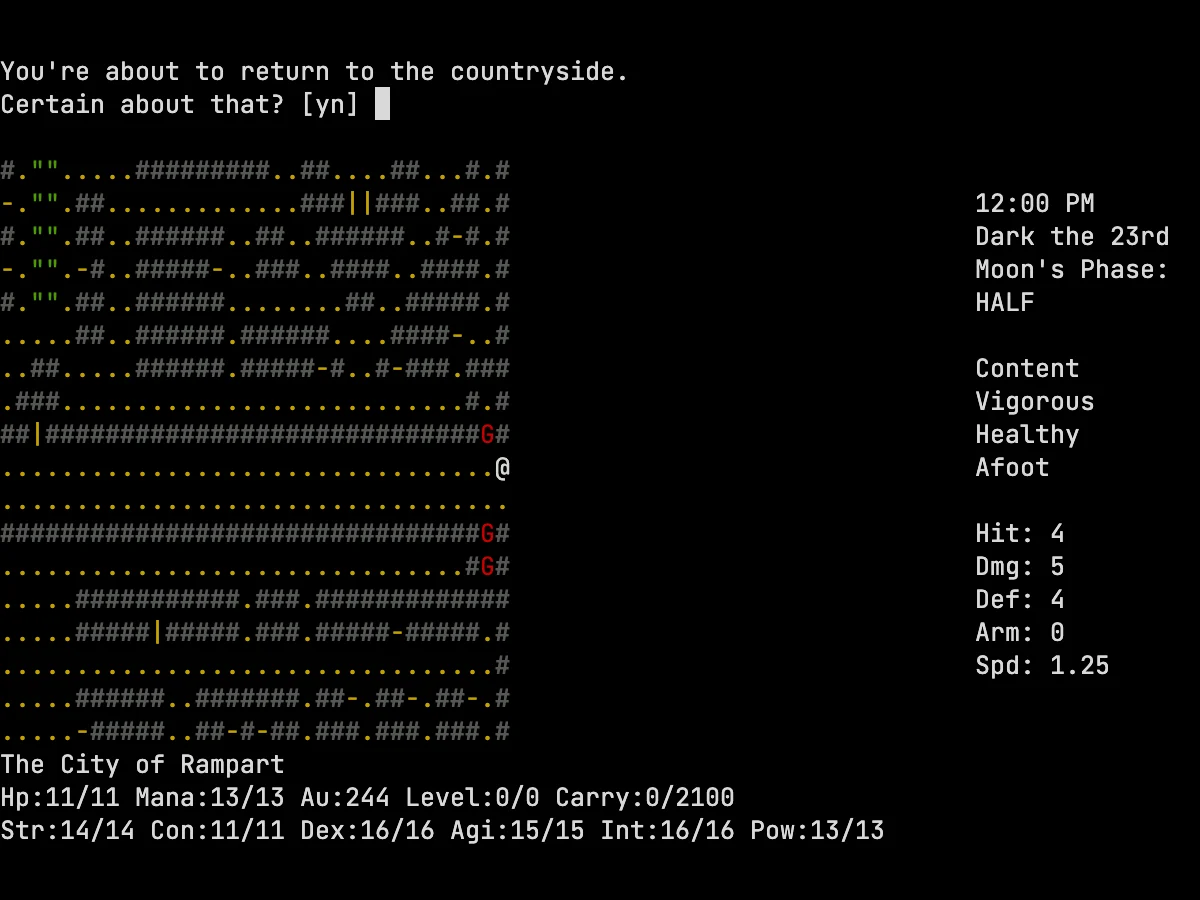
Omega is a roguelike that does not want to be only a dungeon. Laurence R. Brothers wrote it in the late 1980s, and it grew into one of the largest games of its kind. You start in Rampart, a walled city with a gymnasium, a collegium of magic, an arena, a bank, a casino, a diner and taverns, an oracle, temples of several rival faiths, thieves', sorcerers' and mercenary guilds, an order of paladins and a Duke whose guards do not like crime. Beyond the walls is a countryside, drawn on a much larger scale, where villages, special sites and a handful of dungeons lie waiting to be found, the easiest of them, the Caves of the Goblin King, due south of the city in the mountains.
The point is that going down is only one of the ways to get on the high-score board. You can become the head of a guild, the leader of a priesthood or a college, or the best of the gladiators; you can build up the points your possessions and experience are worth; and there is a "total winner" status for the player who does it all. Alignment, between the forces of Law and Chaos, decides which organisations will take you in, and many of your skills come from training at the places in town rather than only from killing things. The game also tracks hidden statuses that you learn about through the oracle or your own self-knowledge, which adds a layer of preparation to every adventure.
You can roll a character or answer a series of questions about yourself to get your own statistics, a mode the help file asks you to answer honestly. The combat is turn-based, with choices of stance and sequence, and the world has a clock: many shops open only by day and some places only come alive at night.
Playing it here
This is Omega 0.90 pre-alpha 9 (the title screen still says pa8), compiled for the
browser from the project's source code. The screen is a text terminal, drawn on a canvas: your character is
a highlighted @, other people are plain @ signs, and monsters are letters.
The download is about 1 MB and the game plays offline once loaded. A keyboard is
required.
S saves and quits the game. The saved game, the high-score table and the log
of past characters stay in this browser, and the next visit picks up where you
left off; clearing this site's data deletes them. The game is in English. We
made two changes beyond what the browser needs: the question about your
character's romantic preference is left out, and the House of the Eclipse in
Rampart is a club for games and conversation, so the scenes in that house that
hinted at more are not shown.
Controls
| Key | Action |
|---|---|
h j k l, arrow keys or keypad digits |
move (y u b n for the diagonals) |
H J K L |
run |
i |
inventory |
g / d |
pick up / drop |
o / c |
open / close a door |
s |
search |
t |
talk to someone next to you |
m |
cast a spell |
q / r / e |
quaff, read, eat |
> < |
stairs down and up |
M |
go quickly to a place in the city you have visited |
O |
options |
? |
help files and the command list |
S |
save and quit |
Q |
quit (the character is lost) |
A few things worth knowing
Rampart is not entirely safe. The guards are strict, so crimes get you in trouble, but the city is a good place to train, shop and earn money before you look for a dungeon.
Look for the Caves of the Goblin King first. They are the easiest dungeon,
a short walk south of the city, and you may need to search with s to find the
entrance.
Use the help. The ? command opens the game's own help, with a page on
inventory, one on movement and one for every kind of command. The game is deep
enough that a few minutes there pay off.
Mind the clock. Many places are open only in the daytime, some only at night, and sleeping outdoors in the city is safer than it looks.