
 Portugues
Parity
Saved games stay in this browser only.
About the game
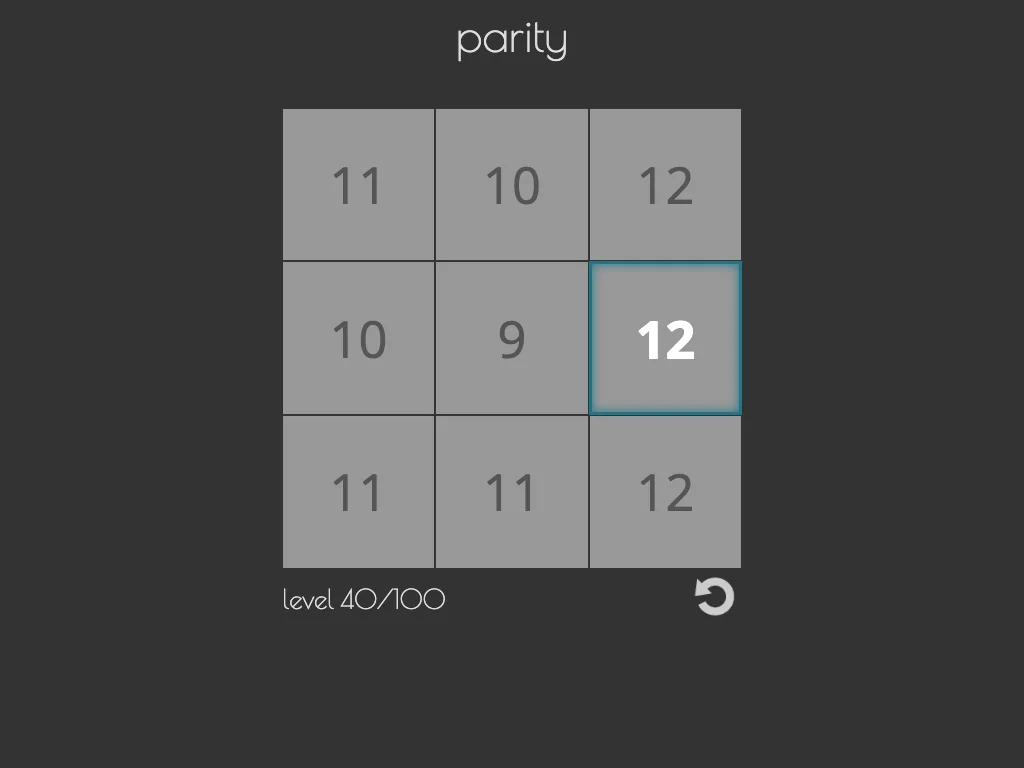
Parity fits on a three-by-three grid of numbers. One square is highlighted, and the arrow keys move the highlight to a neighbouring square. Every time it lands somewhere, that number goes up by one. The goal is to make all nine numbers the same. That is all the rules there are, and the first levels can be solved almost by accident.
The trouble is that you can only add, and you can only add along a path. To raise the numbers in one corner you have to walk there, and every step on the way raises something else. Soon the levels start with numbers like 9, 10, 11 and 12 scattered around the grid, and the question becomes which route lands on each square exactly the right number of times. Some solutions need a long, winding walk; others need going back and forth between two squares.
After fifty levels the game adds a twist: black squares, which go down by one when you step on them, mixed with the usual white ones. A hundred levels in all, with a few short instruction screens along the way. Abe Fehr wrote Parity in 2014, inspired, as he says, by the urge to make sure every icon on his desktop had been clicked the same number of times.
Playing it here
Click Play. The game fills the player and adapts to its size. Your progress is saved in this browser: when you come back, you continue from the last level you reached. If a level goes wrong, the round arrow under the grid (or the R key) starts it again.
This is the game as published by the author, with the advertising, the Facebook and Clay.io scripts removed and the fonts served from this site; the grid area is also a little taller, so that the level number is not cut off. It plays with a keyboard or with swipes on a touch screen.
Controls
| Input | Action |
|---|---|
| Arrow keys | move the selector |
| Swipe | move the selector (touch screens) |
| R or the round arrow | restart the level |
| Enter | close an instruction screen |
A few things worth knowing
Count the difference. Look at the highest number: every other square has to be stepped on exactly as many times as it is short of it.
Corners are expensive. You can only reach a corner from two squares, so plan how to get in and out of it before anything else.
Back and forth works. Moving between two squares and back raises both together, which is handy for evening out a pair.
Black squares change the target. With black squares, the highest number is not always the goal: lowering a few may be easier than raising everything else.
Credits and licence
Parity was created by Abe Fehr and is released under the MIT licence. It uses jQuery and jQuery TouchSwipe (MIT) and the Poiret One and Open Sans fonts (SIL Open Font License). The licence texts and the source code are linked from this page.