
 Portugues
Paylife
Saved games stay in this browser only.
About the game
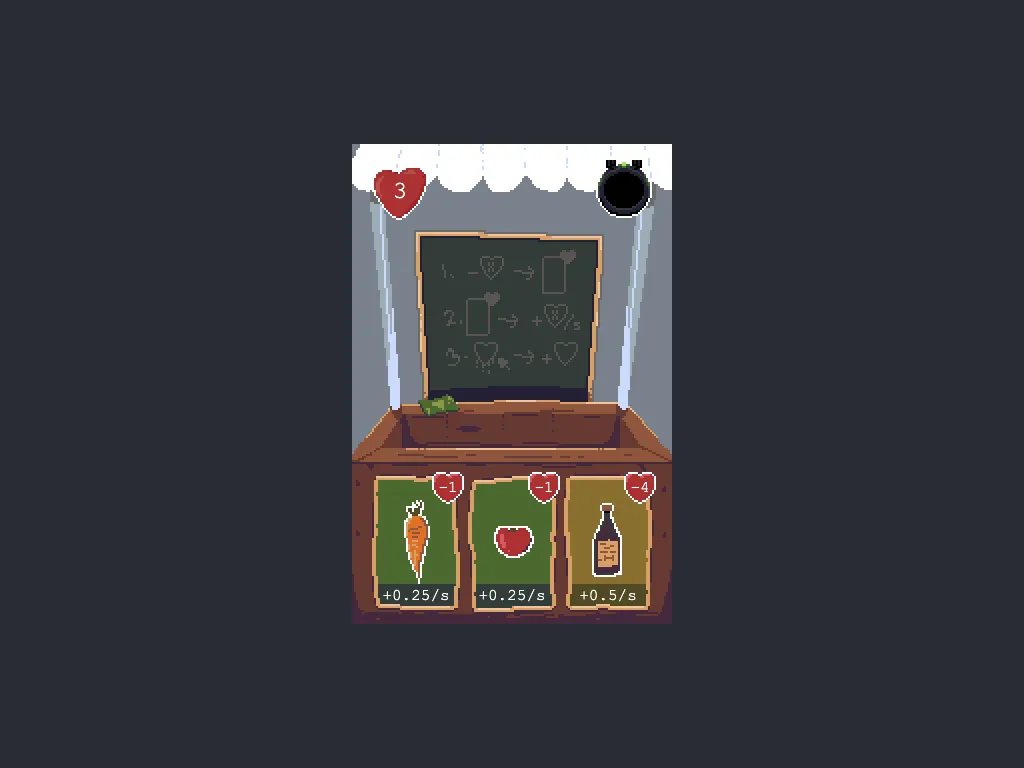
You stand in front of a market stall with a chalkboard of rules and a counter in the top left that shows your life: three hearts to begin with. There are three cards on the counter, a carrot, a tomato and a bottle, and each one tells you two things: what it costs, in hearts, and how much it will earn you per second. The carrot and the tomato cost one heart and give a quarter of a heart per second, and the bottle costs four hearts and gives half a heart per second.
Here, life is money. Clicking on a card spends the hearts it costs and puts the card to work, and from then on it releases little hearts that float up into the air. You click on the hearts to catch them and get their life back, but a heart that is not caught flies away and costs you one point of life. The clock in the top right gives you sixty seconds to get as high a score as you can, and it is up to you whether to invest early, before you run out of life, or play it safe.
Paylife is a small economy game, and it fits a lot of decisions into a minute. Alexandre Blondeau made it in only 24 hours for Ludum Dare 44, with a framework he is building himself, called Theatre. The whole picture is drawn in pixel art and the game has no sound.
Playing it here
Click Play, then click the cards and the hearts inside the game. It is played only with the mouse (or a finger). The game window is small and sits in the middle of the frame, on a dark background. Nothing is sent anywhere.
Controls
| Input | Action |
|---|---|
| Click (or tap) on a card | buy it, spending the hearts it costs |
| Click (or tap) on a heart | catch it and gain life |
A few things worth knowing
Buy early. A card pays off over time, so the sooner you buy it, the more hearts it releases before the minute is over.
Do not let hearts escape. Every heart that flies away takes a point of life, so keep an eye on the ones near the top of the screen.
Watch your life. If you spend everything on cards you will have no hearts left for the next one.
Credits and licence
Paylife was made by Alexandre Blondeau (deformhead) for Ludum Dare 44 and published as open source under the MIT licence, whose text is linked from this page. It runs on the author's own Theatre framework, and the game files are served exactly as the author published them, minus the source map and a preview image.