
 Portugues
Primrose
Saved games stay in this browser only.
About the game
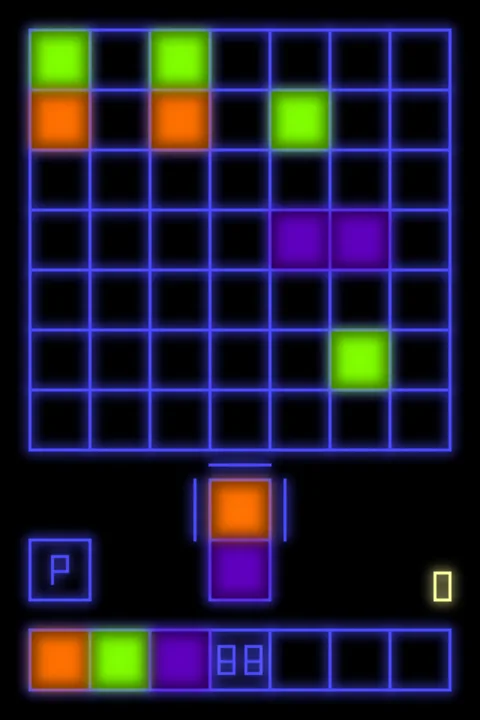
Primrose is a quiet puzzle game on a grid of seven by seven squares, played with glowing tiles in a few colours. Tiles come in pairs. You place the first tile of a pair on any empty square and the second one in the same row or the same column as the first. That is the whole of the movement. The game is in what happens when the tiles meet.
A group of tiles of one colour that is completely surrounded by tiles of another colour is cleared, and you score points for it. The tiles that surrounded it then take on the colour that was cleared, which often sets up the next capture. Big groups are worth much more than small ones, and a capture that makes the next one possible starts a chain reaction, with longer chains scoring even more. The edges of the grid count as walls, so a group can be closed off against the side of the board as well.
You begin with three colours, and a new one arrives after every 96 moves, up to seven. Every new colour makes the board harder to keep clean, and also makes the points of the later phases bigger. The game ends when there is no room left, and what matters is how far you got by then.
Primrose was made by Jason Rohrer in 2009, with a very plain look: glowing lines and flat squares of colour on a black background, and musical tones that the program generates as you play: each tile you place and each clear sounds a note of a scale. It is a game you play for a few minutes at a time, and it keeps your game for you.
Playing it here
This is the original game, compiled for the browser from its source code. The download is small, well under 1 MB. Your game in progress, the score and the options are saved in this browser, so you can close the page and continue later. Clearing this site's data erases them.
The original also had an online table of high scores, where you could send a finished game and replay other players' games. That part needed the author's own server and is not in this version: there is no high-score screen, no name to enter and no "send" button. The score you see on the screen is yours alone.
The game is drawn at 320 by 480 pixels and shown here at the size of the frame, so it is tall and narrow.
Controls
| Input | Action |
|---|---|
| Click or tap a square | place a tile there |
| "undo" button | take back the tile you just placed (until you place the second one) |
| "p" button (bottom left of the grid) | open the menu |
| Menu: new game | start again |
| Menu: instructions | a short tutorial of three pages |
| Menu: colorblind | mark each colour with a letter |
| Menu: sound | turn the sound on or off |
Getting started
Read the instructions once. The menu has a short tutorial. It takes less than a minute and shows the one rule that matters, where the second tile of a pair may go.
Surround something small. The first clears are easy: put a lone tile of one colour in the middle of a few of another, or close it off with the next pair. The surrounding tiles change colour, so look at what they become.
Watch the next pair. The tiles of the next pair are shown below the grid. Use that to leave a square open for the second tile before you place the first.
Tips
Use the edges. A group against the edge of the grid needs fewer tiles to surround it, so edges and corners are good places for the small clears that keep the board from filling up.
Plan chains. A capture changes the colour of the tiles around it. If those tiles are now part of a group that another colour surrounds, they go too. Look one capture ahead before you place.
Do not hurry the colours. A new colour arrives after a fixed number of moves, not when you are ready. The counter below the grid shows how many are left, so clean up before it runs out.
Frequently asked questions
Does it end? Yes. When the grid is full, the game is over; start a new game from the menu.
Is there a time limit? No. You can think as long as you like.
Is there a high-score table? Not in this version (see above); the score you reach is shown on the screen.
Does it work on a phone? Yes. It only needs taps.