
 Portugues
Qulqy
Saved games stay in this browser only.
About the game
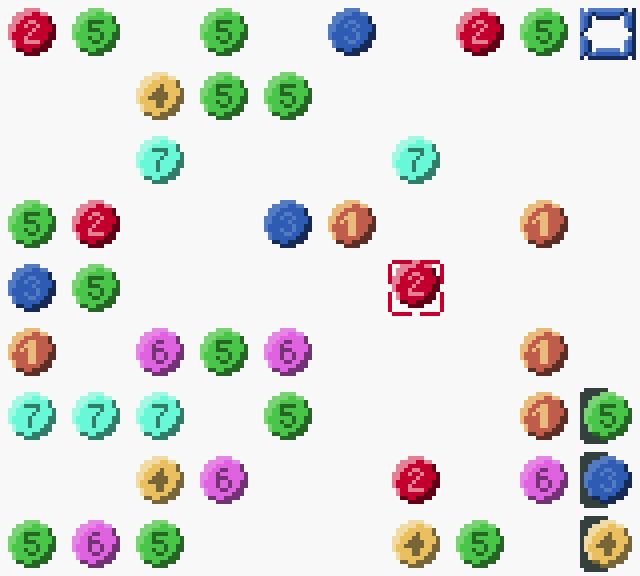
Qulqy is a connect-five puzzle played with coloured balls on a nine-by-nine board. Every turn you pick up one ball and send it to an empty square. If the move lines up five or more balls of the same colour, in a row, a column or either diagonal, they vanish and you score. If it does not, three new balls drop onto the board. The game starts with five balls and ends when the board is full (or, in the rare case, when you clear it completely), so the whole skill is keeping the board open for as long as you can.
There is a catch that makes it more than a matching game: a ball cannot jump. It rolls to its target along a path of empty squares, moving across and up or down, never diagonally, and if every route is blocked the move simply does not happen. Leave a corner walled off and the balls inside it are stuck until you clear a way in.
The game is a remake of Kulki, the 1995 Windows 3.1 puzzle game by Janusz Lewandowski, rebuilt for the Game Boy Color. It is an unofficial tribute, made by plyr0 (Mateusz Teklak) in C with GBDK-2020 for the GB Compo 2025 game jam, with all its graphics drawn by him.
Difficulty, hint and score
From the menu, X cycles through three levels: Easy uses five colours and pays one point per ball removed, Sane uses seven colours and pays two, and Hard uses eight and pays three. More colours means fewer lucky lines, so the board fills faster.
The hint, switched with Z in the menu, shows the three balls that will drop after your next move, in the tray down the right-hand side. It makes planning much easier, and costs you about a third of your score in return. Your best score is kept in the cartridge's battery memory.
Shift or Ctrl (Select) swaps the balls for numbered shapes at any time: a circle, a square, a triangle, a star and so on, one per colour. They are handy if some colours look alike to you.
Playing it here
This is a homebrew game made for the Game Boy Color: a new game by an independent developer, not a commercial release. It runs here in binjgb, a Game Boy emulator compiled to WebAssembly. Click Play and the menu appears; press Enter to start.
To stop in the middle of a game, press Enter to pause and X to save: the next time you open the page, Qulqy picks up that game straight away (the save is used once, then the game carries on from there). The best score and the save live in the cartridge's battery memory, which is kept in this browser. F2 also saves the emulator state and F4 brings it back. A gamepad works too.
The game opened on the logo of the GB Compo 2025 jam, a third-party mark; the version served here is built from the author's source without that screen and goes straight to the menu. Nothing else in the game is changed.
Controls
| Key | Game Boy button | Menu | Game | Pause |
|---|---|---|---|---|
| Arrow keys | Control Pad | — | move the cursor | — |
| X | A | change the level | pick up a ball, drop it | save the game |
| Z | B | hint on or off | — | quit to the menu |
| Enter | Start | new game | pause | resume |
| Shift or Ctrl | Select | balls or shapes | balls or shapes | — |
| F2 / F4 | — | save / load the emulator state |
A few things worth knowing
Keep the middle open. Balls in the centre can reach most of the board; a crowded centre cuts the board into pockets you can no longer reach.
Build lines in more than one place. Three new balls land after every move that does not score, often right where you were building. Two half-finished lines give you a fallback.
Mind the diagonals. Lines count diagonally too, which is easy to miss and sometimes the only five on the board.
Turn the hint on while learning. Seeing the next three balls teaches you how to plan, even if you switch it off later for the full score.
Credits and licence
Qulqy is by plyr0 (Mateusz Teklak): code and graphics, free software under the BSD 3-Clause licence. Kulki, the game it remakes, is by Janusz Lewandowski. The game is built with GBDK-2020, whose libraries in the ROM carry a linking exception. The source code of the build served here, with the patch that removes the jam logo and the build script, is hosted alongside the game, and the licence texts are linked from this page.