
 Portugues
Rubido
Saved games stay in this browser only.
About the game
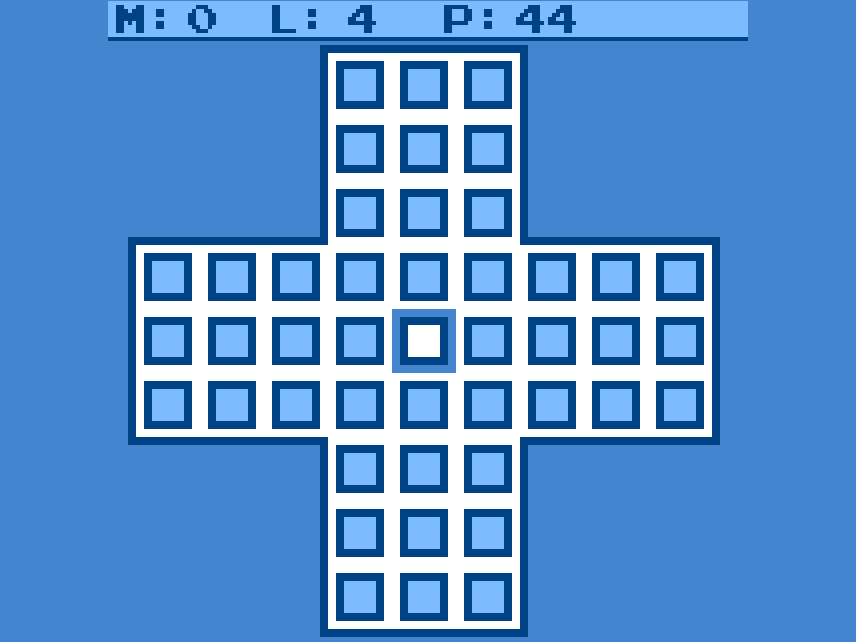
Rubido is peg solitaire, the old one-player board game. The board is a large cross of 45 holes, nine across at its widest, filled with pegs except for the centre. A move takes a peg, jumps it over a neighbouring peg and lands it in the empty hole beyond; the peg that was jumped over leaves the board. The goal is to keep going until a single peg remains.
Four difficulties change the rules. On Very Easy and Easy, pegs may also jump diagonally; on Hard and Very Hard, only up, down, left and right. On Very Easy and Hard, the last peg can finish anywhere, while Easy and Very Hard demand that it ends in the centre hole. A bar at the top keeps count of your moves, how many moves are still possible, how many pegs are left and your best result on that difficulty.
Playing it here
Rubido was made for WASM-4, a fantasy console: an imaginary handheld with a 160 by 160 screen, four colours, a D-pad and two buttons, for which independent developers write new games. It came out in 2024 and runs here in the official WASM-4 runtime. Click Play, choose New Game and pick a difficulty.
Your best results and the options (colour palette, inverted colours, sound) are saved on the game's WASM-4 disk, which stays in this browser. Enter opens the WASM-4 menu, where you can also save and load the state while the page is open (2 and 4 do the same directly). A gamepad works too, and on touch screens you can tap the board or use the on-screen D-pad and buttons.
Controls
| Key | WASM-4 button | Action |
|---|---|---|
| Arrow keys | D-pad | move the selector; choose in menus |
| X | button 1 | confirm; pick up a peg; drop it on the target hole; select again to cancel |
| Z or C | button 2 | back to the title screen |
| Left click / right click | mouse | select / back |
| Enter | — | WASM-4 menu |
Space or V also works as X.
A few things worth knowing
Watch the second number. The L counter at the top shows how many moves are still possible. When it drops to zero with more than one peg on the board, the game is over.
Clear the arms first. Pegs stranded at the ends of the cross are the hardest to reach later, so deal with them while there are still pegs nearby to jump over.
Start on Very Easy. Diagonal jumps and a free finishing spot make it much easier to get a feel for the board before trying the centre-only rules.
Credits and licence
Rubido was created by Willems Davy (joyrider3774), who made the code, the graphics and the little tunes, composed in Online Sequencer. The game's credits thank a friend, THB, for testing and for the idea behind the difficulty screens. It is released under the MIT licence, published with the source code in his repository on GitHub. It runs here in the WASM-4 runtime (ISC licence). The licence text is linked from this page.