
 Portugues
Seven Kingdoms: Ancient Adversaries
Saved games stay in this browser only.
About the game
Seven Kingdoms: Ancient Adversaries is a real-time strategy game designed by Trevor Chan and published by Enlight Software in 1998, the expanded edition of the 1997 original. You start with a king, a fort and a village, and grow from there into an empire that has to share a randomly generated land with up to six rival kingdoms run by the computer.
What sets it apart from most games of its era is how much happens away from the battlefield. Every villager has a nationality and a loyalty level, and a village that stops trusting you can rebel or switch sides. You recruit peasants and train them as builders, leaders, miners, factory workers, researchers or spies; you open mines, factories and markets, and send caravans along trade routes; you sign trade treaties and alliances, or plant spies in a rival's towns to steal technology, stir up unrest or assassinate. Conquest wins the game, but you can also set goals such as a target population, an economic or overall score, or wiping out the Fryhtans.
There are ten peoples to play: Chinese, Egyptian, Greek, Japanese, Maya, Mughul, Norman, Persian, Viking and Zulu. Each has its own units and its own Greater Being, a mythical power you can summon once you capture a Scroll of Power and build a Seat of Power. Across the map live the Fryhtans, monsters that raid nearby kingdoms from their lairs; destroying a lair or defeating its monsters pays out gold, and sometimes a Scroll of Power.
In 2009 Enlight released the game's code and data as free software, and a volunteer team, the 7kfans project, has kept it updated ever since with bug fixes, a smarter computer opponent and many small improvements.
Playing it here
This is version 2.15.7 of Seven Kingdoms: Ancient Adversaries, the latest release, compiled for the browser from the project's source code, with the original 1998 soundtrack by Bjørn Lynne. The download is about 70 MB, mostly the music, and once it has loaded the game runs without the internet. Saved games, settings and the Hall of Fame are kept in this browser; clearing this site's data deletes them. The multiplayer mode is not part of this version. The game needs a mouse and is in English.
Controls
| Input | Action |
|---|---|
| Left click | select a unit, building or village |
| Left drag | select several units at once |
| Right click | move, attack, or send the selection into a building |
| Panel buttons | the orders of the selected building or unit |
| 1 to 9 | game speed |
| Space or 0 | pause and resume |
| F1 to F9 | reports: kingdoms, villages, economy, trade, military, technology, espionage, ranking, news |
| F10 or the MENU button | game menu: options, save, load |
Getting started
Play the Training first. Single Player, then Training, opens a set of short guided lessons that walk through the interface, building, trade and war one step at a time. It is the quickest way into a game with this many systems.
Set up a gentle first game. In New Game, Level I with two computer kingdoms and a medium land mass is a good start. The other tabs let you change how aggressive the Fryhtans are, how much treasure each kingdom starts with and which goals win the game.
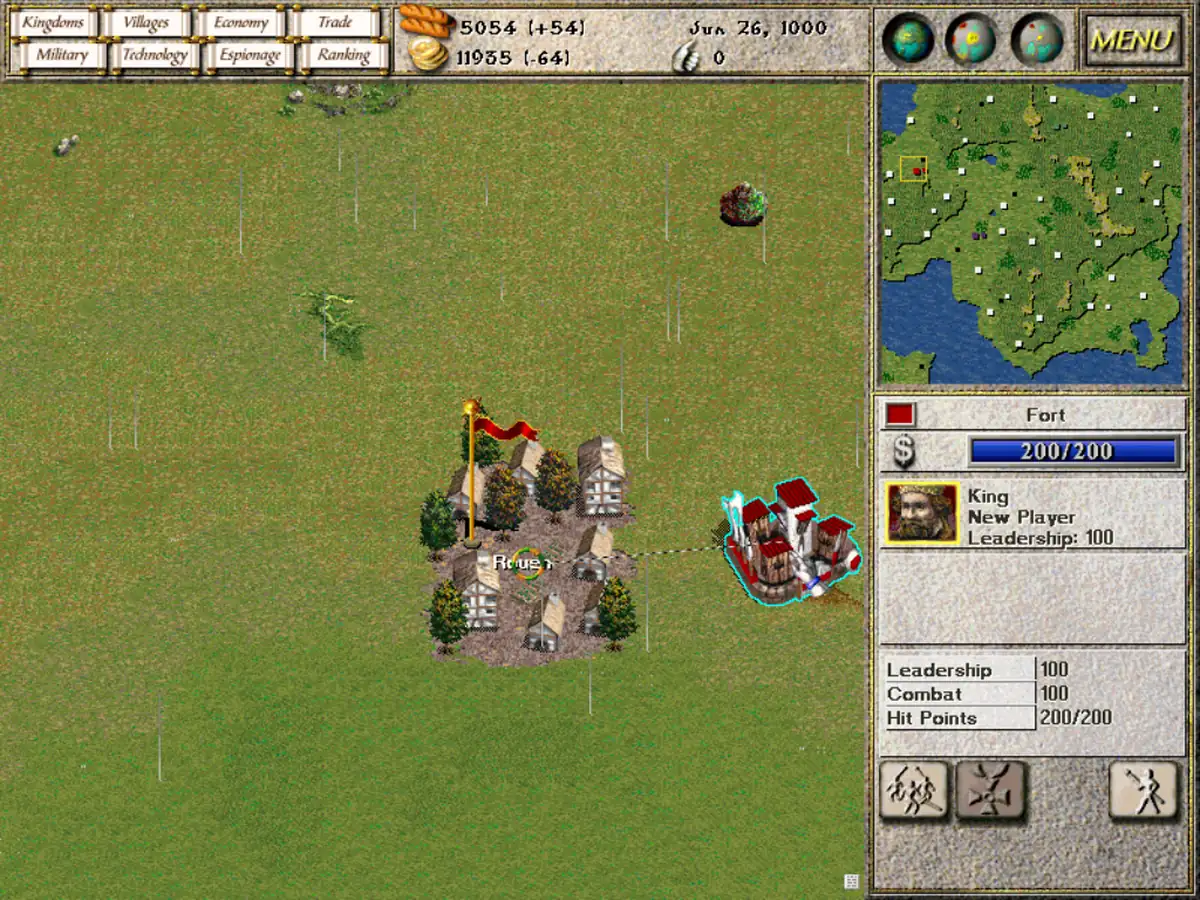
Look after your first village. Your king starts next to a village and a fort. Click the village to see its population and loyalty, recruit peasants from it, and use them to put up the buildings your kingdom needs: a mine on a raw material, a factory to turn it into goods, a market to sell them.
Tips
Loyalty is everything. A village's loyalty depends on a nearby fort with a good general of the same people, on taxes and on how well you treat it. Collecting taxes too often or leaving a village without a commander invites rebellion.
Train before you build. A unit's skill decides how fast it works: a peasant trained in construction builds much faster, and a skilled leader makes a better general. The Train button on a village shows the cost of each skill.
Trade pays for the war. Markets and caravans between your towns, and trade treaties with your neighbours, often bring in more money than taxes. Keep an eye on the Economy and Trade reports.
Watch for spies. Enemy spies can live in your villages for years. Spies of your own, trained in a village or hired at an Inn, work as counter-spies when you station them in your own towns.
Save often. The menu (F10) has several save slots, and a save before a big battle or a risky treaty costs nothing.