
 Portugues
Bridges (Simon Tatham's Puzzles)
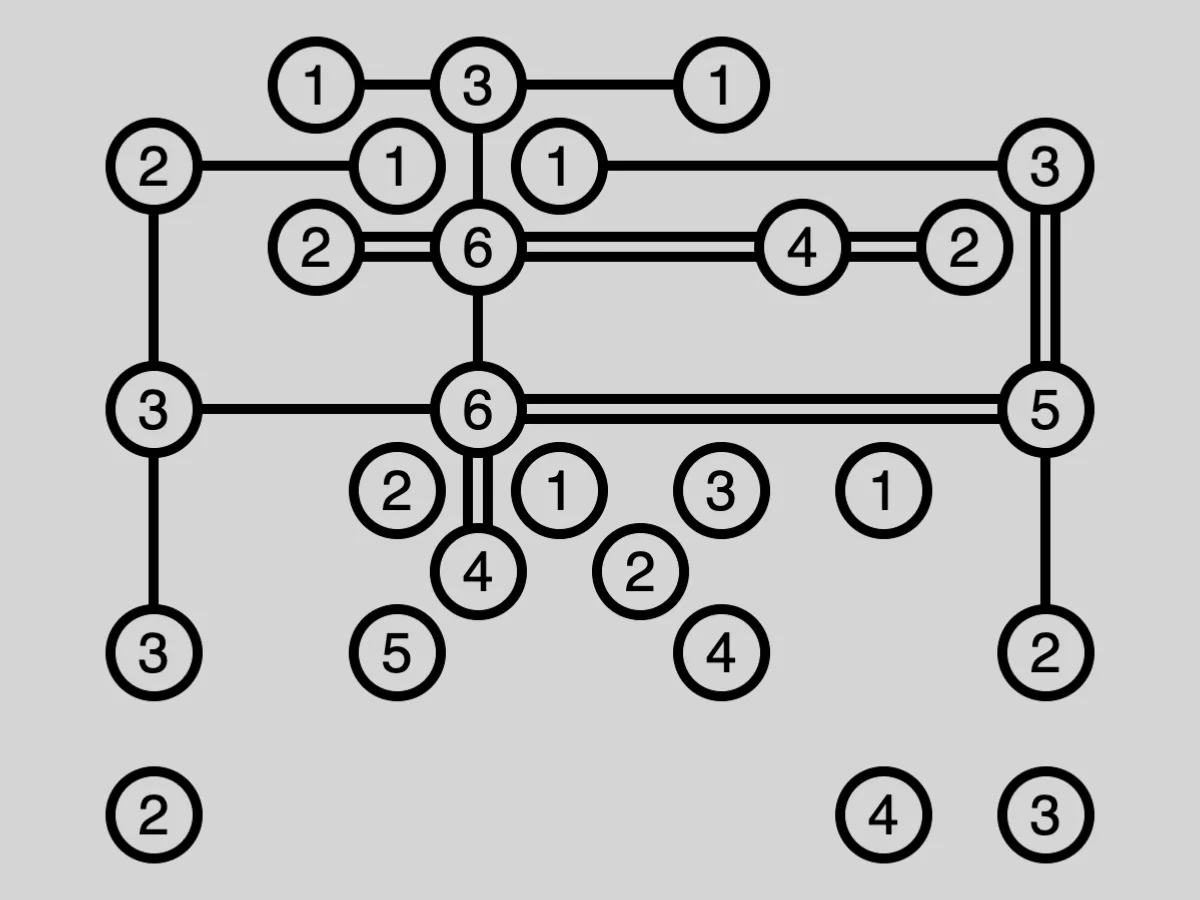
Saved games stay in this browser only.
About the puzzle
Bridges scatters numbered islands across the board. You connect them with bridges, straight horizontal or vertical lines between two islands, so that every island ends up with exactly as many bridges as its number, and so that you can walk from any island to any other.
The puzzle comes from the Japanese publisher Nikoli, where it is called Hashiwokakero ("build bridges"), often shortened to hashi. James Harvey wrote this version for Simon Tatham's collection in 2005.
Rules
- Bridges run horizontally or vertically, in a straight line between two islands.
- The number on an island is the total number of bridges that end there.
- Two islands can be joined by one or two bridges, never more (in the default rules).
- Bridges cannot cross each other or pass over an island.
- All the islands must be connected into a single group.
The game shows problems in red: an island with too many bridges, one that can no longer get enough, or a group of islands that has been closed off from the rest.
Controls
| Input | Action |
|---|---|
| Drag from an island towards a neighbour | build a bridge; again for a double bridge; once more to remove them |
| Right-drag between two islands | mark that they are not joined |
| Left click on an island | mark it finished (locks its bridges); click again to unlock |
| Arrow keys | move the cursor between islands |
| Ctrl+arrow / Enter then arrow | build a bridge in that direction |
| Shift+arrow | mark "no bridge" in that direction |
| Space / Enter twice | mark the island finished |
| A digit | jump to the nearest island with that number |
| G | show every place a bridge could still go |
| N / U / R | new game / undo / redo |
You do not need to drag all the way to the other island: a short drag in its direction is enough, so you can stay on one island and fling bridges out from it.
How to solve it
Islands that need everything. An island with one neighbour must send all its bridges there. An island whose number is twice its number of neighbours (a 4 with two neighbours, a 6 with three, an 8 with four) needs double bridges to all of them.
At least one to each. A 3 with two neighbours must have at least one bridge to each of them, because two bridges to one side are not enough. The same goes for a 5 with three neighbours and a 7 with four.
Do not isolate. Two 1s must not be joined to each other, and two 2s must not be joined with a double bridge, unless they are the only islands left: they would form a closed group. The game will flag the mistake in red, but it is better to see it coming.
Watch for crossings. Building a bridge cuts off every route that would cross it. After each bridge, check the islands on both sides: they may have lost a neighbour and become forced.
Mark the finished islands. Clicking a complete island locks its bridges and greys it out, which keeps your attention on what is left.
Sizes and difficulty
The Type menu offers 7x7, 10x10 and 15x15 boards, each at easy, medium and hard. Custom changes the size and difficulty, can forbid loops (the bridges must then form a tree), allows 1, 3 or 4 bridges per pair instead of 2, and sets how many islands there are and how far apart they tend to be. In Preferences you can keep the possible bridge positions visible all the time, like a permanent G.
Playing here
Click Play to open the puzzle. The menu above the board has New game, Restart, Undo, Redo and Solve (which you can undo to keep going on your own), the Type menu with the sizes, and the Game menu, where you can type in a game ID or a random seed, download the current game as a file, load a saved file and change the preferences. Your game in progress is kept in this browser and comes back with its whole undo history the next time you open the page.
On a touch screen, drag from an island with your finger to build bridges; turn on the Mark button above the board to draw "no bridge" marks instead.
Credits and licence
Bridges was written by James Harvey for Simon Tatham's Portable Puzzle Collection, which Simon Tatham maintains with code contributed by several other authors and distributes with its source code under the MIT licence. This page runs a WebAssembly build made by FredyGames from the author's official source snapshot, with no changes to the puzzle; the source and the build script are hosted with the game, and the licence text is linked from this page.