
 Portugues
Dominosa (Simon Tatham's Puzzles)
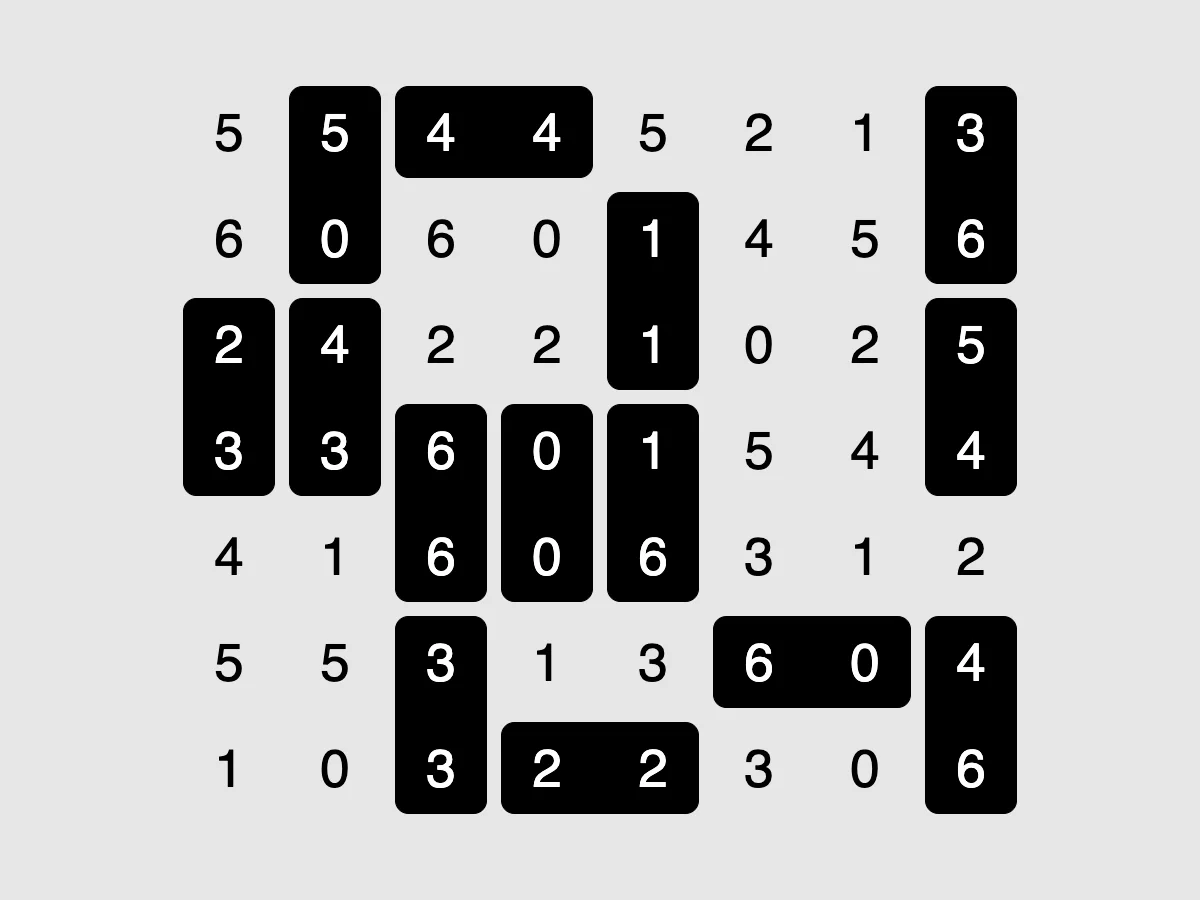
Saved games stay in this browser only.
About the puzzle
Take a complete set of dominoes, one of every pair of numbers from 0-0 up to 6-6, and lay them out so that they fill a rectangle with no gaps. Now write down the number in every square and lift the dominoes off the table. Dominosa gives you that grid of numbers and asks you to find where every domino was.
The puzzle is old enough that its origins are a little hazy; Simon Tatham notes that it is widely credited to O. S. Adler, and that the "-osa" part of the name comes from those initials. His version generates a fresh grid every time and checks that it has exactly one answer.
Rules
- Cover the whole grid with dominoes, each one covering two squares that sit side by side or one above the other.
- Every pair of numbers in the set appears exactly once: with a maximum of 6 there is one 0-0, one 0-1, and so on up to one 6-6, 28 dominoes in all.
- A domino may only cover two squares whose numbers match its own pair.
A set with numbers up to N fills a grid of N+2 by N+1 squares, so the default set up to 6 makes an 8x7 grid.
Controls
| Input | Action |
|---|---|
| Left click between two numbers | place a domino over them, or remove it |
| Right click between two numbers | draw or erase a "not a domino" line |
| Right click on a number, or type it | highlight every copy of that number (up to two at once) |
| Arrow keys | move the cursor |
| Enter / Space | place a domino / a line at the cursor |
| N / U / R | new game / undo / redo |
Placing a domino on top of others removes the ones it overlaps.
How to solve it
Look for unique pairs. Every pair occurs only once in the set, so if two numbers, say a 3 and a 5, sit next to each other in only one place in the whole grid, the 3-5 domino has to go there. Highlighting the two numbers makes such spots easy to find.
Squares with one way out. A square in a corner, or one hemmed in by dominoes already placed, may have just one free neighbour. It has to pair with that neighbour.
Once a pair is used, it is gone. After you place the 3-5, every other place where a 3 touches a 5 is ruled out. Draw lines across those spots; they often leave another square with only one choice.
Doubles are rare. There is only one 4-4, so two 4s side by side are a strong hint, and when there are several such spots, at most one of them can be the double.
On the harder levels the puzzle expects you to combine these ideas, for example noticing that a pair must go in one of two places and that both of them use up the same square.
Sizes and difficulty
The Type menu sets the size by the highest number on the dominoes, from 3 (a 5x4 grid) up to 9 (an 11x10 grid), with difficulty levels Trivial, Basic, Hard and Extreme. Custom also allows other sizes and an option to stop insisting on a unique solution.
Playing here
Click Play to open the puzzle. The menu above the board has New game, Restart, Undo, Redo and Solve (which you can undo to keep going on your own), the Type menu with the sizes, and the Game menu, where you can type in a game ID or a random seed, download the current game as a file, load a saved file and change the preferences. Your game in progress is kept in this browser and comes back with its whole undo history the next time you open the page.
On a touch screen, tap between two numbers to place a domino; turn on the Mark button above the board to draw lines and highlight numbers instead.
Credits and licence
Dominosa is part of Simon Tatham's Portable Puzzle Collection, written by Simon Tatham with code contributed by several other authors, and distributed with its source code under the MIT licence. This page runs a WebAssembly build made by FredyGames from the author's official source snapshot, with no changes to the puzzle; the source and the build script are hosted with the game, and the licence text is linked from this page.