
 Portugues
Galaxies (Simon Tatham's Puzzles)
Saved games stay in this browser only.
About the puzzle
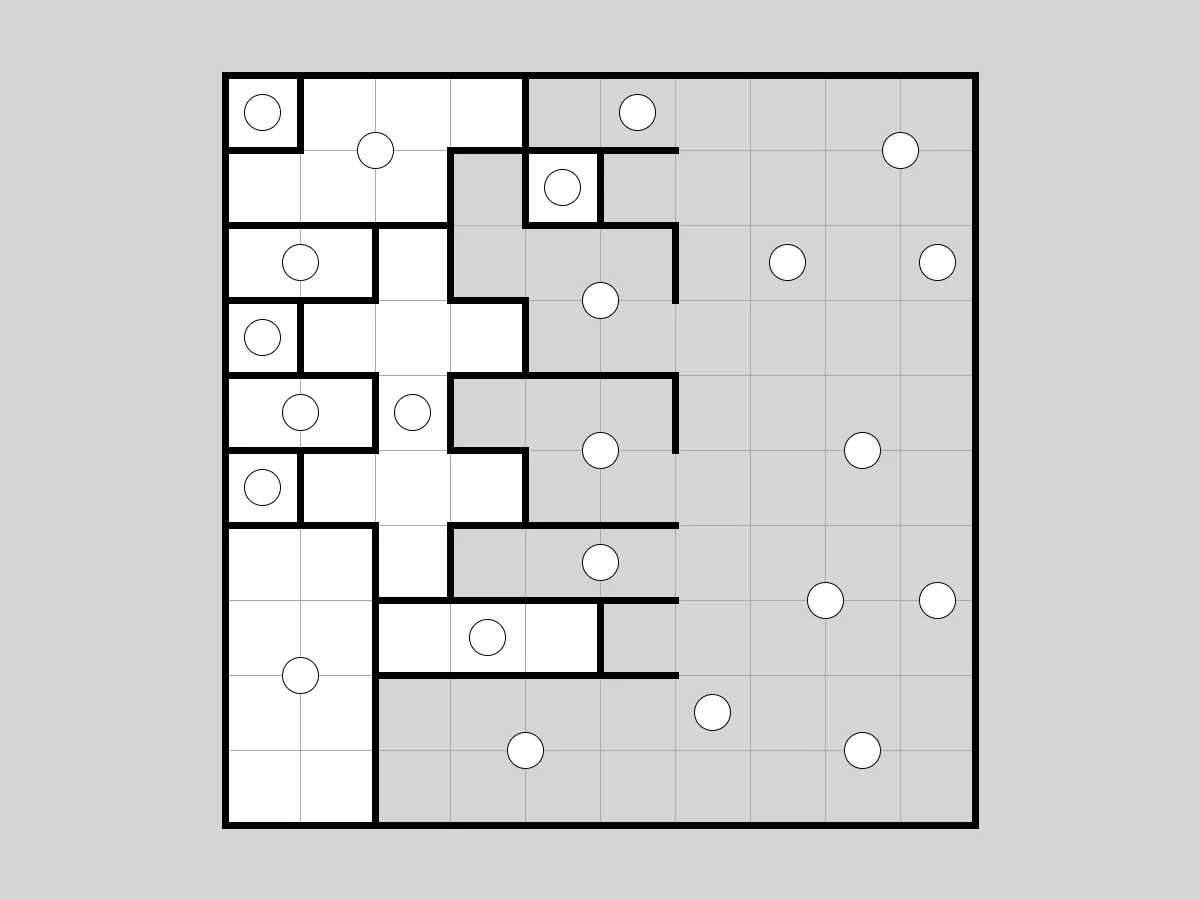
Galaxies scatters dots over a grid: in the middle of squares, on the lines between them, or on the corners where lines meet. Your job is to carve the grid into regions, one for each dot, so that every region is perfectly symmetrical around its own dot. Turn any finished region half a turn about its dot and it lands exactly on itself.
The puzzle comes from the Japanese publisher Nikoli, whose name for it is usually translated into English as Spiral Galaxies. James Harvey wrote this version for Simon Tatham's collection, with a generator that makes a new puzzle with a single solution every time.
Rules
- Divide the grid into regions along the grid lines, so that every square belongs to exactly one region.
- Each region contains exactly one dot.
- Each region is symmetric under a 180-degree rotation about its dot.
You draw the borders between regions. The puzzle is solved when the lines you have drawn are exactly the borders between squares of different regions, with no extra lines inside any region.
Controls
| Input | Action |
|---|---|
| Left click on a grid line | draw an edge, or erase it |
| Right-drag from a dot | drop an arrow in a square to note that it belongs to that dot |
| Right-drag an arrow | move it, or drop it off the grid to delete it |
| Arrow keys | move the cursor over squares and lines |
| Enter | draw or erase the edge under the cursor, or pick up and drop an arrow |
| N / U / R | new game / undo / redo |
When a region is closed, holds exactly one dot, is symmetric about it and has no stray lines inside, the game shades it, so the goal is a fully shaded grid.
How to solve it
Two dots side by side need a wall. Two dots that are next to each other belong to different regions, so whenever a single grid line would be inside both their regions, that line is a border. Starting by drawing the obvious walls between close dots gives the grid its first shape.
The mirror square. If a square belongs to a dot, so does the square exactly opposite it on the other side of the dot. When the mirror square would fall off the grid, or inside a region that is already closed, the first square cannot belong to that dot.
Dots on lines and corners. A dot on a line between two squares owns both of them; a dot on a corner owns the four squares around it. A dot in the middle of a square owns that square. These pieces are your starting cores.
Grow regions carefully. Every time you add a square to a region, add its mirror image too. Use the arrows to mark squares whose owner you know before you are ready to draw the borders.
Lonely squares. A square that only one dot can reach, because every other dot's mirror square is blocked, must belong to that dot.
Sizes and difficulty
The Type menu has 7x7, 10x10 and 15x15 grids at Normal and Unreasonable difficulty. Normal can always be solved by reasoning alone; Unreasonable may need some trial and error. Custom sets any width and height.
Playing here
Click Play to open the puzzle. The menu above the board has New game, Restart, Undo, Redo and Solve (which you can undo to keep going on your own), the Type menu with the sizes, and the Game menu, where you can type in a game ID or a random seed, download the current game as a file, load a saved file and change the preferences. Your game in progress is kept in this browser and comes back with its whole undo history the next time you open the page.
On a touch screen, tap a grid line to draw an edge; turn on the Mark button above the board and drag from a dot to place arrows.
Credits and licence
Galaxies was written by James Harvey for Simon Tatham's Portable Puzzle Collection, which Simon Tatham maintains with code contributed by several other authors and distributes with its source code under the MIT licence. This page runs a WebAssembly build made by FredyGames from the author's official source snapshot, with no changes to the puzzle; the source and the build script are hosted with the game, and the licence text is linked from this page.