
 Portugues
Inertia (Simon Tatham's Puzzles)
Saved games stay in this browser only.
About the puzzle
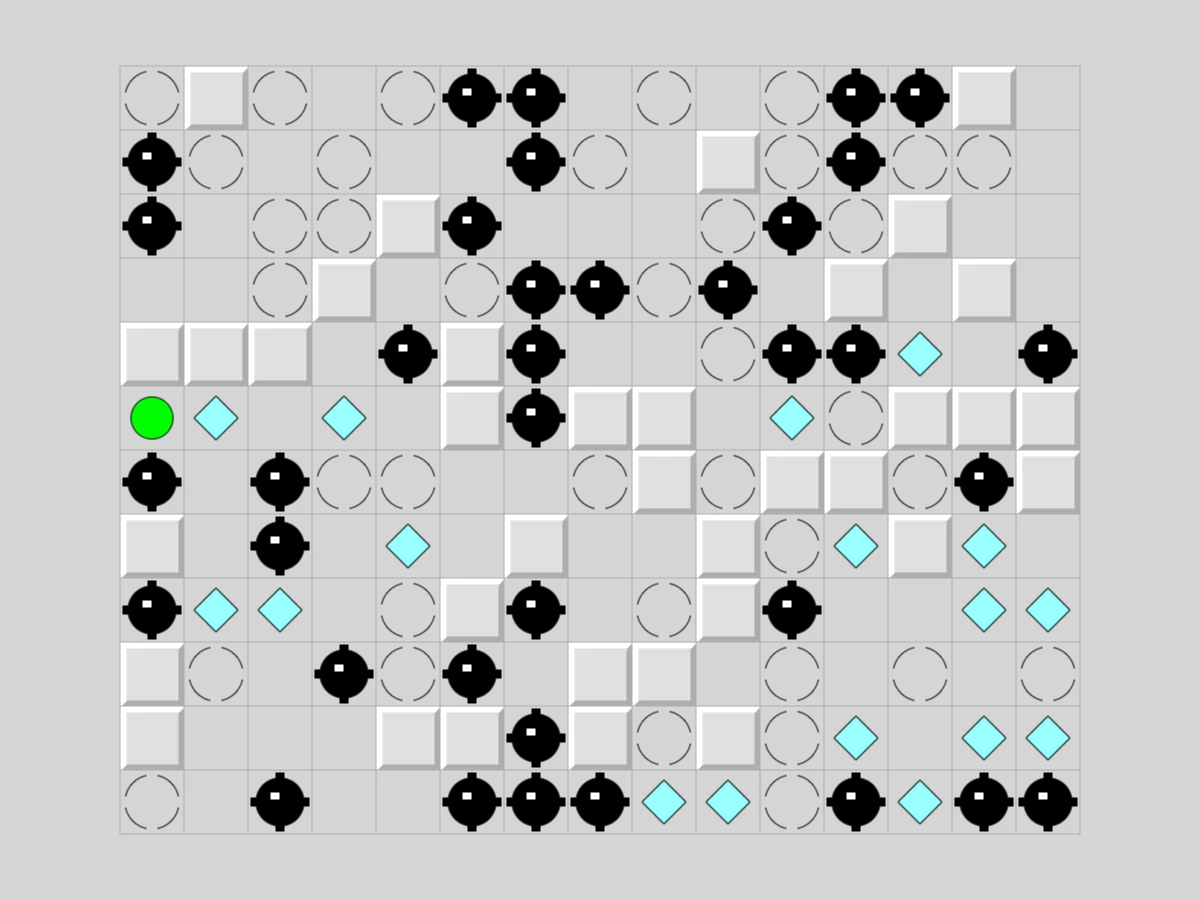
In Inertia you steer a small green ball around a grid of walls, stops, gems and mines. The ball has no brakes: once it starts rolling in a direction, it keeps going until a wall blocks it or it lands on a stop square. You want to collect every gem on the board, and rolling over a gem picks it up without slowing the ball down. Rolling onto a mine ends the game.
The game was first made for Windows by Ben Olmstead, who shared his source code so that Simon Tatham could write this version for the collection. Every board is generated with a guaranteed route to all the gems.
Rules
- The ball moves in any of eight directions: the four straight ones and the four diagonals.
- It keeps moving until the next square in its path is a wall, or until it lands on a stop (the circles), which halts it whatever its direction.
- Moving diagonally, the ball slips through a gap between two walls that touch only at a corner.
- Gems are collected as the ball passes over them and do not stop it.
- Hitting a mine is fatal, even if the same move took the last gem. You can undo the fatal move and carry on; the game counts how often you died.
Controls
| Input | Action |
|---|---|
| Click on the grid | roll the ball towards the click (eight directions) |
| Arrow keys | roll up, down, left or right |
| Numeric keypad 1 to 9 | roll in all eight directions (7, 9, 1 and 3 are the diagonals) |
| Solve, then Space | show a hint arrow, then follow it one move at a time |
| N / U / R | new game / undo / redo |
How to solve it
Find the safe stopping places first. Walls and stops are the only places the ball can rest. Before chasing a gem, look at where the ball would end up afterwards and whether you can get out again from there.
Mines along the line. A move is only as safe as the whole line it travels. Trace the path to its end: a mine anywhere beyond the gem, before the next wall, means that move is out.
Leave an exit. Some gems sit in corners you can reach but not leave without crossing a mine. Collect the easy ones around them first and keep those corners for the end, or find the one approach that leaves you on a stop.
Use the diagonals. Diagonal moves reach gems that straight lines miss, and they slip through corner gaps between walls. If you play on a laptop without a numeric keypad, click diagonally from the ball instead.
Ask for a hint. Solve does not finish the board for you: it plans a route through the remaining gems and shows an arrow on the ball. Press Space to take the next step, or ignore it and keep playing on your own.
Sizes and difficulty
The Type menu has 10x8, 15x12 and 20x16 boards; Custom sets any width and height. Larger boards hold more gems and longer routes.
Playing here
Click Play to open the puzzle. The menu above the board has New game, Restart, Undo, Redo and Solve (which you can undo to keep going on your own), the Type menu with the sizes, and the Game menu, where you can type in a game ID or a random seed, download the current game as a file, load a saved file and change the preferences. Your game in progress is kept in this browser and comes back with its whole undo history the next time you open the page.
On a touch screen, tap the board in the direction you want the ball to go.
Credits and licence
Inertia is part of Simon Tatham's Portable Puzzle Collection, written by Simon Tatham with code contributed by several other authors, and distributed with its source code under the MIT licence. This page runs a WebAssembly build made by FredyGames from the author's official source snapshot, with no changes to the puzzle; the source and the build script are hosted with the game, and the licence text is linked from this page.