
 Portugues
Magnets (Simon Tatham's Puzzles)
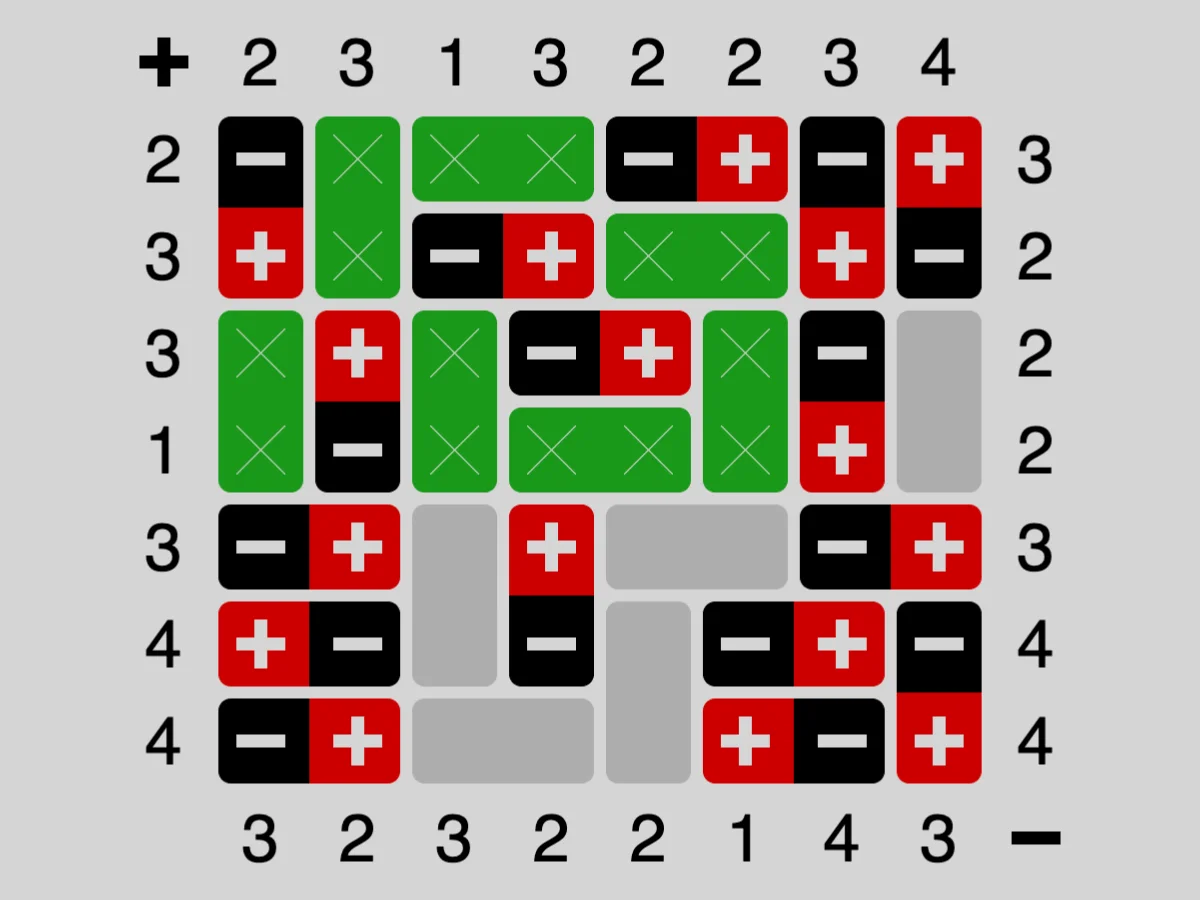
Saved games stay in this browser only.
About the puzzle
Magnets shows a grid already cut into dominoes, but only as outlines. Each domino is either a magnet, with a plus pole at one end and a minus pole at the other, or a blank piece with no poles at all. The numbers along the edges tell you how many plus poles and how many minus poles each row and column holds, and like poles repel, so two plus or two minus ends can never sit side by side.
The puzzle is credited to the Austrian puzzle site of Otto Janko, where it is called Magnete; James Harvey wrote this version for the collection.
Rules
- Every domino is either a magnet (one plus and one minus end) or blank.
- The plus and minus clues at the ends of each row and column give the number of poles of each sign in it. A missing clue can be anything.
- Two squares holding the same pole never touch side by side, even across different dominoes. Blank ends can touch anything.
Controls
| Input | Action |
|---|---|
| Left click on a domino | magnet with plus on this square; again to flip; again to clear |
| Right click on a domino | blank; again for a "cannot be blank" mark; again to clear |
| Click on a clue | grey it out as done (click again to restore) |
| Arrow keys | move the cursor |
| Enter / Space | act as a left / right click on the cursor's square |
| N / U / R | new game / undo / redo |
How to solve it
Start with the zeros. A row with a plus clue of 0 has no plus poles, so every domino lying across it is either blank or has its minus end there. Lying along the row, a domino can only be blank.
Rows full of poles. When the plus and minus clues of a row add up to its length, there are no blank squares in it: every domino touching it is a magnet. Pluses and minuses then usually alternate along it.
Like poles push apart. Once a plus pole is placed, the squares beside it cannot be plus. Each magnet you place restricts the orientation of the dominoes around it, and chains of these deductions run across the board.
Count both ends. Each magnet adds one plus and one minus. A domino lying along a row puts both poles in that row; one standing across it puts one pole there and one in the next row. Comparing the totals of two neighbouring rows often shows which dominoes must be magnets.
Mark the dominoes that cannot be blank. When you know a domino is a magnet but not which way round, the right-click "?" mark keeps that deduction in view until the clues settle its direction.
Sizes and difficulty
The Type menu has 6x5 and 8x7 grids at Easy and Tricky and 10x9 at Tricky; each Tricky size also comes with some clues stripped, which makes it harder. Custom sets the size, the difficulty and whether to strip clues. Grids with an odd side leave one square uncovered, and tend to be a little easier.
Playing here
Click Play to open the puzzle. The menu above the board has New game, Restart, Undo, Redo and Solve (which you can undo to keep going on your own), the Type menu with the sizes, and the Game menu, where you can type in a game ID or a random seed, download the current game as a file, load a saved file and change the preferences. Your game in progress is kept in this browser and comes back with its whole undo history the next time you open the page.
On a touch screen, tap a domino to place and flip a magnet; turn on the Mark button above the board to place blanks and "?" marks instead.
Credits and licence
Magnets was written by James Harvey for Simon Tatham's Portable Puzzle Collection, which Simon Tatham maintains with code contributed by several other authors and distributes with its source code under the MIT licence. This page runs a WebAssembly build made by FredyGames from the author's official source snapshot, with no changes to the puzzle; the source and the build script are hosted with the game, and the licence text is linked from this page.