
 Portugues
Map (Simon Tatham's Puzzles)
Saved games stay in this browser only.
About the puzzle
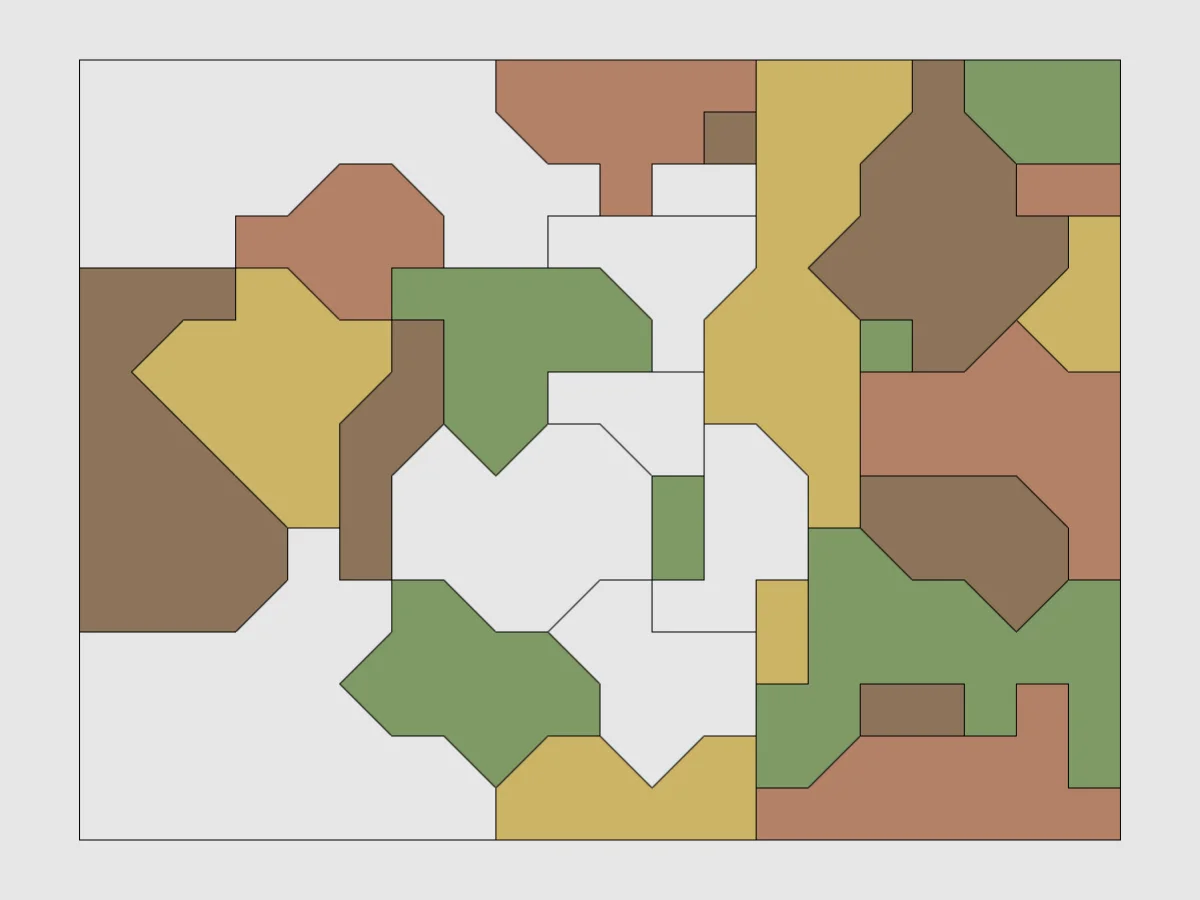
Map gives you a map of irregular regions, a few of them already painted in one of four colours. Paint the rest so that no two regions that share a stretch of border end up the same colour. A famous theorem says four colours are always enough for any flat map; here the starting colours are chosen so that there is exactly one way to finish.
Simon Tatham believes this puzzle is his own invention. The idea of a four-colouring puzzle was suggested to him by Alexandra Lanes, and he credits Nikoli and Verity Allan for the thinking that made it work as a puzzle.
Rules
- Every region gets one of the four colours.
- Two regions that share a length of border must have different colours.
- Regions that meet only at a single point, diagonally, may have the same colour.
- The regions coloured at the start are fixed and cannot be changed.
Controls
| Input | Action |
|---|---|
| Drag from a coloured region into another | paint the second region in that colour |
| Drag from an empty region or from outside the map | clear the region you drop on |
| Right-drag | add a stipple of that colour: "might be this one" (several allowed) |
| Arrow keys | move the cursor; its colour shows what you would drag |
| Enter, arrows, Enter | drag a colour with the keyboard |
| Space, arrows, Space | the same for stipples |
| Enter twice in place | clear the region under the cursor |
| L | show a number in each region |
| N / U / R | new game / undo / redo |
How to solve it
Look for regions with three coloured neighbours. If a region touches regions of three different colours, only the fourth is left. On Easy there is always at least one such region.
Watch the small ones. A tiny region squeezed between big ones often touches many neighbours, which pins it down early; it then becomes a strong clue for everything around it.
Use stipples for pairs. When a region can only be one of two colours, stipple both. When two neighbouring regions share the same two candidates, those colours are taken between them, and every other region touching both must use one of the remaining two.
Follow chains. A row of regions that all touch the same two regions can only alternate between the two colours left over. Once one of them is known, the whole chain falls.
Unreasonable means trial. The Unreasonable level may need guessing and backtracking: stipple your guess, follow it until it works or contradicts itself, and undo if needed.
Sizes and difficulty
The Type menu has 20x15 maps with 30 regions at Easy, Normal, Hard and Unreasonable, and 30x25 maps with 75 regions at Normal and Hard. Up to Hard, every map can be solved by pure logic. Custom sets the size, the number of regions and the level.
Playing here
Click Play to open the puzzle. The menu above the board has New game, Restart, Undo, Redo and Solve (which you can undo to keep going on your own), the Type menu with the sizes, and the Game menu, where you can type in a game ID or a random seed, download the current game as a file, load a saved file and change the preferences. Your game in progress is kept in this browser and comes back with its whole undo history the next time you open the page.
On a touch screen, drag with your finger from a coloured region into the one you want to paint; turn on the Mark button above the board to drag stipples instead.
Credits and licence
Map is part of Simon Tatham's Portable Puzzle Collection, written by Simon Tatham with code contributed by several other authors, and distributed with its source code under the MIT licence. This page runs a WebAssembly build made by FredyGames from the author's official source snapshot, with no changes to the puzzle; the source and the build script are hosted with the game, and the licence text is linked from this page.