
 Portugues
Net (Simon Tatham's Puzzles)
Saved games stay in this browser only.
About the puzzle
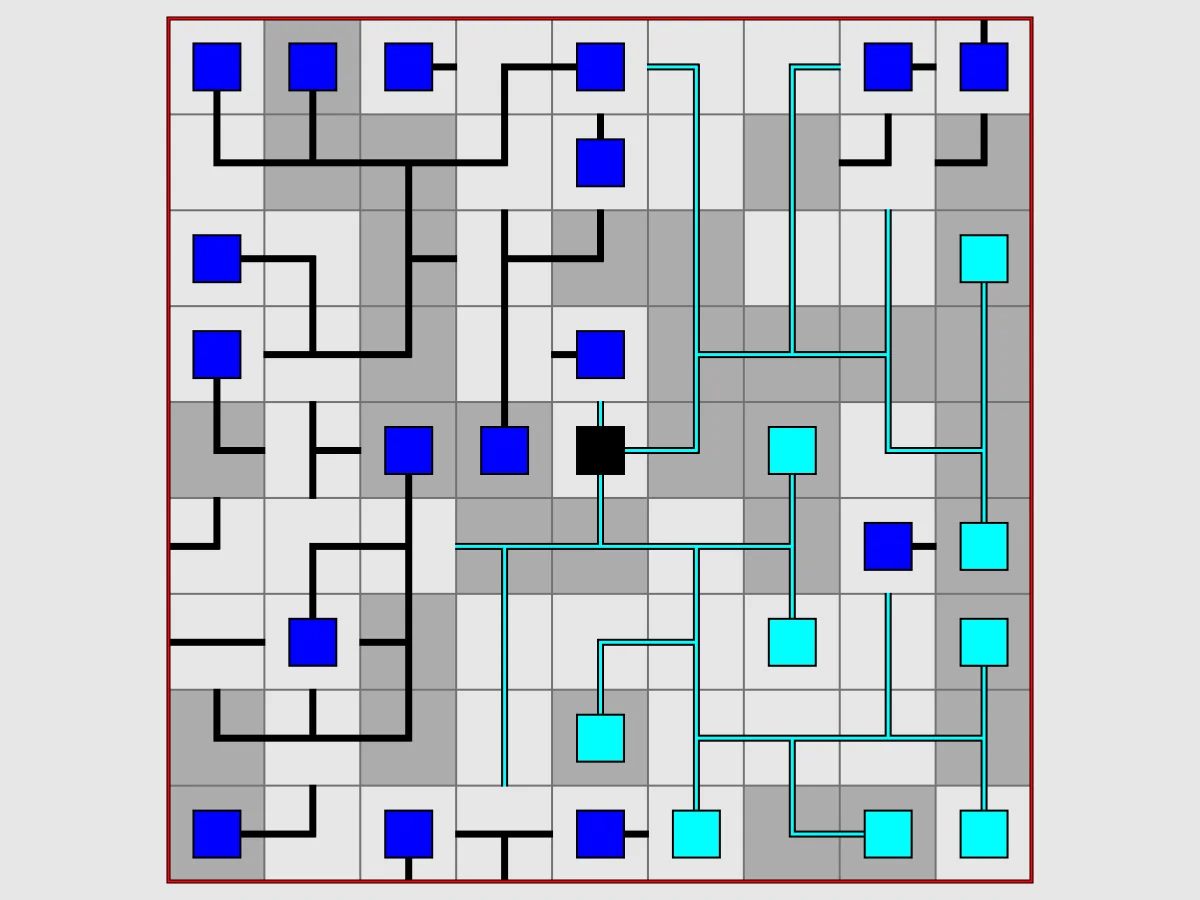
Net hands you a grid of tiles, each carrying a piece of cable: dead ends with a computer on them, straight runs, corners and T-junctions. Somewhere there is a way to turn every tile so that all the cables join into a single network, but the computer has rotated each tile at random. Your job is to turn them back.
The tile in the middle holds the server, and everything currently connected to it is drawn in cyan, so you can watch the lit part of the network grow as you work. The puzzle is solved when every tile is lit.
Net was the first puzzle Simon Tatham wrote for his collection, in 2004, after a Flash game called FreeNet by Pavils Jurjans; the same idea is also known as NetWalk. Like everything in the collection, every grid is generated on the spot, and by default it has exactly one solution.
Rules
- Tiles can be rotated but never moved.
- In the finished network every cable end must meet another cable end: no loose wires pointing at an empty side or at the edge of the grid.
- All tiles must form one connected network.
- The network must not contain any closed loop.
Controls
| Input | Action |
|---|---|
| Left click / A | turn the tile anticlockwise |
| Right click / D | turn the tile clockwise |
| F | turn the tile half a turn |
| Shift+click / middle button / S | lock or unlock the tile |
| Arrow keys | move the cursor |
| Ctrl+arrow keys | move the server (the source of the highlight) |
| Shift+arrow keys | shift the whole grid (wrapping grids only) |
| J | scramble every tile that is not locked |
| N / U / R | new game / undo / redo |
Locked tiles are drawn with a grey background and ignore clicks, which saves you from turning a finished tile by accident.
How to solve it
Start at the border. On a grid that does not wrap, no cable may point off the edge. A straight piece on the edge has to run along it, a T-junction on the edge has its stem pointing inwards, and a corner square can only hold a dead end or an elbow pointing into the grid. Lock those tiles as soon as they are certain.
Two dead ends never face each other. If two computers were joined directly, that pair would be cut off from everything else, so a dead end next to another dead end must point somewhere else.
Look for loops before they close. If turning a tile would complete a ring of cables, that orientation is wrong. Net marks a closed loop in red when it appears.
Work outwards from what is fixed. Each locked tile tells you whether its neighbours must or must not connect on that side, and that usually fixes one more tile, and then another.
Wrapping grids are harder. With "wrapping" the left edge meets the right edge and the top meets the bottom, so there is no border to start from. Use Shift with the arrow keys to slide the view and look for other certainties, like a straight piece between two dead ends.
Sizes and options
The Type menu offers grids of 5x5, 7x7, 9x9, 11x11 and 13x11, each with or without wrapping. Custom lets you choose any width and height, turn wrapping on, add fixed barriers between tiles (a higher barrier probability means more of them, and every barrier is a free hint) and switch off the guarantee of a unique solution. In Preferences you can ask for loops to be highlighted only when every tile in them is locked, so the red marking does not give away deductions you have not made yet.
Playing here
Click Play to open the puzzle. The menu above the board has New game, Restart, Undo, Redo and Solve (which you can undo to keep going on your own), the Type menu with the sizes, and the Game menu, where you can type in a game ID or a random seed, download the current game as a file, load a saved file and change the preferences. Your game in progress is kept in this browser and comes back with its whole undo history the next time you open the page.
On a touch screen, tapping a tile works like the left button; turn on the Mark button above the board to make taps work like the right button.
Credits and licence
Net is part of Simon Tatham's Portable Puzzle Collection, written by Simon Tatham with code contributed by several other authors, and distributed with its source code under the MIT licence. This page runs a WebAssembly build made by FredyGames from the author's official source snapshot, with no changes to the puzzle; the source and the build script are hosted with the game, and the licence text is linked from this page.