
 Portugues
Palisade (Simon Tatham's Puzzles)
Saved games stay in this browser only.
About the puzzle
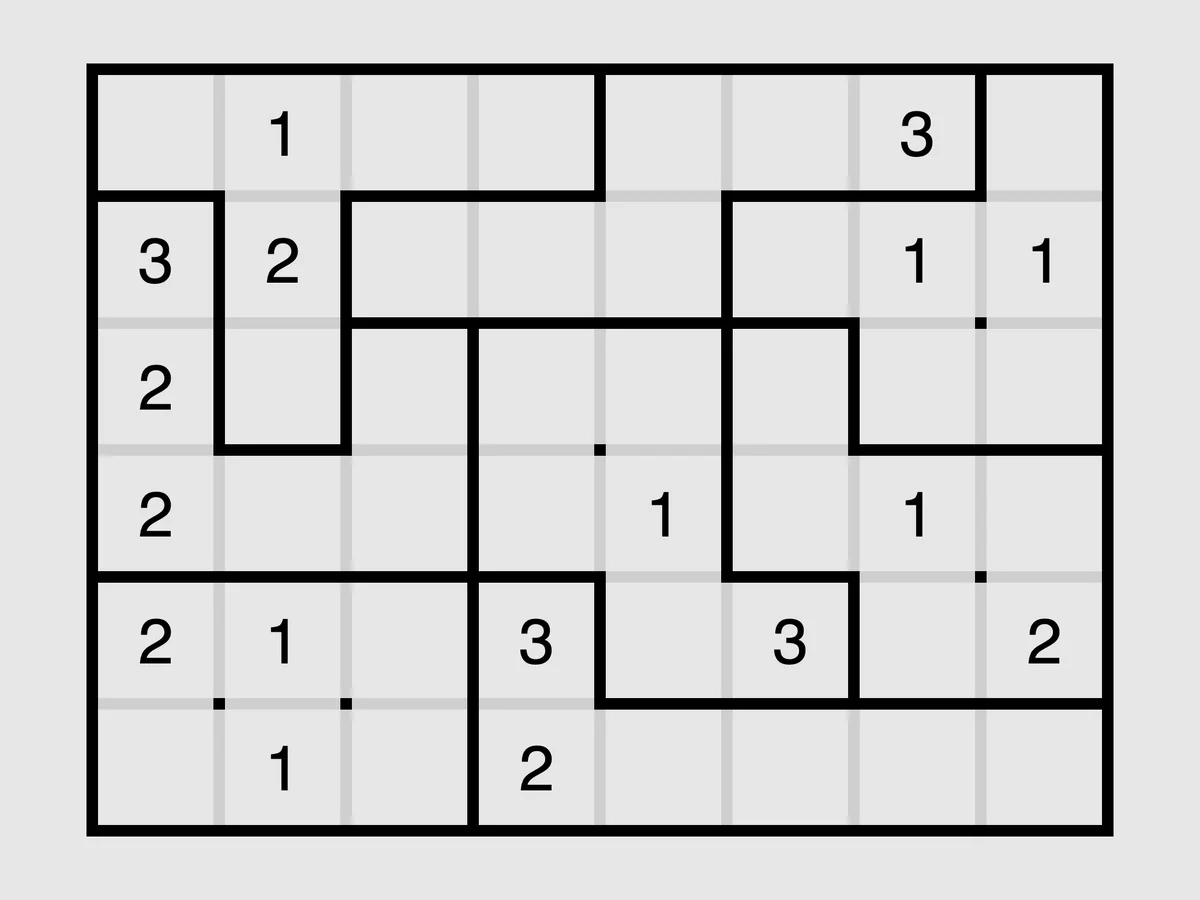
Palisade gives you a grid of squares with a number in some of them, and a region size. Draw walls along the grid lines to split the whole grid into connected regions, all of that size, so that each numbered square ends up with exactly that many walls on its four sides. The outer border of the grid counts as wall.
The puzzle comes from the Japanese publisher Nikoli, which calls it Five Cells after its classic form, where every region has five squares. Jonas Kölker contributed this version to the collection in 2015.
Rules
- Split the grid into regions of connected squares, every one of them exactly the given size.
- A number in a square is how many of its four sides are walls, counting the edge of the grid.
- Squares without a number can have any number of walls.
Controls
| Input | Action |
|---|---|
| Left click on a grid line | draw a wall (click again to remove it) |
| Right click on a grid line | mark the line as open, not a wall (click again to clear) |
| Arrow keys | move the cursor along squares and borders |
| Enter | draw a wall at the cursor (again to remove it) |
| Space | mark no wall at the cursor (again to clear) |
| N / U / R | new game / undo / redo |
In Preferences you can switch the cursor to move from square to square instead, holding Control with an arrow key to draw a wall and Shift to mark it open, and choose whether walls inside a finished region are cleared away automatically.
How to solve it
Count the border first. A corner square already has two walls from the edge of the grid and a square on the side has one. A 1 on the side of the grid therefore has no other walls, and a 2 in a corner has both of its inner sides open.
A 0 joins its neighbours. A square marked 0 has no walls at all, so it shares a region with all four neighbours. With regions of five, that is the whole region, and every line around the cross is a wall.
A 3 has one way out. Three walls leave a single open side. The region continues only through that side, which often means a whole chain of squares has to come along.
Mark the open lines. Right click every line you know is not a wall. Open lines show which squares must share a region, and once a group of joined squares reaches the region size, every line around it must be a wall.
Watch the leftovers. Any area you close off has to hold an exact multiple of the region size. A pocket of three squares in a puzzle with regions of five is impossible, which rules out the wall that would create it.
Sizes
The Type menu has a 5x5 grid with regions of 5 (the classic Five Cells), 8x6 with regions of 6, 10x8 with regions of 8 and 15x12 with regions of 10. Custom sets any width, height and region size, as long as the region size divides the number of squares.
Playing here
Click Play to open the puzzle. The menu above the board has New game, Restart, Undo, Redo and Solve (which you can undo to keep going on your own), the Type menu with the sizes, and the Game menu, where you can type in a game ID or a random seed, download the current game as a file, load a saved file and change the preferences. Your game in progress is kept in this browser and comes back with its whole undo history the next time you open the page.
On a touch screen, tap a grid line to draw a wall; turn on the Mark button above the board to mark lines as open instead.
Credits and licence
Palisade was written by Jonas Kölker for Simon Tatham's Portable Puzzle Collection, which Simon Tatham maintains with code contributed by several other authors and distributes with its source code under the MIT licence. This page runs a WebAssembly build made by FredyGames from the author's official source snapshot, with no changes to the puzzle; the source and the build script are hosted with the game, and the licence text is linked from this page.